Introduction
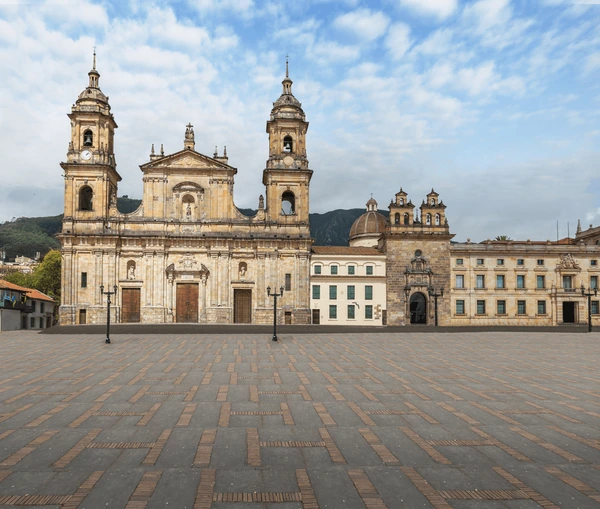
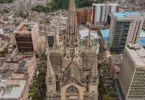
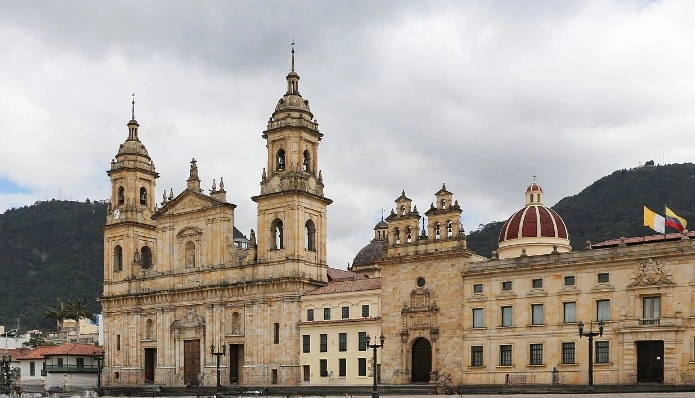
The Metropolitan and Primate Cathedral Basilica of the Immaculate Conception and Saint Peter of Bogotá or better known as the Metropolitan Cathedral Basilica of Bogotá and Primate of Colombia, officially Sacred Holy Temple Metropolitan Cathedral Basilica and Primate of the Immaculate Conception of Mary and Saint Peter, is a cathedral church of Catholic worship consecrated to the Immaculate Conception and under the patronage of Saint Peter; it is a Neoclassical style building located in the Plaza de Bolívar in Bogotá, the country’s capital. The cathedral is the seat of the Metropolitan Archbishop of Bogotá and Primate of Colombia, recognized with the honorary title of Primate of Colombia by Pope Leo XIII, through the Decree of the Consistorial Congregation of November 7, 1902. It is also the seat of the Cabildo metropolitano and of the “Parish of the Cathedral Basilica Metropolitana de Bogotá Saint Peter”. The cathedral was designed by Domingo de Petrés and was built between 1807 and 1823 in the same place where three other churches were previously erected, which successively served as cathedrals for the city. Due to its historical significance, architectural and cultural value, it was declared a Monumento Nacional by decree 1,584 of August 11, 1975.
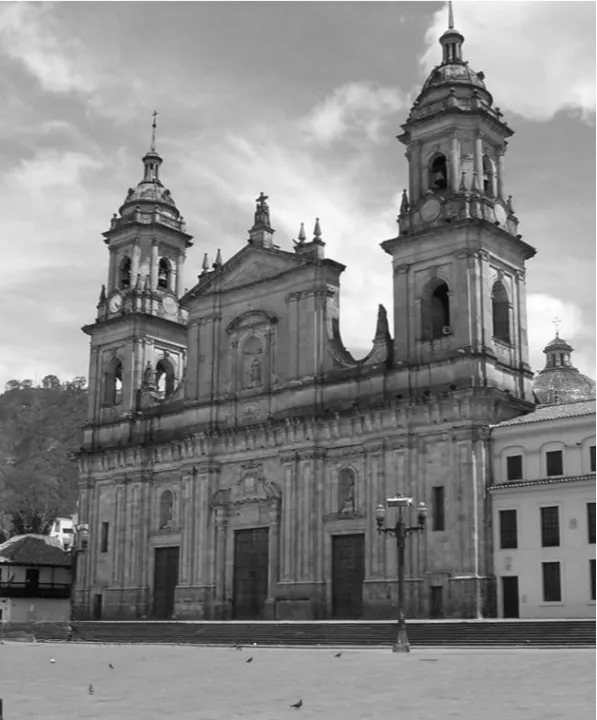
The missionary Friar Domingo de las Casas, the Spanish conquerors of the Bogotá Savannah, celebrated the first Holy Mass on August 6, 1538, in a modest chapel with thatched roofs and bahareque, in front of a banner that hangs in the cathedral, in the spot where the first stones were laid for a church. The Spanish gave the location the name “Our Lady of Hope.” The Metropolitan and Primate Cathedral Basilica in the 1930s. Take note of the towers’ previous form. In 1553, on the initiative of Fray Juan de los Barrios, the decision was made to build a temple with adobe and brick walls on the current site of the cathedral, in accordance with the provisions of the Council, for which a public tender was called that assigned the works to Baltasar Díaz and Pedro Vásquez, associated with the bricklayer Juan Rey, with a budget of 1,000 pesos. In 1560, after spending more than 6,000 pesos, the roof of the building collapsed on the eve of its inauguration. Despite this, Pope Pius V gave it the name Cathedral on September 11, 1562. Twelve years later, Fray Juan de los Barrios, the city’s first Archbishop, carried the first stone for a new Cathedral on his shoulders, setting an example for his friends and followers who managed to store a lot of stones for its construction. The work began on March 12, 1572 under the direction of the architect and master builder Juan de Vergara with his plans and the stonemason Antonio Moreno Dajubita, in the same place, with the same conditions as the previous one, that is, with three naves, but with an additional detail in which four chapels were added forming a cross. The president of the Royal Audience of Santa Fe, Andrés Venero de Leyva, the councilors, the judges, the nobles, Juan de Vergara and illustrious people of Bogotá attended. “He was born in Santafé de Bogotá. He was the author of the plans for the Third Cathedral of Santafereña. He began the Cathedral’s construction on May 12, 1572. Due to a lack of funds, he had to put the work on hold by 1574. The Third Cathedral of Bogotá did not have the proper foundation, was never finished, did not have a sacristy or dependencies, and the only tower, which was only just started and was at the southern end of the façade, was not finished.
Fray Domingo Petrés completed and renovated the cathedral.” The work was completed in 1590, with the main chapel covered as well as the arches, but with the four side chapels and the three naves still pending construction, the tower was completed in 1678. This new church, the third construction of the cathedral, was notable for the richness of its worship and for its musical chapel. On July 12, 1785, a strong earthquake occurred in the city that seriously affected the construction, so the decision was made to partially demolish it in 1805. Some years after the expulsion of the Jesuits from Colombia, the decision was made to put the church of San Ignacio into service as a vice-cathedral , which was called “Vice-Cathedral of San Carlos” (in honor of King Carlos III ) and is located just half a block away from the Plaza.At the beginning of the 19th century , by appointment of Canon Fernando Caycedo y Flórez, Metropolitan Archbishop of Bogotá, the Capuchin friar Fray Domingo de Petrés was appointed as architect for the reconstruction of the cathedral . He was widely influenced by the neoclassical trend prevailing at that time in history and which determined the style of the reconstruction of the Church. Fray Domingo, of Spanish origin, son of a bricklayer, who arrived in Santafé de Bogotá in 1792 to practice his trade as an architect, beginning work on the new cathedral on February 11, 1807. He has been considered one of the most representative architects of the new kingdom of Granada , among other works are the Astronomical Observatory of Bogotá , the Basilica of Our Lady of the Rosary of Chiquinquirá , the Cathedral of the Holy Trinity, Saint Anthony of Padua and Our Lady of the Assumption of Zipaquirá , the Cathedral Basilica Metropolitan Cathedral of Santa Fe de Antioquia , the Cathedral of Our Lady of the Rosary of Facatativá and the Co-Cathedral of Saint Michael the Archangel , in Guaduas .
The interior of the cathedral was completed when Friar Domingo passed away in 1811. Nicolás León was in charge of the remaining works, and he was successful in completing them by April 19, 1823. In that same year the consecration of the cathedral took place. The Metropolitan Cathedral Basilica of Bogotá was recognized with the honorary title of Primate of Colombia by Pope Leo XIII , through the Decree of the Consistorial Congregation of November 7, 1902. In 1943, the Spanish architect Alfredo Rodríguez Orgaz directed the renovations to the façade according to the original plans of Domingo de Petrés. The major renovations were carried out on the occasion of the International Eucharistic Congress of 1968 and the visit of Pope Paul VI when the presbytery was extended to the transept and the altar was located under the dome. Between 1993 and 1997, the cathedral underwent a restoration focused on structural consolidation to reduce the building’s seismic vulnerability and on restoring its architectural features. Work was carried out on the roof, vaults, and interior of the cathedral. Timber frames (alfardas, knuckles, canes, and ties) dating from 1584, which Fray Domingo de Petrés used in 1808, were found in the roof trusses. Some of the timbers were reinforced to restore their mechanical properties and the damaged roundwood was replaced in order to keep these valuable remains in place. The entire timber structure was treated with special waterproofing, and the roof was made waterproof. The dome and vaults were strengthened and consolidated. In the Chapel of El Topo, where the canons’ choir stalls were placed, the vault that had been removed from the antechapel at the beginning of the 20th century was rebuilt, and the entrance arch was restored. The architectural restoration included replacing the color of the vaults, dome, columns, and walls. The new shape of the presbytery recreates its former design, although it retains its current liturgical layout. The primary altarpiece was taken down in 1968 and was not reinstalled. In addition, the altarpieces in the chapels of Santiago and Soledad were returned, and the doors were restored. The new parish office was designed, as was the vault of the cathedral treasury and the nuns’ quarters. The ossuaries were restructured, as were the lighting and sound systems. Prior to the start of the work, a documentary and archaeological investigation was carried out.
Architecture of Primatial Cathedral of Bogotá, Colombia
Architect : Juan de Vergara, Fray Domingo de Petrés.
Architectural style: Neoclassical architecture.
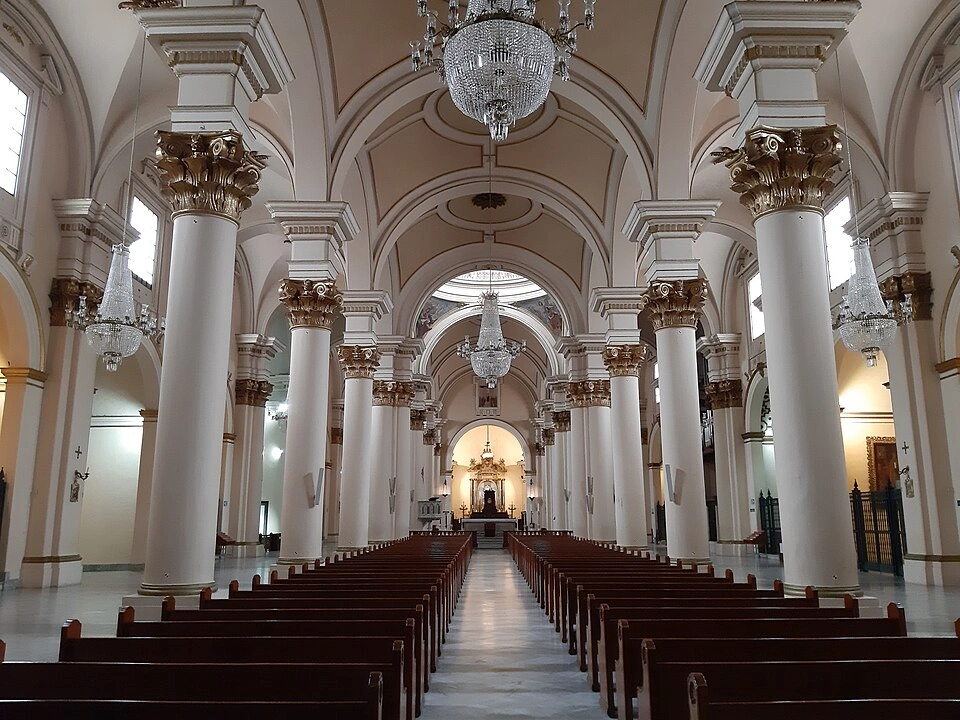
The Cathedral is made up of a classic basilica plan in the shape of a Latin cross that occupies an area of 5,300 square meters, has five naves: the central nave and two lateral ones of the same height and the other two for the chapels. It also has a main altar and 16 chapels: 8 in the south nave, 8 in the north nave and a frontal one in the central nave, which are complemented by the choir and two sacristies. The lantern and dome are located at the intersection of the transept with the crossing, supported by four pendentives and decorated in the shape of a half orange, with indigo blue and thirteen tongues of fire. The vaults of the naves and chapels feature florets in the center of the white interior painting. The façade is divided into two sections. The first is composed of eight Corinthian pilasters that rise to the architrave, frieze and cornice, also in the Doric order; the second section is in the Ionic order and is adorned with eight pilasters. Three sculptures made by Juan de Cabrera adorn the upper part of each door: the north door, Saint Peter; the south door, Saint Paul; and the frontispiece, the Immaculate Conception with two angels on either side crowning her; above the latter, the façade is finished with an isosceles triangle adorned with indented, Ionic moldings and above it a double-armed papal cross. Below the statue, above the lintel of the main door, a white marble slab bears the inscription: “Under the title and patronage of the Immaculate Conception of Our Lady, religious Santafé will prosper. Year MDCCCXIV. Capuchin architect Fray Domingo de Petrés The towers, rebuilt after the earthquake of 1827, are 52 meters high and start from the main cornice in the manner of a bell tower, each one is formed by three bodies with openings on the four sides in the upper body for the bells and in the middle body; the south tower is consecrated to Santa Bárbara , while the north tower, consecrated to San Emigdio has a clock. The main door, made in the 16th century, is 7.20 meters high by 3.60 meters wide, is adorned by two independent pilasters in the form of fluted columns of Ionic order, whose capitals end in the cornice of the front, and has knockers, bolts, studs and fittings in Spanish cast bronze and five salamanders in solvier. The side doors measure 5.60 meters high by 2.80 meters wide. The atrium measures 110 meters in length and was built between 1631 and 1664. It was paved in 1842 and extended to the southern end of the square, and in 1913, the angle of the corner was rounded to make it easier for the tram to turn along Seventh Street. In 1815, it was extended to the Chapel of the Tabernacle. In 1842, it was paved.
Urban context
The Metropolitan and Primate Cathedral Basilica occupies the northern part of the eastern block of Plaza Bolívar, in the historic center of the city of Bogotá, corresponding to the town of La Candelaria, whose minor mayor’s office was created by the Bogotá Council by agreement 7 of December 4, 1974. Its precise location is between Carrera Séptima and Carrera Sexta, between Calles 10.a and 11.a. The cover is oriented west (on Carrera Séptima, with a view of Plaza Bolvar) and the side door, or false door, is oriented north (on Calle 11.a, with a view of the Casa del Florero, or Museum of July 20, where the Cry of Independence took place, and the buildings that surround it). Its location corresponds to the Episcopal Pastoral Zone of the Immaculate Conception, forming the parish of the Cathedral in the neighborhood of La Candelaria. In the same neighborhood there are four other Catholic churches. On the south side of the Cathedral is the Chapel of the Tabernacle, a temple built between 1660 and 1689. Between the Cathedral and the Chapel of the Tabernacle is the House of the Ecclesiastical Chapter (also known as the Town Hall), which is a three-story building built in 1689 by order of Archbishop Julián Cortázar. Completing the block on the Plaza de Bolívar is the Archbishop’s Palace, a building constructed between 1952 and 1959 to replace the old palace, destroyed in April 1948 during the Bogotazo, which was located on 14th Street with Sixth Avenue, next to the Casa de la Moneda . The Customs building stood on the current site of the Archbishop’s Palace since 1793, which served as a prison for Viceroy Amar y Borbón after July 20, 1810, and as an office for Viceroy Sámano and Pablo Morillo during the Reconquista. At the back of the Cathedral is the rectory, the lot of which was initially designated for the Hospital of San Pedro by order of Archbishop Fray Juan de los Barrios on October 21, 1564. Due to limited space, in 1723 the hospital was moved to the west of the city, to the site currently occupied by the Hospital San Juan de Dios. The current rectory building on the corner of 11th Street and 6th Avenue dates from 1759 and was declared a national monument by resolution 191 of March 1, 2005. The Plaza de Bolívar as the main square of the city has been the scene of some of the main political and social demonstrations throughout the history of the country. Its framework is complemented by the Palace of Justice to the north side, the Liévano Palace (headquarters of the Mayor’s Office of Bogotá) to the west and the National Capitol to the south. The Plaza is home to a number of important institutions that represent the country’s three branches of public power in this way. Since July 20, 1847 in the center of it there is a statue of Simón Bolívar, from whom it officially receives its name, work of the Italian sculptor Pietro Tenerani.
Chapels
Chapel I: Baptistery Chapel
From west to east, the Baptistery Chapel with the baptismal font a carved stone font from the 18th century and the 1898 oil on canvas painting “Baptism of Christ” are the first things you see upon entering the cathedral. To the right of the Baptistery Chapel is the south nave. The oil on canvas painting “Child Jesus and the Eternal Father” by Pedro Figueroa can be found on the western side of the chapel.
Chapel II: Chapel of St. Peter
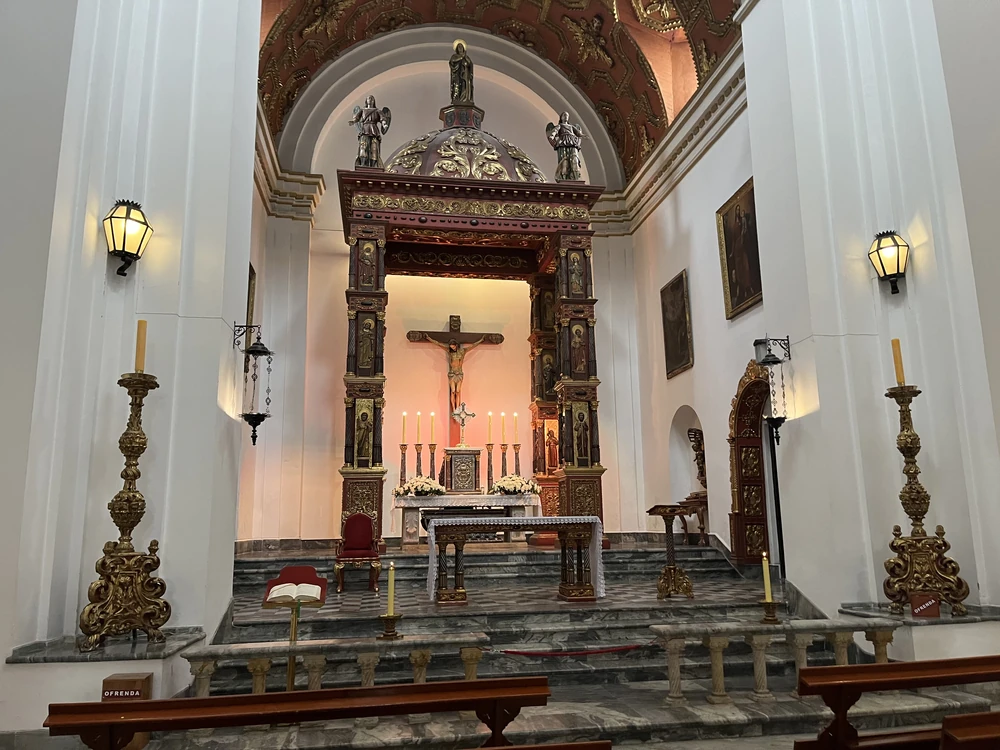
Continuing east along the south nave, we find the Chapel de San José, which contains a masonry altar of Composite order, designed by Petrés. A wooden carving from the 17th-century Sevillian School can be found in this altar. “Jesus with the Cross on His Back,” an oil on canvas painting, can be found on the eastern side of the chapel. The painting “Our Lady of Sorrows,” an oil on canvas from the 17th century by an unknown artist, can be found to the west of the chapel. Saint Peter is the second name of the Metropolitan Basilica Cathedral.
Chapel of the Tabernacle From the Metropolitan and Primate Cathedral Basilica we can access the Chapel of the Tabernacle.
Chapel III: Chapel of Our Lady of Mount Carmel 20th-century carved and multicolored wooden sculpture. The anonymous 17th-century oil on canvas painting titled “Saint Teresa of Jesus” can be found on the chapel’s eastern side. The oil on canvas, 17th-century work “Appearance of Our Lady to San Simón Stock,” by an unknown artist, can be found on the western side.
Chapel IV: Chapel of Saint Elizabeth of Hungary
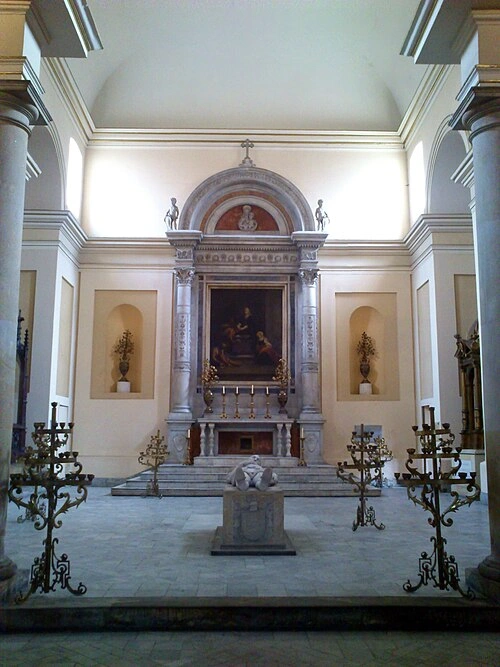
Saint Elizabeth of Hungary is the patroness saint of the Archdiocese of Bogotá. Previously known as the chapel of Saint Ursula and later as Saint Catherine of Siena. At the bottom of the chapel is the painting “Saint Elizabeth of Hungary”, oil on canvas by the Spaniard Domínguez (copy of a painting by the Spaniard Esteban Murillo).In this chapel stands out the tomb of the Spanish conquistador and founder of the city Gonzalo Jiménez de Quesada, sculpted by the artist Luis Alberto Acuña on a white marble altar by Cassioli; On the eastern wall, the bust of General Antonio Nariño stands out in the place where his remains lie. Three apses in front of the chapel’s colonnade contain the monuments of the city’s archbishops, in order that of Vicente Arbeláez in Renaissance style, that of Manuel José Mosquera in wood and Gothic style, and that of José Telésforo Paul in Florentine Gothic style. On the western wall, a marble monument contains the ashes of the Venezuelan Pedro Gual and a plaque commemorates Archbishop Fernando Caicedo y Flores, complemented by a picture of the Creed of Santiago and the statue of Mary Immaculate, which was on the main altar for three centuries. Four columns rest on the step, which contain the remains of Archbishops Aquinao Camacho, del Pórtico and Torres and a few steps to the south is Monsignor Juan Bautista Agnozzi, delegate of the Holy See who visited the city in 1882.
Chapel V: Chapel of Santiago Apóstol
It consists of a painting by Gregorio Vásquez de Arce y Ceballos titled “Santiago Apóstol en la Batalla de Clavijo,” which is an Ionic altar. All of the paintings in this chapel were created by the artist Gregorio Vásquez de Arce y Ceballos (1638–1711), who is buried here.
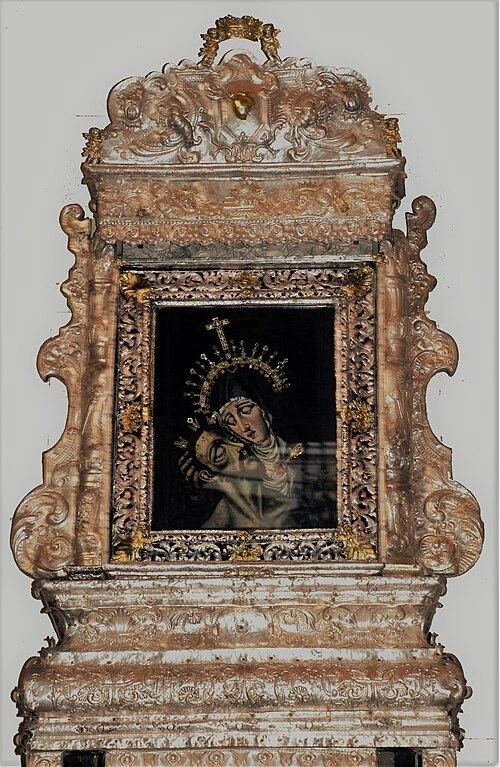
Chapel VI: Chapel of Our Lady of the Mole
Behind the main altar is the Chapel of Our Lady of El Topo, a historical and religious relic where the Behind the main altar is the Chapel of Our Lady of El Topo, a historical and religious relic where the choir stalls of the canons are located. It measures 29 meters long by 14 wide, has a semicircular arch entrance supported by two pilasters and closed by an iron fence. The central altar is from the 18th century, of Doric order embossed in silver and also has two altars on the side walls. The main altarpiece is dated 1610 by an unknown author, represents the invocation of Our Lady of Sorrows of El Topo, patron saint of the canons of Bogotá, in which the Virgin appears leaning over the head of the dead Jesus. On its sides are an image of Saint Joseph and an image of Saint Francis. In this chapel are the remains of Aurelio París Sanz de Santamaria.
Chapel VII: Chapel of Our Lady of Sorrows
Built in 1906, it has an Ionic altar and three niches: one with Mary Magdalena on the left, one with Our Lady in the middle, and one with Saint John the Evangelist on the right. This is where Juan Martn de Sarratea, superintendent of the Mint House, is buried. There is also a door that connects to the Sacristy of the Choir Chaplains, and a painting of the Sepulchre of the Lord is above it.
Chapel VIII: Chapel of St. John of Nepomuk
It was built in 1630 and was previously known as the Chapel of the Virgin of Perpetual Help (also known as the Holy Trinity). It is now known as the Chapel of John of Nepomuk. It has four lateral paintings, a statue of Our Lady in a niche, a Doric altar surrounded by a grille, and a Doric altar. A painting of Saint Francis Borgia by Gregorio Vásquez de Arce y Ceballos is on display there.
Chapel IX: Chapel of the Immaculate Conception
This chapel is adorned with a half-round arch and a masonry altar. It contains a statue of the Immaculate Conception, patron saint of Bogotá, bearing the first title of the Metropolitan Cathedral Basilica of Bogotá, installed in the central niche in 1904, and a statue above the tomb of Archbishop Bernardo Herrera Restrepo on the west wall, the work of artist Gustavo Arcila Uribe.
Chapel X: Chapel of St. Joseph
Before it was dedicated to Saint Joseph, this oldest chapel, built in 1590, was known as the Chapel of Our Lady of Mercy. It was originally the Chapel of Saint Anne, after the painting by Gaspar Figueroa, and houses an Ionic altar, a Quito statue of Our Lady of Mercy in the central niche, and the tomb of Eulogio Tamayo (treasurer and Dean of the Cathedral in 1887, who, during the Concordat, requested legal status for the Congregation of the Sacred Hearts).
“False” door
The side entrance of the church, or “false door,” is located after the Chapel of San José. It has two old Italian-style paintings on the inside and a stone-sculpted Spain coat of arms on its exterior.
Chapel XI: Chapel of the Souls
The Holy Christ (also known as the souls or the souls of purgatory) is the focus of the second chapel in this nave. It has an altar of composite order with a small grille, a painting of the crucified Christ, two smaller paintings on the right side, and a Vásquez painting of the Savior.
Chapel XII: Chapel of the Sacred Heart of Jesus
The north nave has on the western side the Chapel of the Sacred Heart of Jesus, which has a gilded altar in the Doric style and a marble statue of Christ, the work of the Pussilque Russaud house of Paris, and inscriptions in marble on the laws of 1913 in homage to Jesus Christ and of 1919 in homage to Our Lady.
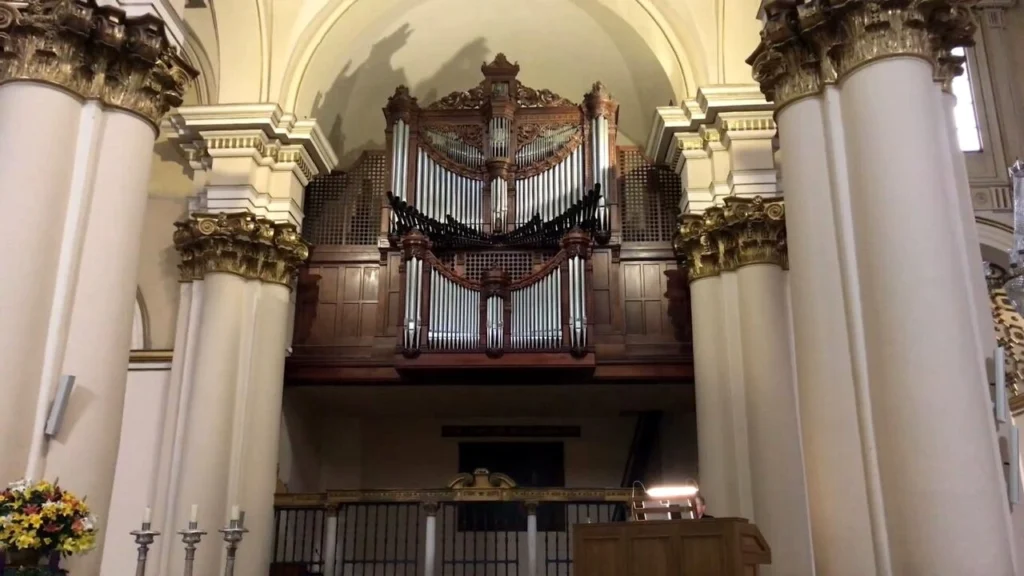
Pipe organ
The Cathedral’s pipe organ was originally an instrument by Aquilino Amezua, a prominent Spanish organ builder, built in 1891, but after two interventions in 1965 and 2016, the instrument is now an Amezúa – Binder – Grenzing organ , its current system is 58 games or registers , a console with four manual keyboards and a keyboard that is played with the feet ( pedalboard ), it also has around 4,500 pipes, all this makes it the largest organ in Colombia. In itself, the organ is an orchestra with instruments such as trumpets, bombards, oboes, clarinets, flutes and human voices. It is not only played in religious services, but also in concerts. The instrument underwent a restoration and expansion, valued at 2.515 billion pesos, which was financed by the Ministry of Culture of Colombia, the National Tourism Fund (Fontur) and the Archdiocese of Bogotá. The process took place between 2013 and 2016 and was carried out by the Spanish organ company Gerhard Grenzing SA, which has worked on the organs of the cathedrals of Seville, Brussels and Mexico, among others. Finally, the inauguration of the organ took place on July 2, 2016, with the blessing of the instrument by Cardinal Rubén Salazar Gómez and an inaugural concert presided over by the Spanish maestro Juan de la Rubia , titular organist of the Basilica of the Sagrada Familia in Barcelona (Spain).
Feast Day
Feast Day : 08 December
The Primatial Cathedral of Bogotá, officially named the Sacred Holy Temple Metropolitan and Primate Cathedral Basilica of the Immaculate Conception of Mary and Saint Peter, celebrates its feast day on December 8th each year, coinciding with the Solemnity of the Immaculate Conception. This feast honors the Catholic doctrine that the Virgin Mary was conceived without original sin.
Church Mass Timing
Monday to Saturday : 12:00 PM,
Sunday : 10:30 AM, 12:00 PM.
Church Opening Time:
Monday to Friday : 10:00 AM, 01:00 PM, 02:00 PM, 04:00 PM.
Saturday, Sunday : 10:00 AM, 04:00 PM.
Contact Info
Address : Primate Cathedral of Colombia
Cra. 7 #11-10, La Candelaria, Bogotá, Colombia.
Phone : +57 13411954
Accommodations
Connectivities
Airway
Primatial Cathedral of Bogotá, Colombia, to El Dorado International Airport (BOG), distance 20 min (16.0 km) via Av. El Dorado.
Railway
Primatial Cathedral of Bogotá, Colombia, to C.c Gran Estación Bogotá, distance between 19 min (11.3 km) via Av Circunvalar and Av. El Dorado.