Introduction
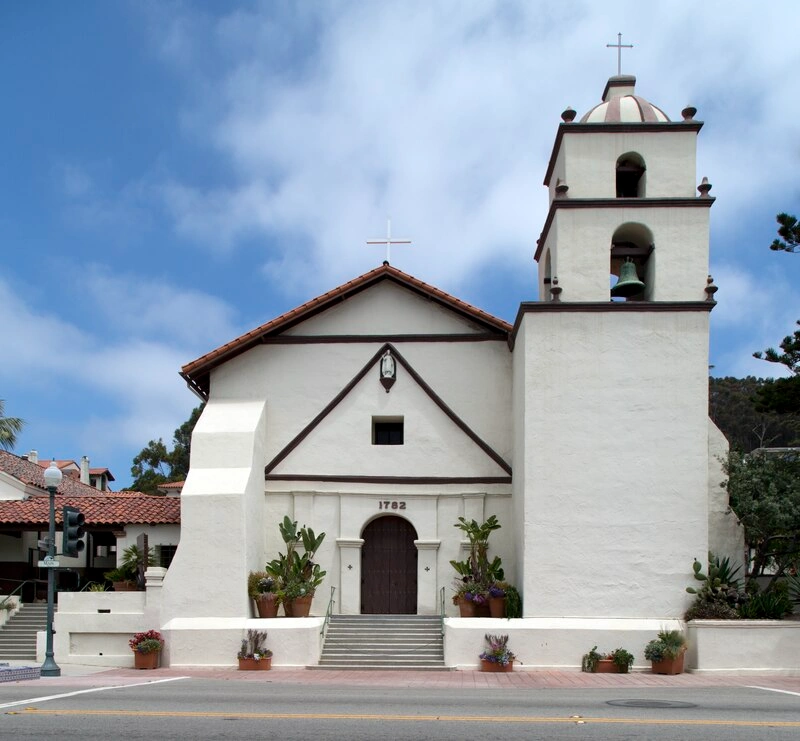
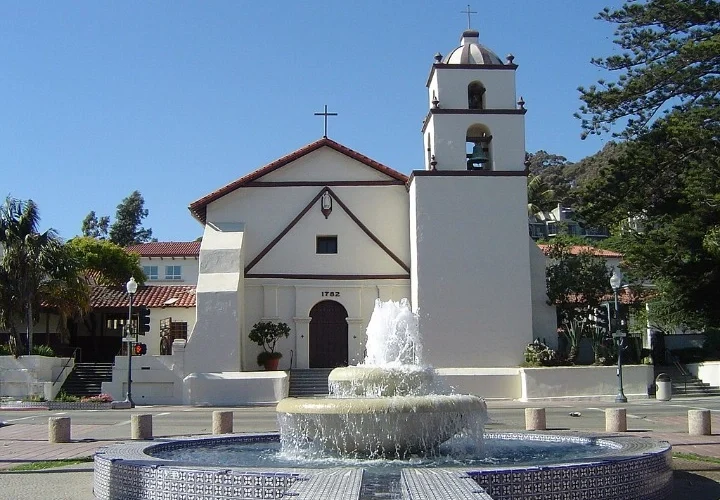
Mission San Buenaventura, also known as the Mission Basilica of San Buenaventura, is a Catholic church located in downtown Ventura, California. It’s part of the Archdiocese of Los Angeles and has a long history dating back to the Spanish colonial era. The mission was founded on March 31, 1782, by the Franciscan friar Junípero Serra, making it the ninth mission built in Alta California. It was also the last one Serra personally established. The mission was named after St. Bonaventure, a 13th-century Franciscan who was a major figure in the early years of the order and is recognized as a Doctor of the Church. The mission grew to become an integral part of local life over time. At its peak around 1816, it had a large population and was one of the more active missions in the region. Like all missions, it was built on land that belonged to the local Indigenous people in this case, the Chumash who lived here long before the Spanish arrived. It was initially intended to be established in 1770 as the third California mission; however, due to a lack of sufficient soldiers at the time, its establishment was postponed. The first church on the site was destroyed by fire in 1793, but the mission was rebuilt and expanded. In the end, it had a quadrangle with places to work and live. Today, only the church and the garden remain from the original structures. After years of change and restoration especially after the church was returned to the Catholic Church in 1862 the mission became more than just a place of worship. It now serves as a religious, historical, and cultural site and is listed on the National Register of Historic Places. On June 9, 2020, Pope Francis elevated the mission to the status of a minor basilica, and the announcement was made official about a month later, on July 15, the feast day of St. Bonaventure. Mission San Buenaventura still functions as a parish and serves as a reminder of California’s complicated past.
Spanish Empire
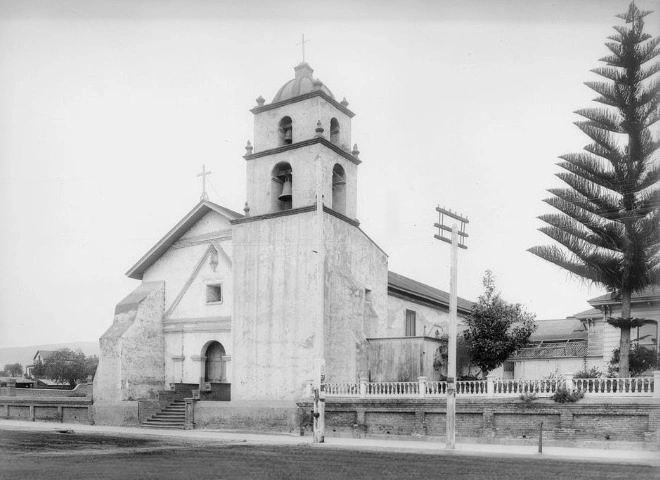
The founding of the San Buenaventura Mission traces to the decision on Palm Sunday, March 30, 1749, by the Franciscan friar Junipero Serra to journey to the New World as a missionary to the native peoples. Thirty-three years and one day later he raised the Cross at “la playa de la canal de Santa Barbara” (the beach of the Santa Barbara Channel) on Easter morning, March 31, 1782. Assisted by Pedro Benito Cambon, he celebrated a High Mass, preached on the Resurrection, and dedicated a mission to San Buenaventura (St. Bonaventure). It was originally intended to be the third of Serra’s 21 missions, but it was destined to be the ninth and final mission established during his lifetime one of six he personally dedicated. Under the direction of Friar Cambon, whom Serra left in charge of the new mission, a system of aqueducts were built by the Chumash people between 1805 and 1815 to meet the needs of the Mission population and consisted of both ditches and elevated stone masonry. The watercourse ran from a point on the Ventura River about ½ mile north of the remaining ruins and carried the water to holding tanks behind the mission, a total of about 7 miles (11 km). The English navigator George Vancouver said that the mission’s orchards and gardens were the best he had ever seen because of the abundance of water. The water distribution system was damaged by floods and abandoned in 1862. The mission’s first church was destroyed by fire in 1793. The construction of a second church was abandoned because “the door gave way.” Before 1812, a permanent replacement could not be built. About the same time, the San Miguel Chapel and the Santa Gertrudis Chapel were completed. A series of earthquakes and an accompanying seismic sea wave in 1812 forced the friars and Indian neophytes to seek temporary shelter a few miles inland. Six years later the friars had to remove sacred objects from the church and the whole mission flee into the hills to elude an attack led by Argentine pirate Hippolyte de Bouchard, who was pillaging the missions and had just conducted a successful attack against Mission San Juan Capistrano.
Mexican Rule
After its independence from Spain, in 1834 the Mexican government issued a secularization decree, divesting the friars of administrative control over the missions. In 1845 Mission San Buenaventura was rented to Jose Arnaz and Narciso Botello and was later sold illegally to Arnaz. The mission did not fully escape the impact that the Mexican–American War of 1846–1847 had on California. On January 5, 1847, while on its way from Santa Barbara to Los Angeles, the 428 men-strong California Battalion, under the command of U.S. Army Major John C. Fremont, managed to disperse an armed force of up to 70 enemy Californios near the mission.
Under the United States
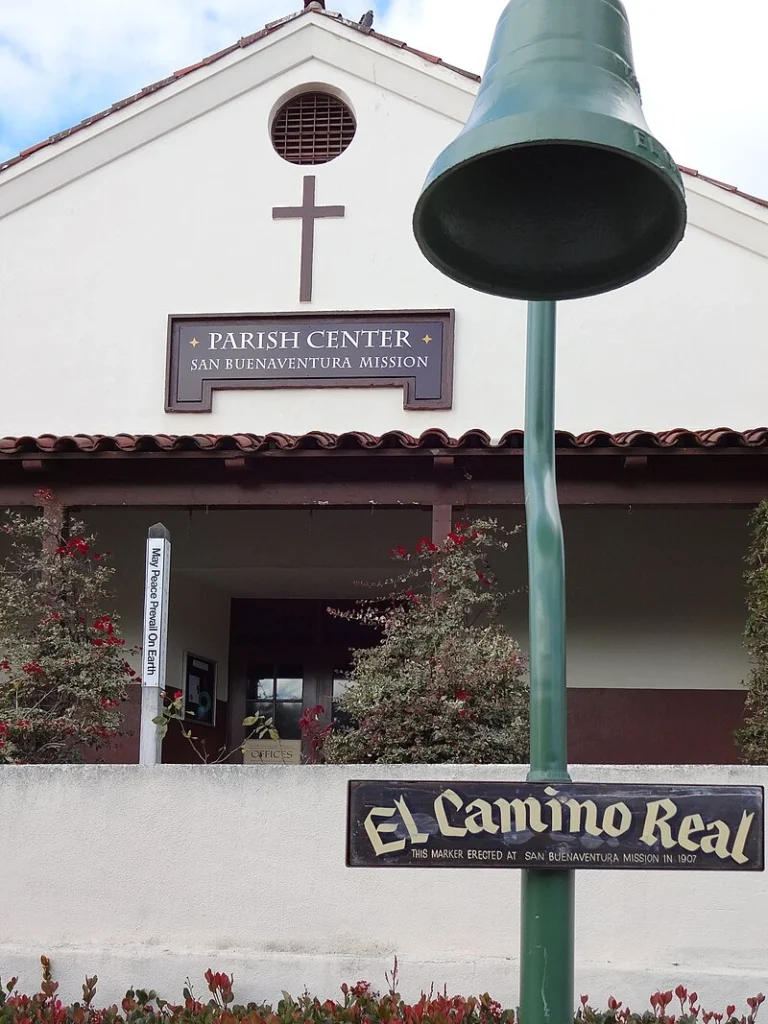
As California had become a state of the Union, when Joseph Sadoc Alemany, O.P., was named the first Bishop of Monterey in 1850, he petitioned the United States Government to return that part of the mission holdings comprising the church, clergy residence, cemetery, orchard, and vineyard to the Catholic Church. The request was granted in the form of a proclamation by President Abraham Lincoln on May 23, 1862. Because of severe damage in the 1857 Fort Tejon earthquake, the Mission’s tile roof was replaced by a shingle roof. Cyprian Rubio “modernized” the church’s interior in 1893 by painting over the original artwork. When he was done, the old church was little changed. The quadrangle was demolished, the beamed ceiling and tile floor were covered, and the windows were extended. The west sacristy was removed to provide room for a school, which was not actually built until 1921. During the pastorate of Patrick Grogan the roof of the church was once again tiled, the convent and present rectory were built, and a new fountain was placed in the garden. Since 1829, when Mexico was in control, Mission San Buenaventura has had a continuous education program for children. Originally a four-classroom structure, Holy Cross School served its students and the parish admirably since its 1922 dedication. In 1925 it was expanded to accommodate growth and in 1949 a subsequent renovation brought it out to Main Street (El Camino Real) with no space left for further expansion. In a major restoration under the supervision of Aubrey J.O’Reilly in 1956–1957 the windows were reconstructed to their original size, and the ceiling and floor were uncovered. A long-time parishioner commissioned the casting of a bell with an automatic angelus device and donated it to the mission; it hangs in the bell tower above the four ancient hand-operated bells.
The second half of the 20th century brought more growth, as well as wear-and-tear and obsolescence, and the school’s problems far exceed spatial deficiency. In response to this situation, the San Buenaventura Mission parish, under the leadership of Monsignor Patrick J. O’Brien, formed a Planning and Development Committee comprising parishioners, faculty, parish staff, and parents. In June 1994, the downtown firm of Mainstreet Architects and Planners prepared a conceptual master site plan for the mission properties, incorporating the design of a new school and an adjoining multi-purpose building which would serve both school and parish. This plan also necessitated the deconstruction of the convent and the two remaining Holy Cross Sisters moved into the larger St. Catherine by the Sea Convent, a short distance from the Mission. The entire roof of the church was removed and replaced in 1976. In December of that year the church was solemnly consecrated by Cardinal Timothy Manning, the Archbishop of Los Angeles. In 1982 the mission marked its bicentennial. A new three-story school building, with pre-kindergarten, kindergarten, and grades 1–8, located at the base of the hill behind the Mission, was dedicated in January 2001. The school also houses the Serra Chapel for Eucharistic Adoration, adult classrooms, a parish/school kitchen, and a large assembly hall used as a school auditorium and for large parish gatherings and one Sunday Mass. O’Brien, who served as the pastor of the church for 25 years before passing away suddenly in 2005, is the name of the assembly room. The mission celebrated its 225th anniversary with a year-long series of events and activities during 2006–07.
Historic site
San Buenaventura is listed on the National Register of Historic Places. Some of the mission’s most important sites and archaeologically significant remains can be viewed at the site. A museum is also located there. The mission is one of three in California that are situated in the historic heart of a city. The others are San Luis Obispo de Tolosa and San Gabriel Arcángel. In this case, Ventura. The list of historical sites and vestiges of San Buenaventura includes: the mission garden, the chapel of San Miguel, the native cemetery, remains of the aqueduct and the Cross of Father Serra, among others.
Architecture of Mission Basilica of St. Bonaventure, Ventura, California, United States
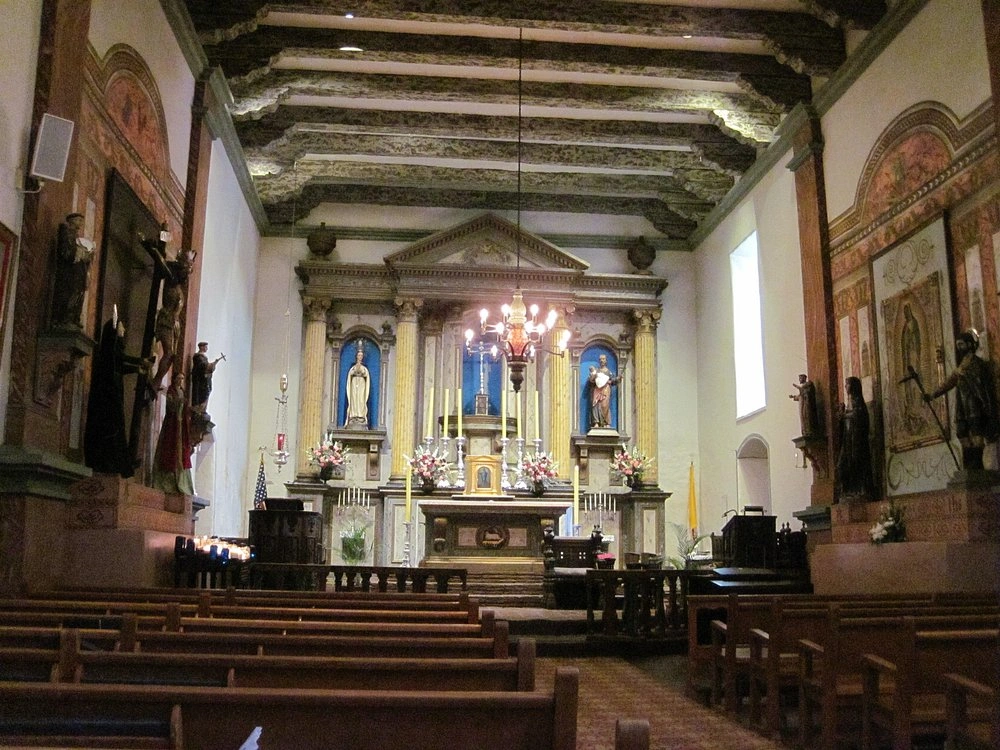
All that remains of the original mission is the church and its garden. A small museum sits at the mission with displays of Chumash Indian artifacts and mission-era items. Located in the historic downtown of Ventura, very few California missions had the center of business and commerce remain at the location where the mission was established like Mission San Buenaventura. The church remains an active Catholic parish, serving approximately 2,000 families, and services are still held in the parish church. The current pastor is Tom Elewaut, who has served since 2011. A reproduction of the Pieta at St. Peter’s Basilica was donated to the parish in 2018. The Father Serra statue that was removed from the plaza in front of the Ventura City Hall was installed in the garden in 2024.
Mission industries
Some animals at San Buenaventura were cattle, horses, sheep, donkeys and goats. The cattle were very important because they provided food, oil and hides. In the year of 1818, 35,274 cattle wandered over the mission lands as far as the Oxnard Plain. The animal population dropped to a low of 4,000 cattle, 3,000 sheep, 300 horses, and 60 mules shortly after January 7, 1831. In July 1839, Inspector-General E.P. Hartnell found 2,208 cattle, 1,670 sheep, 799 horses, 35 mules and 65 goats. The soil around Mission San Buenaventura was very good so the mission could grow many crops. San Buenaventura grew apples, grapes, bananas, pears, plums, pomegranates, figs, oranges, coconuts, beans, grain, corn and barley. In the year of 1818, 12,483 bushels of grain were harvested. The harvest had been reduced to 1,750 bushels of wheat, 2,000 bushels of barley, 500 bushels of corn, and 400 bushels of beans shortly after January 7, 1831. In July 1839, Inspector-General William E.P. Hartnell found 322 fanegas of wheat, 182 fanegas of corn and 35 fanegas of peas.
Mission bells
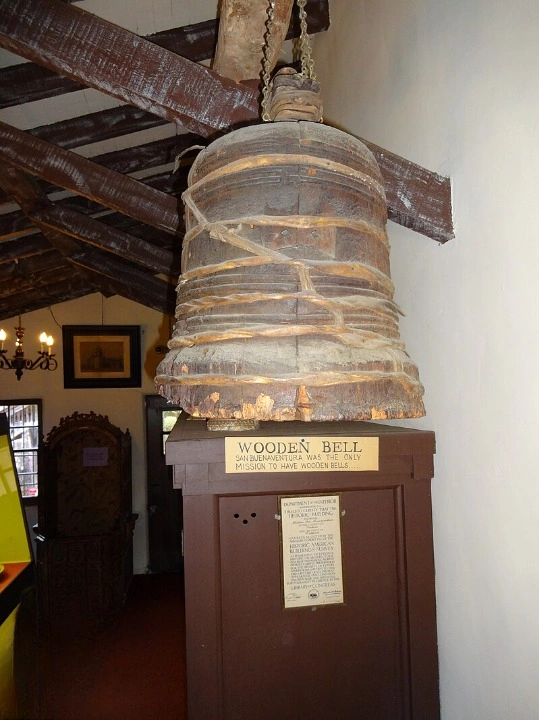
Bells were vitally important to daily life at Mission San Buenaventura, which had five bells. The bells were borrowed from Mission Santa Barbara because there were no bells at the time. They were never returned. The bell facing north is labeled S. San Francisco 1781. The bell facing east has the inscription: San Pedro Alcantra 1781. A small swinging bell hangs in the southern arch with the lettering: Ave Maria S. Joseph. The only bell used daily at San Buenaventura is large and crown topped with a cross on its side. Inscribed on the bell is Ave Maria Pruysyma D Sapoyan Ano D 1825, which means “Hail Mary Most Pure. Maryof Zapopan Year of 1825.” This bell was originally cast for the church of Zapopan but was later sent to Mission San Buenaventura. Another bell, which was once the gift of the Spanish Viceroy, is inscribed Marquez de Croix Mexico November 12, 1770. It is currently owned by Senora Isabel del Valle Cram. There are also two wooden bells in the museum that measure about two feet. These were the only wooden bells in the California missions.
Feast Day
Feast Day : 15 July
The Mission Basilica of St. Bonaventure in Ventura, California, celebrates the feast day of its patron saint, St. Bonaventure, on July 15 each year. This annual event includes special Masses and receptions in the Mission Gardens.
Church Mass Timing
Monday to Thursday : 7:30 AM.
Friday : 8:15 AM
Saturday : 5:30 PM, 7:30 PM
Sunday : 7:15 AM, 9:00 AM, 10:45 AM, 12:30 PM
Church Opening Time:
Monday to Friday, Sunday : 6:30 AM, 05:00 PM.
Saturday : 08:00 AM, 09:00 PM
Contact Info
Address : Mission Basilica of St. Bonaventure
211 E Main St, Ventura, CA 93001, United States.
Phone : +1 805-643-4318
Accommodations
Connectivities
Airway
Mission Basilica of St. Bonaventure,Ventura, California, United States, to Santa Barbara Airport (SBA), distance between 35 min (36.3 mi) via US-101 N.
Railway
Mission Basilica of St. Bonaventure,Ventura, California, United States, to Amtrak Station – VEC, distance between 3 min (0.7 mi) via E Main St and S Garden St.