Introduction
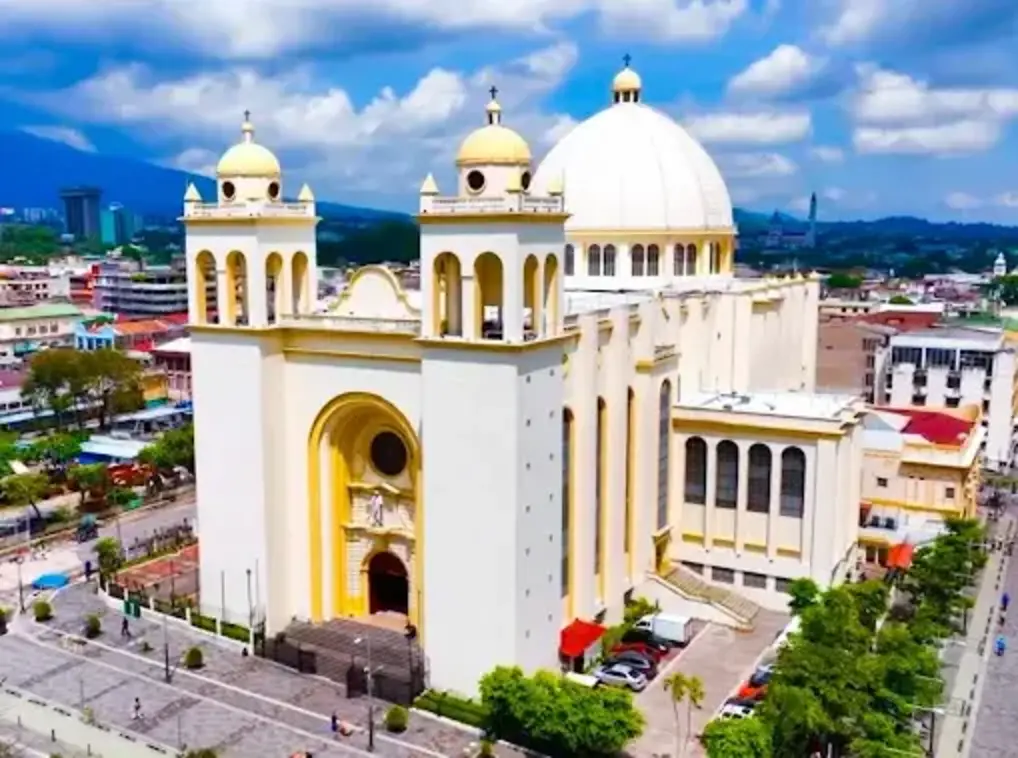
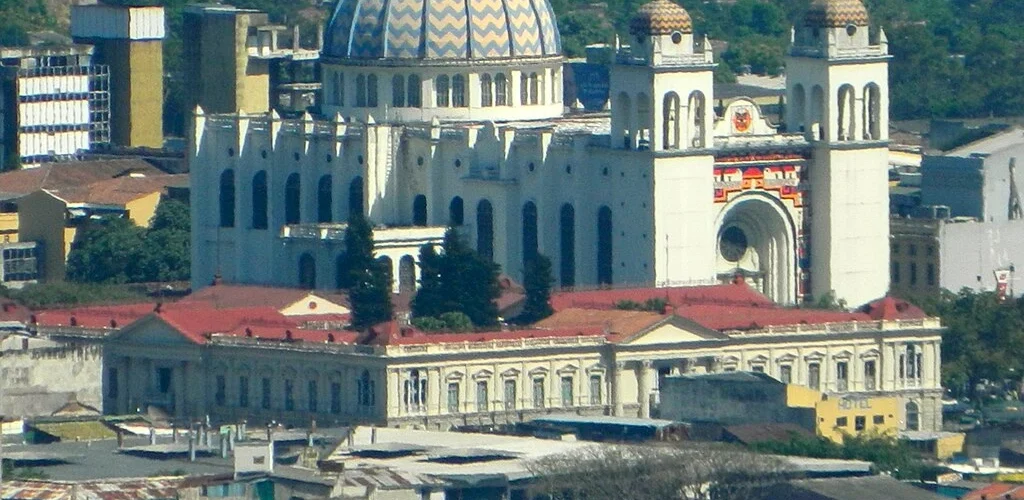
The Metropolitan Cathedral of the Holy Savior, known in Spanish as Catedral Metropolitana de San Salvador, is the main Catholic church in San Salvador, El Salvador. It is the metropolitan archbishop’s seat and the central place of worship for the Roman Catholic Archdiocese of San Salvador.
Origins
The city of San Salvador has had three cathedrals in its history due to disasters that destroyed the buildings. The first cathedral was located on the site of the old parish church and where the Rosario Church is today, east of Plaza Libertad. The second and third cathedrals were both situated in front of Plaza Gerardo Barrios de San Salvador, also referred to as Plaza Cvica. On its western side, this square is home to the National Palace. The cathedral has seen both tragedy and revival in its history.
Former parish church and first cathedral
When the town of San Salvador was moved from its original site in the Bermuda Valley near Suchitoto (which is the archaeological site of Ciudad Vieja) to the Zalcoatitán or Hamacas Valley (where it is currently located) a plot of land was set aside to the east of the Public Plaza (also called Plaza de Armas or Plaza Mayor, today Plaza Libertad) to build the town’s parish, on the same site where the El Rosario church had stood since the late 19th century. Due to the earthquakes that devastated San Salvador, the parish was destroyed and rebuilt several times; thus, due to the earthquake of April 21, 1594, the parish priest Francisco Ramos was buried under the rubble of the temple. Several of the city’s buildings had been destroyed by the tremors by the time Pedro Cortés y Larraz, Archbishop of Guatemala (in whose jurisdiction the then-mayor’s office of San Salvador was located), came to the city. The parish church had to be rebuilt after the May 30, 1776, and February 2, 1798 earthquakes rendered it inoperable. In the meantime, the Presentation Church or hermitage (later known as the Pilar Church or San José Church, which was left in ruins after the fire of December 8, 1975) was used as a temporary parish church. The new church’s construction began in 1808 on the initiative of priest José Matas Delgado, who had been the San Salvador district’s provincial vicar and ecclesiastical judge since August 12, 1797. It was opened for divine services in 1811 and completed in 1818. This church was shaped like a Latin cross, with a central nave and two lateral ones and a major axis running east to west. The facade, made of solid masonry, had a bell tower on the south side. The side aisles were built on their foundations of stone and on top of that of brick; and the roof was covered with tiles. Father José Ignacio Zaldaa sang the Gloria on September 21, 1821, after the government of the then-province of San Salvador received the news of the independence signed on September 15 of that year. On November 5, 1811, Father Delgado sang the Te Deum in the newly rebuilt parish after the success of the first independence movement. Later, on January 24, 1814, on the order of the priest brothers Aguilar, its bells rang with rapture during the second independence movement.
Since 1770, there had been a demand for San Salvador to become the seat of its own diocese, separate from that of Guatemala. On March 30, 1822, the governing board of the province of San Salvador named priest José Matas Delgado, then governor of the province with the title of political leader, bishop of San Salvador due to the authorities’ lack of willingness and the fact that provincial governments would inherit the royal patronage held by the Spanish monarch after independence. This decision was ratified by the provincial congress on November 10 of that year, and then by the constituent congress of the state of El Salvador on April 27 and May 4, 1824. On May 5, 1824, Delgado was sworn in as bishop in the presence of the deputies of the constituent congress and the political head of the State Juan Manuel Rodríguez, and with a speech given by the former rector of the University of San Carlos of Guatemala, the priest José Simeón Cañas. Due to the opposition of the bishop of Guatemala Fray Ramón Casaus y Torres , mainly due to the loss of tithes from the Salvadoran territory, Pope Leo XII condemned the decision of the Salvadoran authorities and forced Delgado to retract his election by the bishop, which was done, so that the Salvadoran territory remained united to the diocese of Guatemala, maintaining in constant dispute the Salvadoran ecclesiastical authorities and those of Guatemala during the existence of the Federal Republic of Central America. By papal bull of Pope Gregory XVI on February 28, 1842, the old parish became the first cathedral of the diocese of San Salvador. On January 28, 1843, Monsignor Jorge de Viteri y Ungo was appointed as the first bishop, and he took office on September 25 of that year. The August 10, 1815, February 7, 1831, March 22, and October 1, 1839 earthquakes damaged the parish church, which later became a cathedral. The cathedral’s clock tower and bell tower collapsed in the April 16, 1854, earthquake, causing much of the church to fall. The ecclesiastical and civil authorities moved to Cojutepeque, where the San Sebastián Church served as the bishop’s interim seat. The cathedral was later rebuilt, but its upper part was made of wood and sheet metal instead of masonry. It finally gave way as a result of the March 19, 1873 earthquake.
Second Cathedral
Temple and convent of Santo Domingo
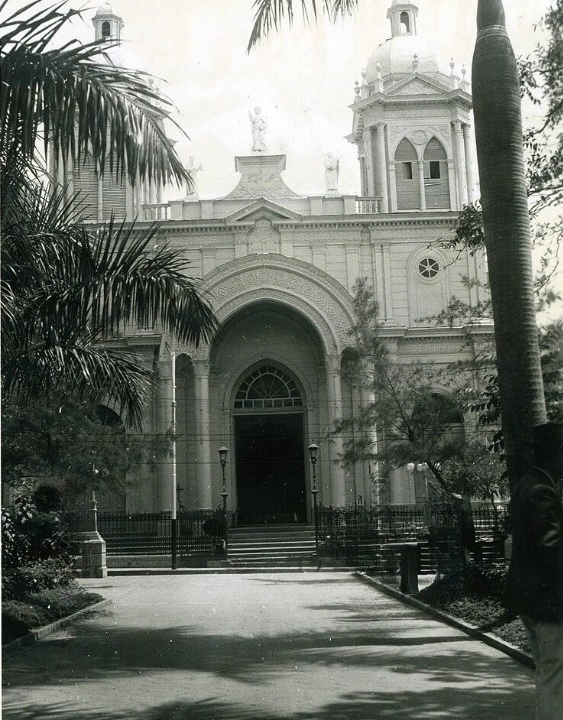
The church and convent of the Order of Santo Domingo, or the Dominicans, stood on the land in front of the old Plaza de Santo Domingo before the 1873 earthquake. This land later became the park, Plaza Central, Plaza Bolvar, and finally Plaza Barrios, and it was where the second and third cathedrals were built. They had settled in San Salvador in 1551 near the Acelhuate River, and they made the decision in 1556 to move to a new area. They didn’t move until 1566, when they moved to the houses and land that Nicolás López de Irraraga gave them. On that land, they built a ranch of poles that served as a temporary temple until 1568, when they tried to make it permanent. The earthquake of May 23, 1575, destroyed the houses of Irraraga, where the monks were housed, leaving a large esplanade in front of the temple that became the plaza, while the convent was built on the west side of the temple, extending to the current Plaza San Martín. Due to the order’s wealth and power during that time, it even served as a loan bank for landowners and owned iron factories and forges, as well as several properties like the haciendas: Estamecayo, Atapasco, and La Anunciación (all in the Zapotitán Valley). The Dominican convent in San Salvador was the one that reached its greatest splendor during the colonial period. It contained a variety of religious artifacts and abundant silverware. The earthquakes of April 21, 1594, November 3, 1658, 1671, and March 6, 1719 caused the temple and convent to be destroyed and rebuilt multiple times. After that last earthquake, a thatched ranch was built in the Santo Domingo square to house the religious and a thatched hermitage that remained until 1721, when it was inaugurated the temple and convent. The temple and convent built in 1721 were the last of the colonial era; and the hero Santiago José Celis was buried in this temple in 1814. In 1829, the Dominicans were expelled from the country, the temple was converted into a parish, and the former convent of Santo Domingo would be the headquarters of the Colegio de la Asunción and the National University from November 5, 1844, and later it was converted into barracks. After being damaged by the earthquakes of 1776, 1798, 1815, 1831, and 1839, these buildings underwent a number of repairs before the 1854 earthquake caused most of the temple to sink when its towers collapsed.
According to the “Description of the Church of Santo Domingo, its condition until the ruin of 1854” written by the parish priest José Miguel Funes, who took charge of the temple in 1860, that temple existed from 1721 to 1854. It was oriented north to south, shaped like a Latin cross, and it was 50 yards long and 15 yards wide. Its façade was Ionic , made of fairly thick masonry and was composed of two bodies; in the first, the main door protruded in the middle and there were four columns on each side forming squares; above the cornice of the first body rose the second, which was similar with a round window in the middle, while at the highest part there were two domes or towers at the ends of both sides and in the center a small pedestal on which a star (symbol of Santo Domingo) was engraved, above which rose a peak proportional to the domes. The bell tower was lower than the rest of the façade, had a small dome, and three bells of varying sizes. They appeared to be arranged in descending order, but by 1854, only the smallest bell was working. The church had tile roofs, limestone and adobe walls, and four chapels filled with altars, figures, and oil paintings. It had three naves inside, separated by masonry pillars. The main altar was shaped like a pyramid and had three sections. The lowest one had a tabernacle in the middle that held the Blessed Sacrament. This tabernacle opened and closed by means of a rotating screw, which was easily turned and raised or lowered two wooden children sculpted like angels; the rest of the altar featured figures of the Virgin Mary, her parents, and other saints. On the western arm of the temple, there was a sacristy 14 yards long and seven wide that communicated with the cloister or courtyard of the adjacent convent; said cloister was surrounded by masonry arches (behind which the monastic cells were distributed) and in it there was a font surrounded by battering rams cultivated with flowers; the convent had two doors: one to the south, facing the square, a few meters from the façade of the church; and another to the north, which was called the field door, since the pack animals entered through there. The temple and the building that had previously been the convent were restored after the earthquake of 1854, but only one of the temple towers was repaired, specifically the eastern one that would serve as a bell tower. The temple and the barracks at the time were both completely destroyed by the March 19, 1873 earthquake.
Construction and history of the second cathedral
The parish council of San Salvador reached an agreement with the Dominican order following the earthquake of 1873 to exchange their respective properties for the construction of their new churches. Later, in January 1878, the government granted the Parish Council’s request to also be granted the site occupied by the Santo Domingo barracks, in order to increase the area where the parish church should be built; said site, which belonged to the Municipality, was purchased for the sum of 6,148 pesos. The ecclesiastical council led by Monsignor Luis Cárcamo y Rodrguez, the third bishop of San Salvador, would begin the reconstruction of the temple on September 30, 1880. The architect José Dolores Melara created the plans; Canon Miguel Vechiotti, the purveyor and vicar general of the diocese, was in charge of overseeing the work; and Pascacio González, an architect, sculptor, and painter, was in charge of carrying it out. Twenty thousand pesos were invested in its construction, which was funded by daily contributions from market ladies, alms from parishioners, and contributions from wealthy individuals. The new cathedral, still incomplete, was inaugurated on June 29, 1888 by the consecration of the fourth bishop of San Salvador, Monsignor Antonio Adolfo Pérez y Aguilar ; an event attended by President General Francisco Menéndez and other members of the government, and in which Monsignor Manuel Francisco Vélez, prelate of the diocese of Comayagua , was the consecrator. The temple was built with the best wood in the country and had a galvanized iron roof. It was shaped almost like a Greek cross, with the major axis from south to north of 72.5 meters and the minor axis from west to east of 72 meters; the building had a height of 11.9 m with a dome of 23.5 by 8.5 m that rose 23 m from the floor. It had seven access doors, a central nave, two side naves, and an apse with paintings and ornamentation. On February 11, 1913, Pope Pius X elevated the diocese of San Salvador to an archdiocese, while also creating the suffragan dioceses of Santa Ana and San Miguel ; thus, Bishop Pérez y Aguilar became the first archbishop of San Salvador. This second cathedral was destroyed by fire on August 8, 1951.
Modern cathedral
From 1951 to 1956, the cathedral site remained vacant with no construction having begun. A competition to come up with a design for a new cathedral was held in 1953, but on May 9 of that year, it was declared null and void. On March 11, 1954, the archbishopric announced that plans created by architect Dominikus Böhm had arrived from Germany after requesting a design from Europe. In 1956, Archbishop Luis Chávez y González undertook the reconstruction work; the cornerstone was laid on Friday, October 12. of the cathedral that lasted four decades.
During the 1970s and the civil war in El Salvador
When Archbishop Oscar Romero took over for Monsignor Chávez in 1977, he found that the construction was only halfway done. Even though the church was not finished, he used it for Sunday services. He delivered most of his homilies in defense of human rights there. Romero put off the completion of the cathedral to pay for projects that helped the poor. The cathedral was witness to the numerous social conflicts that the nation was going through at this time. In response to government repression, the Popular Revolutionary Bloc (BPR) took control of the church on August 6, 1975. It was the first of several takeovers of cathedrals that took place up until 1980. Despite his disapproval of church takeovers, Monsignor Romero felt for those who carried them out because he was aware of the country’s limited legal avenues for protest. Salvadoran security forces killed 24 protesters on the steps of the cathedral on May 8, 1979, during one of the takeovers of the cathedral. The “Cathedral Steps Massacre” was the name given to this act. On Sunday, March 30, 1980, during the burial of Archbishop Romero, who had been assassinated by a group of soldiers from the far right, an even greater tragedy occurred. After security forces fired from the National Palace at parishioners who were forming the funeral procession, a stampede resulted in the deaths of 44 people. Archbishop Arturo Rivera y Damas, Romero’s successor, continued the church’s construction, but the San Salvador earthquake of October 10, 1986 severely damaged it. Work on the construction project ceased in 1990.
After the Peace Accords
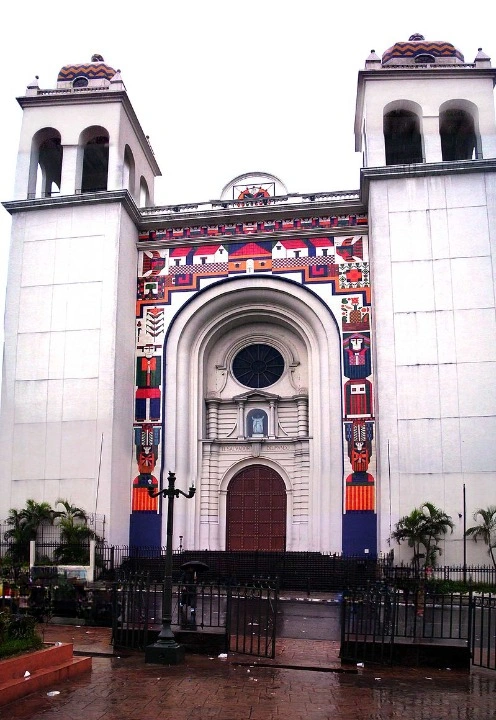
In 1992, the plaza in front of the cathedral was the scene of popular celebrations for the signing of the Chapultepec Peace Accords. The church was visited twice by Pope John Paul II who said that the cathedral is “closely linked to the joys and hopes of the Salvadoran people ”. During his visits in 1983 and 1996, the Pope knelt and prayed before the tomb of Archbishop Óscar Romero, assassinated in 1980, who is buried in the crypt of the cathedral. The cathedral was finally completed and consecrated on 19 March 1999 by Monsignor Fernando Sáenz Lacalle. Since then, the facade displayed a mosaic with handcrafted motifs by the artist Fernando Llort called The Harmony of My People, which combined the ancestral and pre-Columbian with Christian iconography, which began to be removed in December 2011 by decision of the Catholic hierarchy and amid some controversy, since the country’s Ministry of Culture was in the process of declaring it as a cultural asset.
Architecture of Metropolitan Cathedral Basilica of the Holy Saviour, San Salvador, El Salvador
Architect: José Dolores Melara (2nd Cathedral), Dominikus Böhm (3rd Cathedral)
Architectural style: Eclecticism in architecture.
Burials: Óscar Romero, José Matías Delgado.
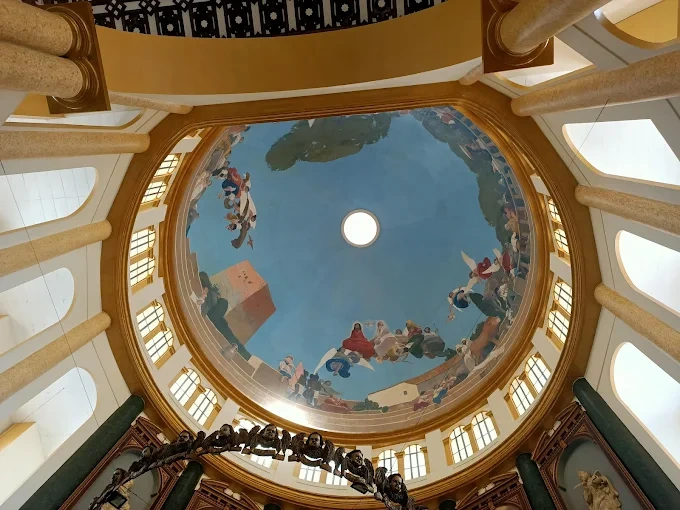
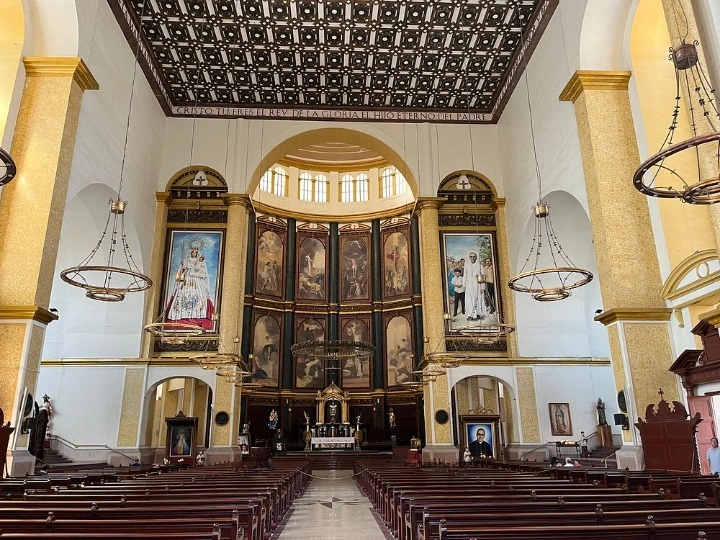
The festive and colorful facade surrounds a shrine to an image of the Divine Saviour of the World (Jesus, after the Transfiguration, the patron of El Salvador) sculpted by Friar Francisco Silvestre García in 1777. The main altar features an image of the Divine Saviour donated by the Holy Roman Emperor Charles V in 1546. The image rests on a four-column baldacchino surrounded by images of the prophets Moses and Elijah, who take part in the Transfiguration story. The main altar is surrounded by eight large paintings showing scenes from the life of Christ painted by Andrés García Ibáñez. Above it all, the bright Churrigueresque cupola stands 148 feet in height, with a 79-foot radius.
Design
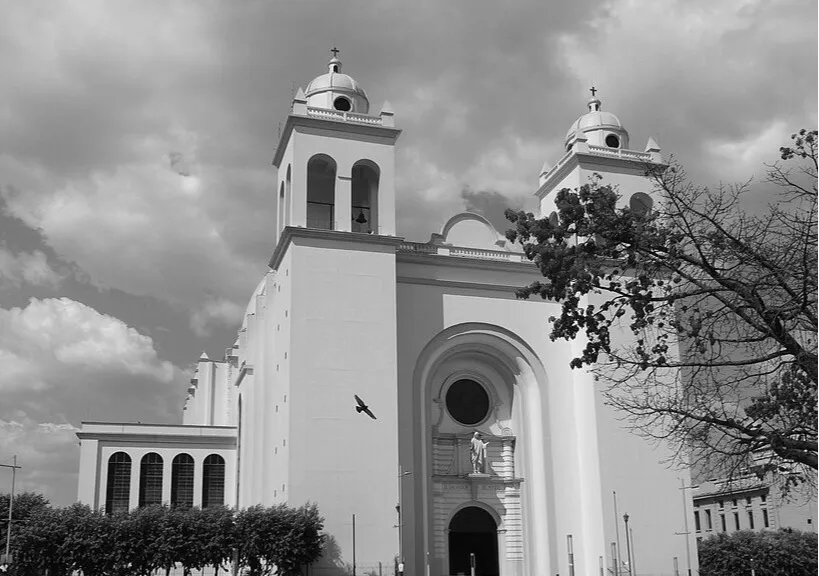
The Neo-Renaissance and Byzantine styles of architecture combine in the cathedral’s eclectic design. It had a steel frame and was made of concrete. It has a façade with two bell towers and a dome with a fifteen-story dome that rises above the main altar. It has the shape of a Latin cross, with a single nave and no columns. Inside, it has two chapels on each side. The Tabernacle Chapel is located in a wooden display case that looks like marble and has rows of gilded brass candlesticks. The custodian is a fine piece of Granada silver. The right chapel has a Renaissance altarpiece for a sculpture of the Virgin Mary made of wood that has been touched up with gold leaf. The left chapel is the Tabernacle Chapel. In front is the main altarpiece, adorned with paintings made by the Spanish artist Antonio García Ibáñez in 1990, who also painted the interior frescoes of the main dome. On the main altar there is a Mannerist, almost Baroque piece of the Divine Savior of the World that was restored in 2008 and probably dates back to the 17th century, although according to tradition it was a gift from Emperor Charles V in the 16th century . Also placed is the image of the Transfigured Christ, known as “El Colocho” because of his curly hair, which was sculpted by the Franciscan friar Silvestre García in 1770 and is the one that every August 5, since the time of Silvestre García (who started the tradition) goes out in procession and is transfigured, for which a monumental set is made in front of the cathedral, which was declared intangible cultural heritage of the Nation.
Crypt
A substantial area referred to as “the crypt” lies beneath the cathedral floor and houses two chapels. Just below the altar of the temple is the mausoleum of the saint and martyr Oscar Romero , behind which are the niches containing the remains of bishops and archbishops of the Salvadoran Catholic Church; and some lay people, including that of Enrique Álvarez Córdova.
Feast Day
Feast Day : 06 August
The feast day of the Metropolitan Cathedral Basilica of the Holy Savior in San Salvador, El Salvador, is celebrated on August 6th. This date honors the Transfiguration of Jesus, who is the Divine Savior and patron of El Salvador.
Church Mass Timing
Monday to Saturday : 7:00 AM, 12:00 PM, 5:00 PM
Sunday : 8:00 AM, 10:00 AM, 12:00 PM, 3:00 PM, 5:00 PM
Church Opening Time:
Monday to Friday : 02:00 AM, 05:00 PM
Saturday, Sunday : 06:00 AM, 01:00 PM, 04:00 PM , 6:00 PM.
Contact Info
Address : Metropolitan Cathedral of San Salvador
2a Calle Oriente, San Salvador, El Salvador.
Phone : +503 2271 2573
Accommodations
Connectivities
Airway
Metropolitan Cathedral Basilica of the Holy Saviour, San Salvador, El Salvador, to Ilopango International Airport, distance 16 min (9.7 km) via Blvr. del Ejercito Nacional.
Railway
Metropolitan Cathedral Basilica of the Holy Saviour, San Salvador, El Salvador, to Fenadesal Avenida Peralta,distance between 6 min (1.8 km) via 2a Calle Oriente and Avenida Independencia.