Introduction
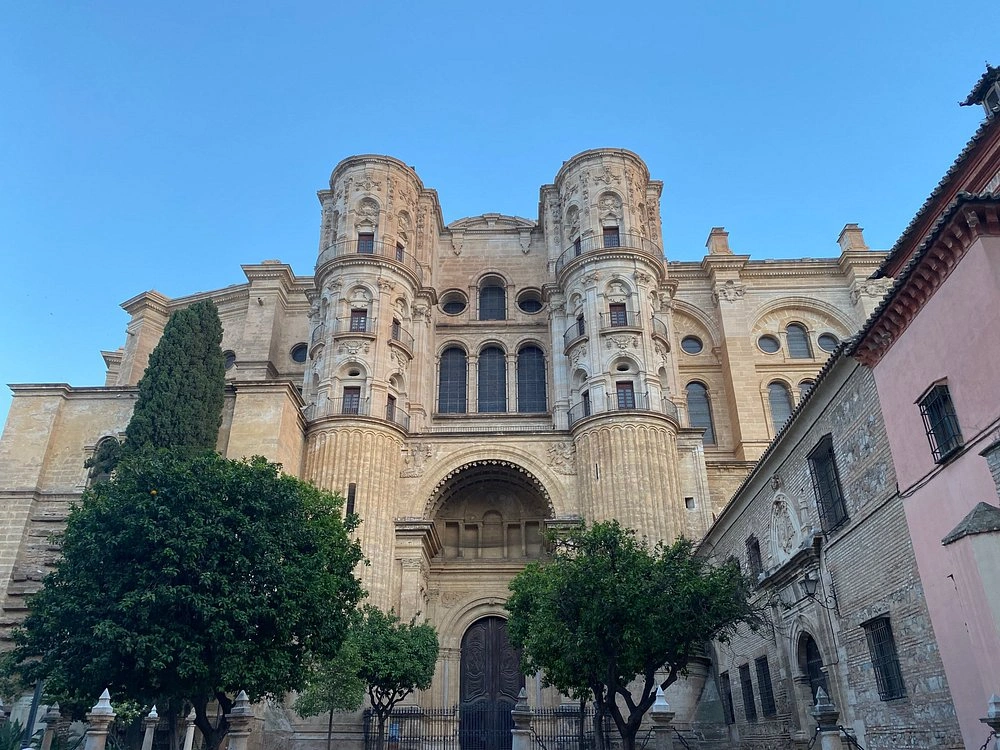
The Holy Cathedral Basilica of the Incarnation is the cathedral of Málaga, Spain. Located opposite the Plaza del Obispo, the temple is considered one of the most valuable Renaissance jewels of Andalusia . It stands within the boundaries of the now-vanished Arab wall, on the site of the original main mosque, the place where the Catholic Monarchs Isabella and Ferdinand ordered the construction of a Christian temple a few days after conquering the city in 1487. Its construction began in 1528 and ended in 1782, although it remains unfinished. The original Gothic plans evolved into a Renaissance project, with Diego de Siloé participating in the design. The cathedral is a synthesis of architectural styles, predominantly Renaissance, with the earlier Gothic elements of the original structure and Baroque additions from the early 18th century onwards. Until 2012, it was the second tallest building in Andalusia, surpassed only by the Giralda in its tower.The height of its vaults in Spain is only exceeded by the Cathedral of Palma, making the cathedral of Malaga one of the fifteen European churches with the highest naves.
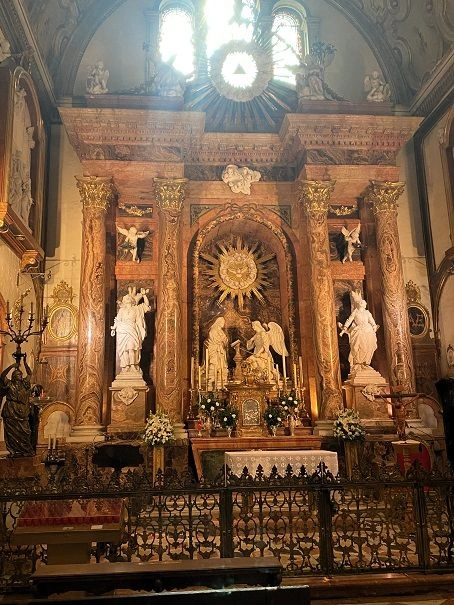
Construction on the Cathedral Church of the Incarnation in Málaga kicked off in 1528, right on the grounds where the old Great Mosque once stood. The architect Enrique Egas came down from Toledo with Pedro López, a master stonemason, and put together the first design report that same year. That was three years after the cathedral chapter had decided they wanted a new church. Pedro López actually took charge of building the apse, which was designed by Diego de Siloé one of the top masters back then. Work slowed down for a while, but in 1549, the cathedral chapter brought in Andrés de Vandelvira. A year later, they passed the project to Hernán Ruiz II. Both of these guys were big names in Renaissance architecture in Andalusia. After that, Diego de Vergara, who trained in Italy, took over, and later his son stepped in, too. They kept working on the cathedral almost until the 1600s. By that point, the apse and the sacristy were finished, and pretty much all the big names of the Andalusian Renaissance had left their mark on the place. The Cathedral was finally consecrated on August 3, 1588. Much later, on March 13, 1855, Pope Pius IX gave it the title of minor basilica. That makes it one of only three churches in the city with that honor, along with the Basilica of Hope (since 1998) and the Sanctuary of Victory (since 2007). The Spanish Civil War hit the Cathedral hard. Anti-clerical violence damaged a lot of religious buildings, and Málaga’s Cathedral wasn’t spared. They lost priceless works altarpieces, religious images, all sorts of liturgical items. The main structure survived, but places like the Chapel of the Blessed Sacrament (with its Alonso Cano altarpiece) took a beating. After the war, especially through the 1940s and 50s, they tackled restoration: bringing in altarpieces from other regions to fill empty chapels, reproducing lost works, and creating new ones. Some treasures made it through thanks to quick thinking like the Gothic altarpiece in the Chapel of Calvary, which stayed safe because someone walled up the chapel during the fighting.
Unfinished Cathedral
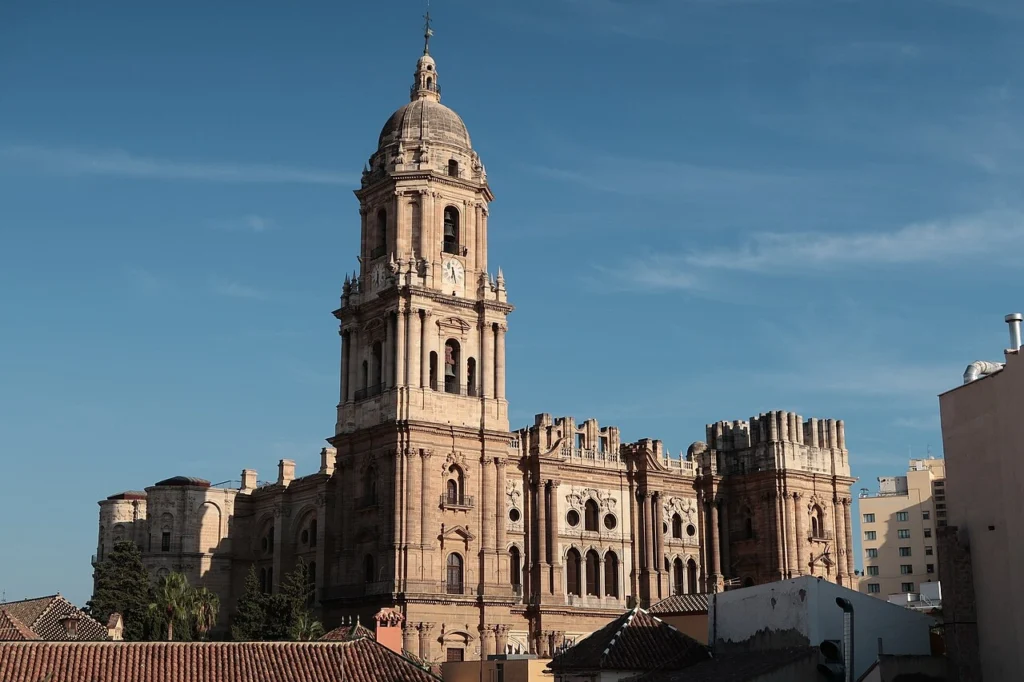
At the start of the 18th century, work on the Cathedral picked up again after nearly a hundred years of waiting. The architects José de Bada, Antonio Ramos, and Ventura Rodríguez worked under the direction of canon Tomás de Unzaga Amézaga y Paniza. They warned the other canons that if they didn’t finish the already-built sections, the whole thing could collapse. So, construction started up again, this time beginning from the current façade and moving back toward the oldest part, the section first opened in 1588. The project was massive, and money was a big problem. After the War of the Spanish Succession, the Crown slapped a tax on every ship arriving in Málaga, charging them for every arroba of cargo about 115 kilos. Thanks to this, and especially after 1776 when trade with the Americas started opening up (thanks to families like the Unzaga, Gálvez, and Molina), work sped up. But by the end of the century, the money ran out. King Charles III, through the Ortega Monroy brothers and canon Tomás de Unzaga Amézaga, redirected the funds. Instead of finishing the Cathedral, he sent the money to his brother, Luis de Unzaga y Amézaga, the governor of Louisiana, so it could help the Americans fighting for independence from England. Now, there’s a bilingual plaque that remembers this. It even led to a special connection between Málaga and Mobile, Alabama. The people of Mobile once offered to raise money to help finish the Cathedral as a thank-you. The rest of the port tax funds went to fixing roads to Vélez-Málaga and Antequera, bringing water to Málaga with the San Telmo aqueduct, starting the road to Colmenar, and supporting a mutual aid society for winegrowers mainly to help the widows and orphans of soldiers who had fought in the American Revolution.
So, the Cathedral stayed unfinished. One of its towers was never built people started calling it “La Manquita,” or “the one-armed lady.” The roof, main sacristy, central bell gable, sculptural decorations, and several other features never made it off the drawing board. The debate about finishing the Cathedral is still alive. It’s not just the missing second tower and the decorations the vaulted ceiling was never built, either. Because of this, the interior started to suffer serious damage after 2000. Moisture got in, bas-reliefs started falling from the vaults, and they had to put up safety nets. In 2009, the Regional Government of Andalusia carried out the first emergency repairs to the Cathedral’s roofs. Then in 2011, they created a Master Plan for the Cathedral, which led to more temporary repairs in 2015. The 2009 fix hadn’t worked; leaks came back, but at least the area opened to the public. The City Council, Provincial Council, and Málaga’s Bishopric all want to see the Cathedral finished according to the existing plans. For that, they’d need financial help from the Regional Government, though there’s also talk of a patronage plan with a 7 million euro budget. The master plan announced by the Bishopric in November 2016 calls for finishing the pediment, finally fixing the roof (which still lets in water), completing the balustrade, the tower, and the sculptures. There’s even talk of expanding the sacristy, though that would mean losing part of the Cathedral gardens. The aim is to get it all done in time for the Cathedral’s 500th anniversary. After more than two centuries of delays, finishing it would finally make it the Renaissance jewel it was meant to be.
Architecture of Holy Cathedral Basilica of the Incarnation of Malaga, Spain
Architect: Diego Siloe
Architectural style : Late Gothic Architecture, Renaissance Architecture, Baroque Architecture.
Burials : Angel Herrera Oria
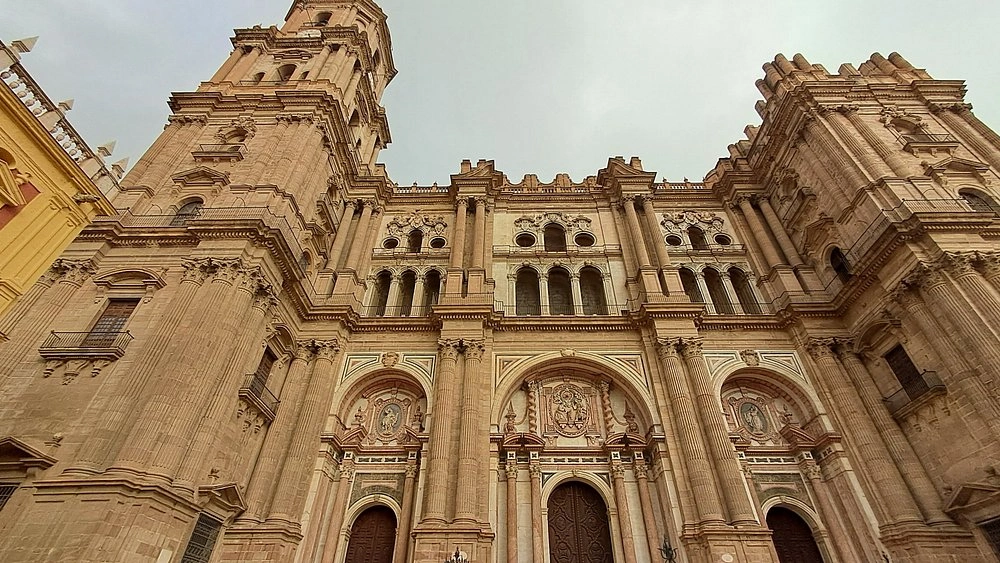
The central section of the façade is divided into two levels and three bays separated by monumental Corinthian columns erected on tall bases. On the lower level are three monumental arches, each flanked by a doorway with a reddish marble column. The main doorway is crowned with Solomonic columns. Above the doors are medallions. Those on the side doors depict the patron saints of Málaga, Saint Ciriaco and Saint Paula, while the central medallion represents the Annunciation of the Lord, a work sculpted in 1743 by the Baroque sculptor Antonio Ramos. The Renaissance portals of the transept are flanked by unique turrets with balconies, one of the finest examples of Malaga stonework. These portals feature a semicircular doorway with archivolts resting on capitals and a body with three niches: the central one round-arched and the lateral ones lintelled, displaying an interesting Palladian composition. The beautiful Portal of the Tabernacle, with its round-arched arch between a row of columns, has a curved pediment with the episcopal coat of arms in its tympanum; the side walls showcase the grandeur of their buttresses, topped by classical cornices and two tiers of windows.
Apse
The 16th- century apse of the church is large and undecorated, creating an impression of solidity. Below, triple arches are visible, while above, single arches are flanked by round windows. This allows ample natural light to enter the interior, filtered through stained-glass windows.
North Tower
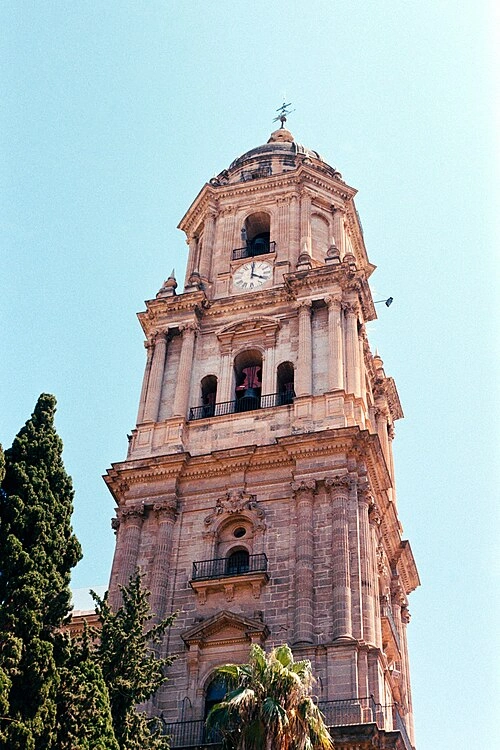
The north tower rises to a height of 84 meters, or 92 meters if measured to the harpoon. Located to the left of the main façade, its first two sections have the same proportions as the two levels of the central structure. The third section features a triple arcade on all four sides, housing the 14 bells, the 8 main ones of which were cast by the master bellmaker Francisco Venero in 1784. The cathedral has its own gardens and a beautiful orange tree courtyard reminiscent of the old mosque.
Inside
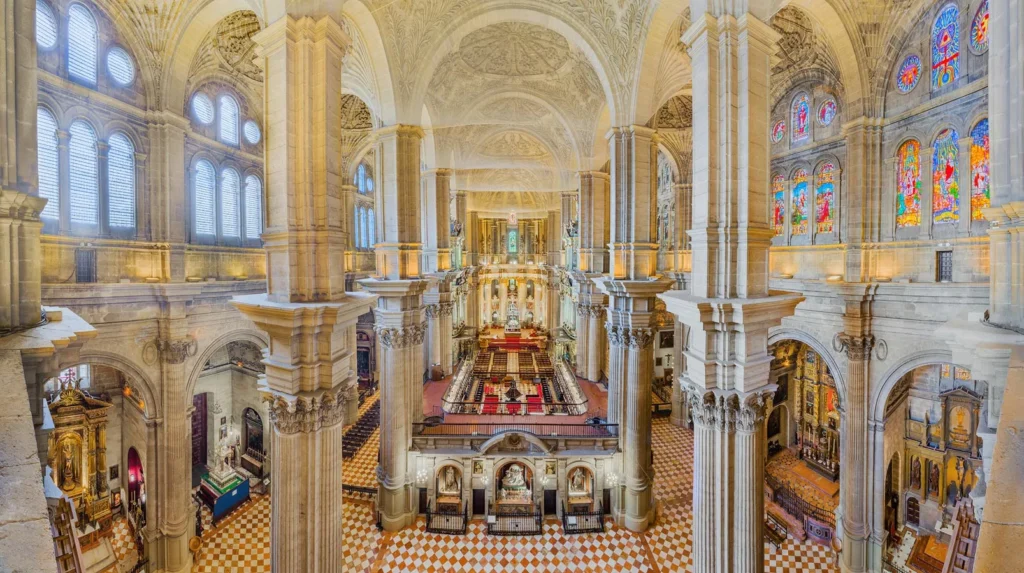
The cathedral has a rectangular floor plan and consists of three naves, the central one being wider than the side aisles, all of equal height. At 41.79 meters, its vaults are the tallest cathedral vaults in all of Andalusia. It has side chapels around the entire perimeter of the church except at the west end, with a prominent transept, ambulatory, and polygonal apse. The main altar, a semicircular work by Diego de Vergara from 1541, stands out, its walls pierced by tall windows set between fluted Corinthian columns and covered with a beautiful ribbed vault. The rest of the interior is covered by spectacular groin vaults, decorated with grotesques and palm motifs, where, in a display of mastery, new pillars are erected atop the existing ones in the center of the church to gain height, definitively abandoning the traditional Gothic stepped arrangement of the three naves.
Choir
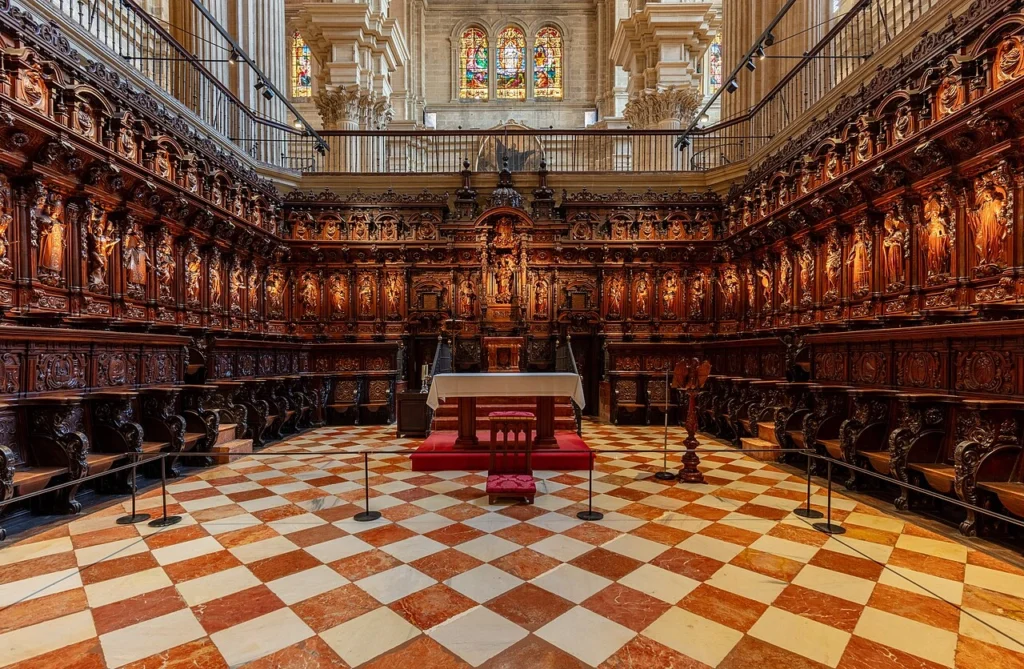
The choir is one of the cathedral’s most valuable spaces, a masterpiece of Baroque carpentry and one of the most dazzling works of the sculptor Pedro de Mena. However, several artists worked on the choir. In 1633, the Málaga city council contracted Luis Ortiz de Vargas, who designed the wooden structure of the complex and created some of the sculptures. Shortly afterward, José Micael Alfaro carved the apostles and some of the small busts of saints that adorn the choir stalls. Work was interrupted by his death in 1649. José Micael Alfaro imbued his sculptures with a stark dramatic quality, employing Mannerist techniques. In 1658, work resumed after the arrival of Pedro de Mena, who created forty-two high-relief figures attached to the backs of the choir stalls, in addition to the crowning of the choir. The expressiveness of the hands, the mysticism of the figures, and the gestures of his sculptures are exceptional.Above the sides of the choir stand the horizontal trumpet organs , the work of Julián de la Orden between 1779 and 1781. The cases were carved and designed by José Martín de Aldehuela, in harmonious composition with the rest of the church. They have more than four thousand pipes. The two organs are practically identical, except for the length of some of their pipes. They also differ in sound. Each organ has 3 keyboards and 64 stops.The choir screen is dominated by an altar where a beautiful Pietà, sculpted in marble by the Pissanis brothers, rests. In the side niches are venerated the carvings of Saint John and Mary Magdalene, created, like the images in the side chapels, by the 19th-century sculptor from Málaga , Salvador Gutiérrez de León.
Cathedral treasury
Several pieces and works of art are located in the temple. Among them are the Gothic altarpiece of the Chapel of Saint Barbara and the 16th- century tombs of the Chapel of Saint Francis, as well as valuable works by Juan Niño de Guevara, Claudio Coello , Alonso de Mena , Francisco Palma Burgos , and Enrique Simonet . The main chapel houses Mannerist paintings by the Italian artist César Arbasia .The Chapel of the Incarnation was designed by Ventura Rodríguez and carved from agate stone. It features a neoclassical altarpiece from 1785, the work of Juan de Villanueva and carved by Antonio Ramos y Aldehuela, with sculptures by Salazar and Palomino. It houses the tombs of Bishops Bernardo Manrique and Molina Lario. The Chapel of Our Lady of the Rosary houses a painting by Alonso Cano, made in 1665, in which the Virgin gives a rosary to Saint Dominic.
Visit to the decks
On May 12, 2015, after a process of adaptation and construction of walkways, access to the Cathedral’s rooftops was opened to the public. The guided tour lasts approximately one hour, with about 30 minutes spent at the top, offering panoramic views of the city, including the Alcazaba, Gibralfaro Castle, and the cathedral’s roof and tower. Nighttime tours are also available in the summer. Tickets can be purchased at the Episcopal Palace, Plaza del Obispo, or at the ArsMálaga ticket office. In March 2016, new information panels were installed on the decks to inform visitors.
Church of the Tabernacle
The main mosque of Málaga had its entrance on what is now Císter Street, where the Church of the Sagrario now stands. When King Ferdinand and Queen Isabella conquered Málaga, they ordered the Islamic temple to be converted into a Christian church. The Gothic portal through which the church is accessed is the oldest part of the building. It is believed to have been opened in 1498 at the base of the minaret of the old mosque, under the orders of the first Bishop of Málaga, Diego Ramírez de Villaescusa. The portal is a masterpiece of Isabelline Gothic architecture. In 1487, the Catholic Monarchs captured the city, and six months later the Great Mosque was consecrated as Santa María de la Encarnación (Saint Mary of the Incarnation). Its small size led Bishops Diego Ramírez de Vinuesa and César Riario to build a larger mosque, of which only the north wall door of the Sagrario (Tabernacle), known as the Puerta del Perdón (Gate of Forgiveness), remains. This Gothic door dates from the 16th century. The rest of the building is Islamic and Mudéjar in style, although it underwent extensive renovations in the 17th century, after the completion of the first phase of the current Málaga Cathedral. The portal of the Tabernacle stands out from the rest of the façade. Framed by pinnacles, it is essentially iconographic and narrative, laden with altarpieces and vestments from the period, as explained by the Cathedral’s Building Surveyor, Fernando Ramos de Rivas. “The Virgin Mary is depicted on the right, and on the left, the Archangel Gabriel. This represents the moment when the Word became flesh, and it is highly symbolic. The name that the Catholic Monarchs gave to cathedrals after the Reconquista, the Annunciation or Incarnation, is a distinguishing element with respect to Islam.” The precursors of the Church are located in the four archivolts, and above the keystone of the arch is God the Father, omnipresent, with a scepter and an orb in his hand. To the left is the coat of arms of Cardinal Riario, and to the right, the cardinal’s seal. At the top are sculpted figures from the Reconquista, such as Cardinal Mendoza with an angel on the left; On the right is the first bishop of Málaga, Pedro de Toledo y Ovalle, who was a canon of Seville Cathedral and almoner to the Catholic Monarchs, depicted “assisted by the apostle and standard-bearer of the Reconquista, Saint James.” Above the arch, one can discern “a stone that was a Virgin of the O, a Virgin in a state of good expectation.”
Construction was halted because, according to engineer Ramos, they realized they were building the cathedral from north to south, “when every monotheistic temple is oriented from east to west; moreover, the style was already outdated, as the Renaissance was prevalent in the rest of Europe.” Thus, what was intended to be the Cathedral of Santa María de la Encarnación became the Church of Santa María, and later the first parish in the city center, until the center became depopulated and its parishioners were incorporated into the Church of Santiago, where the Cathedral Chapter even relocated when the second phase of construction made the original church uninhabitable. Beyond the Gate of Forgiveness, in the gardens of the Tabernacle, formerly the ablutions courtyard, the sgraffito façade displays Marian symbols that have sometimes been misinterpreted. A solitary stone depicts another Annunciation, and near the main entrance is the cathedral’s first sundial. Today, the Tabernacle is considered just another chapel. Inside, Masses are celebrated beneath the plaster vaults, designed by the architect Zuzurrunzaga, which conceal the original Mudéjar wooden structure. The altar dome is Renaissance in design with Baroque muqarnas, as the last alterations date from the 18th century. It was then that the minaret of the tower was demolished, and a century later, in 1862, the seminary and the choir school attached to the church also disappeared. It still remains and you can see the outline of its structure on one side, which connected the Bishopric to the original cathedral.That same year, on the occasion of a visit by Queen Isabella II, the steps leading to the Sagrario church on Santa María Street were removed, “because the royal motorcade couldn’t fit through the passageway, and the portico looked like an altarpiece hanging on the wall,” Ramos explained. The stone steps weren’t reinstalled until 1954, but the traffic made it difficult for pedestrians to pass. In the 1990s, Mayor Celia Villalobos permanently closed the street to traffic. The Tabernacle and the entire cathedral complex, built upon foundations steeped in history, “including, it is thought, the remains of a Visigothic church,” are listed as Cultural Heritage Sites. The portal underwent a 19th-century restoration using hot micro-ceramics that have flooded the stone, which is also eroded by humidity, as an underground river from the Montes de León region flows beneath the foundations. In 2020, during a series of surveys being carried out on the foundations of the temple, Paleochristian remains were discovered, confirming a Christian presence in the vicinity of the cathedral from a very early date.
Cataloging
Asset of Cultural Interest, Monument category, according to Law 16/1985 of June 25. Declared a Historical-Artistic Monument on June 3, 1931.
Cathedral Chapter
The Cathedral Chapter is the governing and administrative body of the Cathedral. It is composed of priests of the diocese with a certain standing or seniority, sometimes holding positions in the curia or serving as parish priests of the main churches; these are appointed by the bishop. Among its functions is attending to the spiritual needs of the faithful who visit the Cathedral, with its members responsible for liturgical celebrations. This chapter is headed by the Dean-President, appointed by the diocesan Bishop upon the chapter’s recommendation. The Dean is the representative of the Chapter and, therefore, is the highest-ranking official directly responsible for the Cathedral, overseeing its upkeep and maintenance. The Chapter of Málaga Cathedral is currently composed of 20 canons, including the Dean-President, Alfonso Fernández-Casamayor Palacio.
Feast Day
Feast Day : 25 March
The Holy Cathedral Basilica of the Incarnation of Málaga (Santa Iglesia Catedral Basílica de la Encarnación) celebrates its patronal feast on 25 March, the Feast of the Incarnation, which coincides with the Solemnity of the Annunciation. This feast commemorates the angel Gabriel’s announcement to the Virgin Mary and is marked by special liturgical celebrations in the cathedral.
Church Mass Timing
Monday to Friday : 9:00 AM, 10:00 AM.
Saturday : 9:00 AM, 10:00 AM, 6:30 PM.
Sunday : 9:00 AM, 10:00 AM, 11:30 AM, 1:00 PM, 6:30 PM.
Church Opening Time:
Monday to Friday : 10:00 AM, 8:00 PM
Saturday : 10:00 AM, 6:00 PM
Sunday : 2:00 PM, 6:00 PM
Contact Info
Address: Malaga Cathedral
C.Molina Lario, 9, Distrito Centro, 29015 Málaga, Spain.
Phone : +34 617 50 05 82
Accommodations
Connectivities
Airway
Holy Cathedral Basilica of the Incarnation of Malaga, Spain, to Málaga‑Costa del Sol Airport, distance 16m (10.9 km) via Autovía de Circunvalación de Málaga.
Railway
Holy Cathedral Basilica of the Incarnation of Malaga, Spain, to Málaga María Zambrano, distance between 9m (2.2 km) via Av. de Andalucía.