Introduction
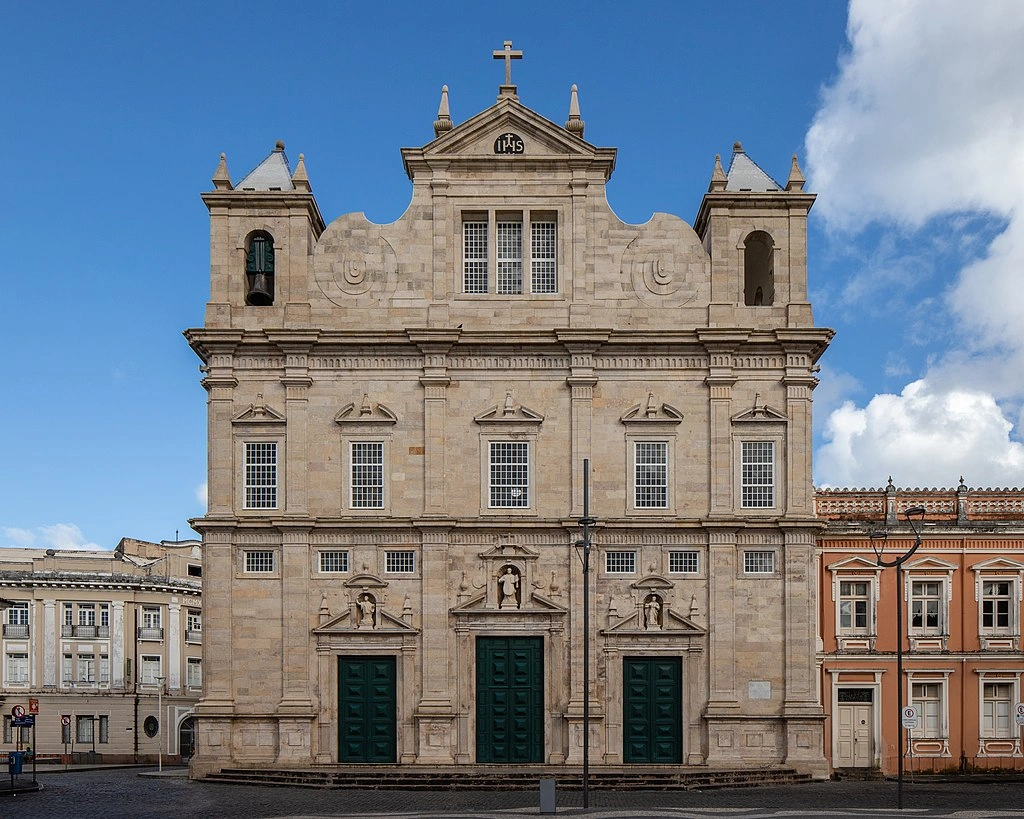
The Cathedral Basilica of Salvador, officially known as the Primatial Cathedral Basilica of the Transfiguration of the Lord, is one of the most iconic landmarks in Salvador, Bahia, Brazil. It serves as the seat of the Archbishop of Salvador, who also happens to be the Primate of Brazil basically the highest-ranking church official in the country. This grand structure wasn’t originally built to be a cathedral. It was actually part of a massive Jesuit college and religious complex, built by the Society of Jesus. The church we see today was consecrated way back in 1654, right on the same spot where the Jesuits first set up. But things changed in 1759, when the Jesuits were expelled from Brazil. Their church and school were handed over to the local archdiocese. Then in 1933, the original cathedral of Salvador which stood elsewhere was torn down to make way for a tram line. Instead of building a brand-new one from scratch, the Archbishop at the time, Augusto Álvaro da Silva, decided to elevate the old Jesuit church to cathedral status. That’s how this building became the cathedral we know today. Architecturally, it’s a masterpiece. The building is known for its Mannerist style, and if you’ve ever seen the Jesuit Church in Coimbra, Portugal, you’ll notice a strong resemblance. The façade is built from Lioz stone, a type of limestone imported straight from Portugal. Inside, the cathedral is stunning a large nave, richly decorated Baroque-style side altars, a historic sacristy, a library, and even an ossuary. It sits right in the heart of Salvador’s historic center facing the open plaza called Terreiro de Jesus, with Praça da Sé just nearby, and the Bay of All Saints shimmering in the background. The whole area is part of the UNESCO World Heritage Site, and the cathedral is definitely one of its crown jewels. More than just a historic monument, this cathedral is very much alive it’s the central church of the Archdiocese of São Salvador da Bahia, home to the Parish of the Transfiguration of the Lord, and where the archbishop leads the most important liturgical celebrations. It holds a special place not only in the city’s skyline but also in its religious and cultural identity.
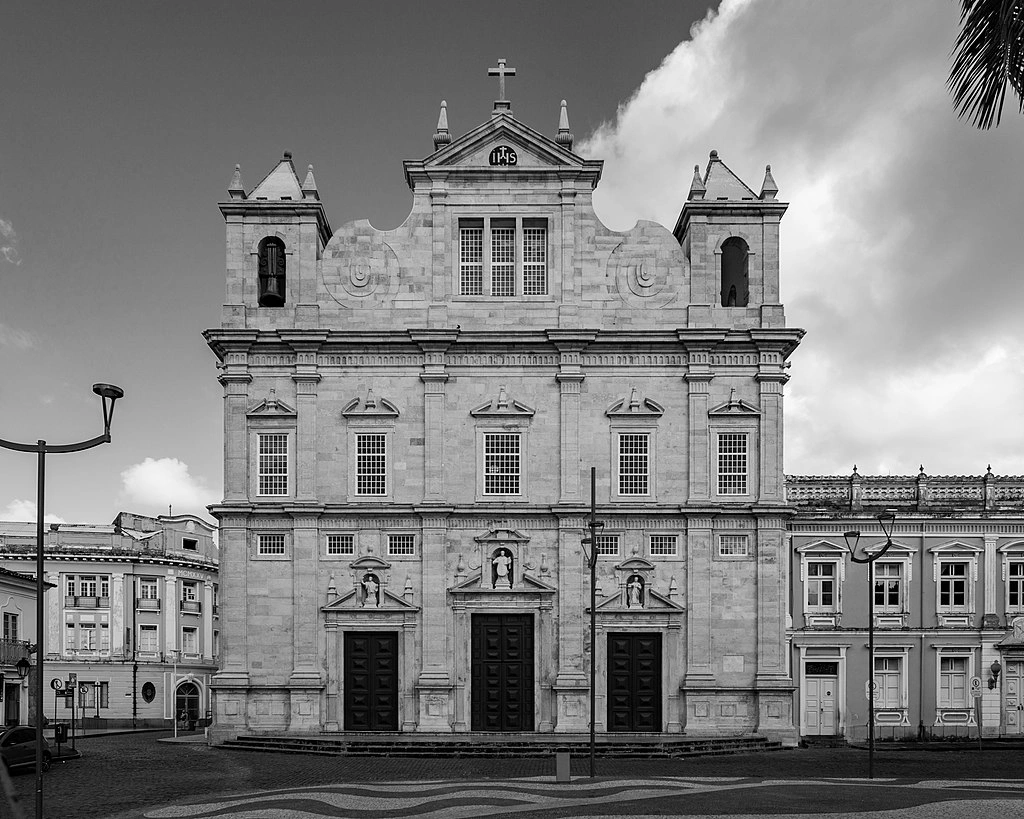
The Jesuits arrived in the city in the 1549 and planned a Jesuit college under Father Manuel da Nóbrega (1517-1570). The Diocese of São Salvador da Bahia de Todos os Santos, the first in the Portuguese colony of Brazil, was created in 1551, only two years after the founding of Salvador by the Portuguese nobleman Tomé de Sousa. The first bishop, Pero Fernandes Sardinha, arrived in 1552, and a Jesuit college was established in 1564. The Colégio de Jesus (School of Jesus) was completed in 1585 through the financial support of the first governor-general of Bahia, Mem de Sá. Separately, a cathedral was built in the centre of Salvador around this time. Three Jesuit church buildings were erected on the site of the present-day cathedral, the final being destroyed during the Dutch occupation of Brazil.
Dutch occupation
The Dutch, upon their entry into Salvador in 1624, stripped the interior of the Jesuit college of its silverwork and a relic reportedly used by St. Francis Xavier. The Dutch used the Jesuit chapel as a warehouse to store barrels of wine confiscated from the city. Salvador was reoccupied by the Portuguese in 1625, but the church and most buildings of the city were heavily damaged and remained under siege by the Dutch until 1654.
Reconstruction of Jesuit complex
The Jesuits gathered to build a fourth church, the present structure, in 1654. The cornerstone of the present structure was laid in 1657 at a grand ceremony and mass attended by Governor-General Jerónimo de Ataíde, the Conde de Atouguia (1610-1665) and numerous government and military figures. The mass was celebrated by Father Simão de Vasconcelos. The structure was completed in 1672. Its frontispiece dates to 1679 and its steeples were completed in 1694. The images of Saint Ignatius, Saint Francis Xavier, and Saint Francis of Borja were placed on the frontispiece in 1746. Housing for three religious communities, the father, the Escolásticas, and the Brotherhood; a smaller chapel; a refectory and kitchen; a novitiate; and a small school were completed soon after the opening of the church. The religious community numbered approximately 150, as evidenced by the seating of the domestic chapel. The novitiate was moved to the lower city in 1728 to the present-day Casa Pia and College of the Orphans of Saint Joachim.
Expulsion of the Jesuits
The Jesuit Order was expelled from Brazil by a Royal Letter dated August 28, 1759. The college was besieged by soldiers and all its inhabitants, including priests, students, and brothers, were detained on December 26, 1759. It was one of the final acts of Governor Marcos de Noronha before the arrival of the new governor from Portugal, Antônio de Almeida Soares. Soares moved the entire community of Jesuits on January 7, 1760 into the domestic chapel of the college and sealed the doors and windows. The members of the community, now prisoners, were taken by armed soldiers to Novitiate of Jiquitaia in the lower city; other troops guarded the route to ward off observers. The community was held until April 18, 1760, when they boarded two boats. The Jesuits were taken to either dungeons in Lisbon or dispersed to pontifical territories in Italy. Their church was transferred to the Archbishopric in 1765 under Manuel de Santa Inês.
20th century
The remains of the school of the Jesuits, north of the current structure, burned in 1905. The church became the only remnant of the Jesuit complex. The Jesuit school was replaced by the Medical School of Bahia, and a corridor was built to connect the school to the church. The Old Cathedral of Salvador, built in the late 16th century, was demolished in 1933 under Archbishop Augusto Álvaro da Silva (1876-1968) in order to construct a tram route in Salvador. The former Jesuit church became the cathedral of the city.
Restoration
In September 2018, the Cathedral was handed over to the public after a restoration process that lasted three years and eight months. The project involved the restoration of the thirteen altars, the paintings on canvases kept in the Cathedral, the tile panels, the atrium, the tile towers, the ceiling under the choir, the facade, the floor and also the tombstones of the graves, such as that of Mem de Sá (third governor-general of Brazil). This entire effort cost approximately seventeen million reais, a budget used for the fifty thousand gold sheets and five thousand silver sheets to restore the pieces, in addition to the labor. The work involved a multidisciplinary team of over one hundred and twenty professionals, who masterfully integrated traditional and contemporary techniques and materials to restore the Cathedral and its collection.
Location
The Cathedral Basilica of Salvador is located on the edge of the bluff of the historic center of Salvador. It façade faces west and church doors open to the wide Terreiro de Jesus, a public square. The cathedral looks directly towards the Church of Saint Dominic at the opposite end of the square; the Medical School of Bahia and church Church of Saint Peter of the Clergymen to the north of the square; and 19th-century sobrados at the south of the square. The rear of the church faces the Bay of All Saints and the lower city. The cathedral is connected to the Medical School of Bahia by a corridor. The medical school dates to the early 20th century, and replaced the burned-out school of the Jesuits, once part of the church complex. The southern façade of the cathedral was connected to the Old Cathedral of Salvador until its demolition in 1933. The Praça da Sé, a broad square, was built after the demolition of the cathedral and the south façade of the Cathedral Basilica of Salvador, obscured for many centuries, looks onto the square.
Architecture of Primatial Cathedral Basilica of the Most Holy Saviour, Salvador, Brazil
Architectural style: Baroque architecture.
Façade
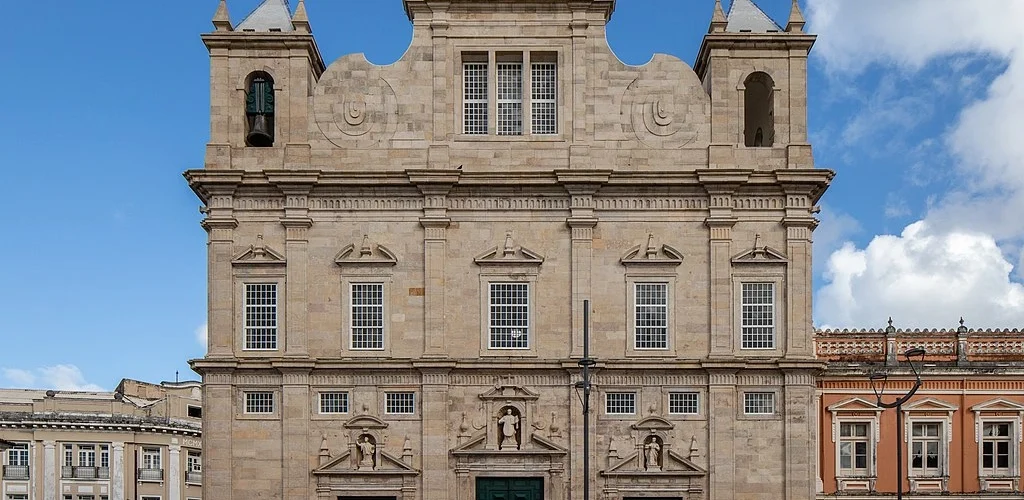
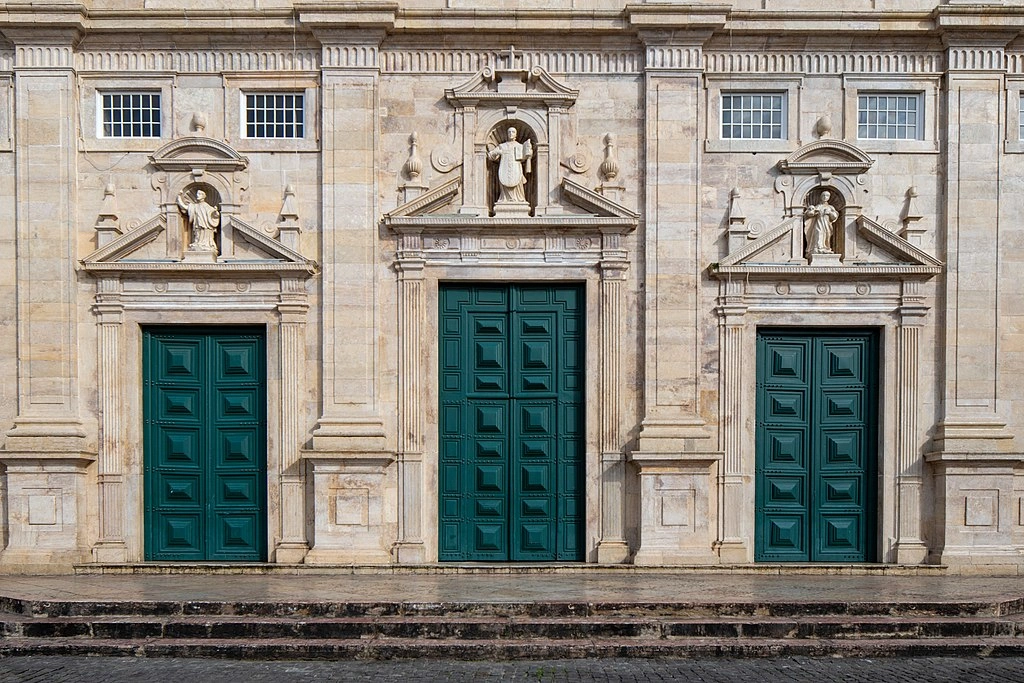
The façade of the cathedral, though constructed during the Baroque period, is predominantly Mannerist in style, reflecting the architectural trends fashionable in Portugal at the time. Its design closely resembles that of contemporary Portuguese Jesuit churches, such as the Jesuit Church of Coimbra. Constructed using light Lioz limestone imported from Portugal also seen in the Basilica of the Immaculate Conception in Salvador’s lower city the façade presents an austere yet monumental appearance. It is vertically divided into five modules by pilasters, creating a structured and rhythmic composition. The three central modules feature portals topped by pediments containing niches with statues of prominent Jesuit saints: Saint Ignatius of Loyola, Saint Francis Xavier, and Saint Francis Borgia. Above the doors, small rectangular windows offer light to the interior, maintaining the geometric balance of the design. A broad cornice separates the lower section from the upper level, where five smaller windows, also crowned by pediments, mirror the vertical divisions below. The uppermost level is formed by a pediment pierced by a square window, and it is crowned by a cross, pinnacles, and flanked by two large Mannerist volutes a hallmark of the style. At both ends of the façade rise two short bell towers, each topped with prismatic spires, reinforcing the symmetrical and restrained elegance of the overall design
Interior Layout
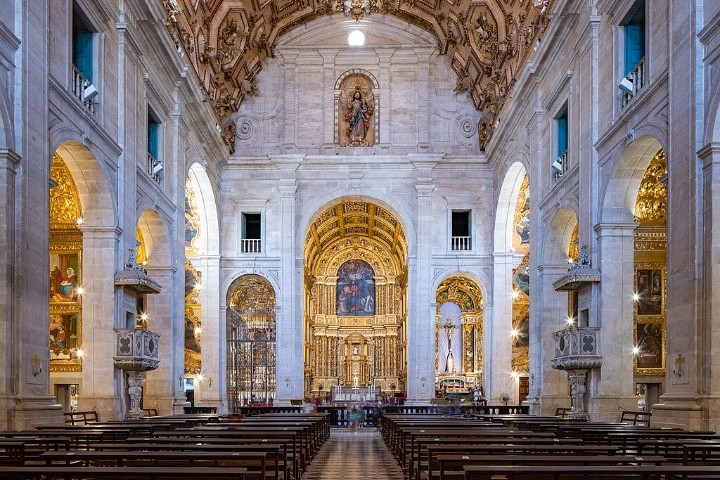
The Cathedral Basilica of Salvador is a one-aisled, rectangular church without a transept and features a very shallow main chapel. Its interior, like the façade, is lined with imported lioz stone from Portugal. The side walls contain a series of lateral chapels decorated with altarpieces. This floorplan follows the design of the Church of São Roque in Lisbon, the Jesuit mother church built a century earlier. The nave includes a deep central altar, two lateral chapels, two transept chapels, and three chapels along each side, reflecting a rich architectural history spanning several centuries.
Chapels and Artistic Styles
The cathedral’s chapels showcase an impressive range of altarpiece art from the late 16th to mid-18th centuries, decorated with sculptures and paintings. Particularly rare are two 16th-century Renaissance altarpieces reused from the earlier Jesuit church. The main chapel’s altarpiece, dating from 1665–1670, is a prime example of 17th-century Mannerist art, created by Brother João Correia and his assistants. Many other chapels feature Baroque altarpieces from the mid-18th century. The nave’s barrel vault ceiling is adorned with 18th-century wooden panels painted with vibrant Asian-inspired motifs by Jesuit artist Charles Belleville, who spent ten years in Macau before coming to Bahia. A large central emblem displays the Jesuit monogram IHS (Iesus Hominum Salvator).
Baptistery and Influences
The original Jesuit church lacked a baptistery, as it was not a parish church. The baptismal font currently in the cathedral was transferred from the former See Cathedral prior to its demolition in 1933. The Jesuit church’s façade and floorplan served as models for other colonial churches in Northeast Brazil, including the notable São Francisco Church in Salvador. Beneath the high altar lies the tomb of Mem de Sá, the third governor-general of Bahia.
Sacristy, Nave, and Altars
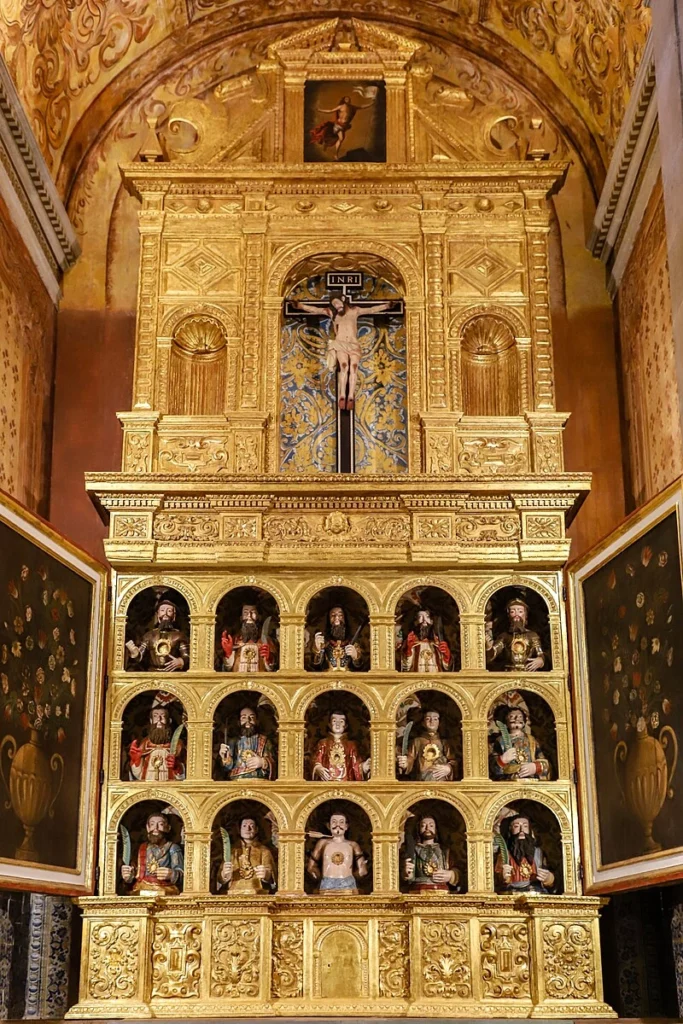
The cathedral contains a single nave, a chancel flanked by two small chapels, two chapels in the transept, and additional chapels along the nave. The decoration of the secondary chapels is varied and was renovated multiple times between the 17th and 18th centuries, evolving towards Baroque style. Notable artists include woodcarver João Correia, painters Domingos Rodrigues and Eusébio de Matos, and the Trigueiros brothers. The chapels of Saint Ursula, Saint Francis Xavier, and Saint Ignatius of Loyola have retained their original layouts. The main altar features richly carved colored marble from Portugal and Italy, and is one of the few remaining Mannerist altars in Brazil.
Notable Chapels and Decorations
In 1670, a dressing room was added above the main altar to display the Blessed Sacrament, decorated with panels by Brother Domingos Rodrigues depicting Saints Ignatius and Francis Xavier. The Chapel of Saint Francis de Borgia, completed in 1696, was funded by the sale of a donated farm. Above the transept arch, an image of Christ the Savior was installed in 1746. To the left of the chancel, the Chapel of the Blessed Sacrament holds precious items transferred from the old cathedral, including a diamond-studded gold and silver reliquary and silver altar plates. The Chapel of Our Lady of Sorrows on the right has undergone alterations but retains important carvings and statues. The transept chapels, comparable in size to the chancel, feature monumental Baroque altars installed in 1754, dedicated to Saints Francis Xavier and Ignatius, with framed carved paintings on the walls and ceilings.
Relics and Ceiling Decoration
Many original artworks from the secondary chapels have been lost or relocated to the sacristy and the Museum of Sacred Art. Surviving relics include a silver-plated bust-reliquary of Saint Ignatius, a silver image of Our Lady of Wonders, and busts representing Saint Ursula and the Eleven Thousand Virgins. The nave ceiling is richly decorated with carved woodwork featuring Jesuit symbols, crowned by a large radiant medallion bearing the IHS monogram, the emblem of the Society of Jesus.
Baptistery and Sacristy
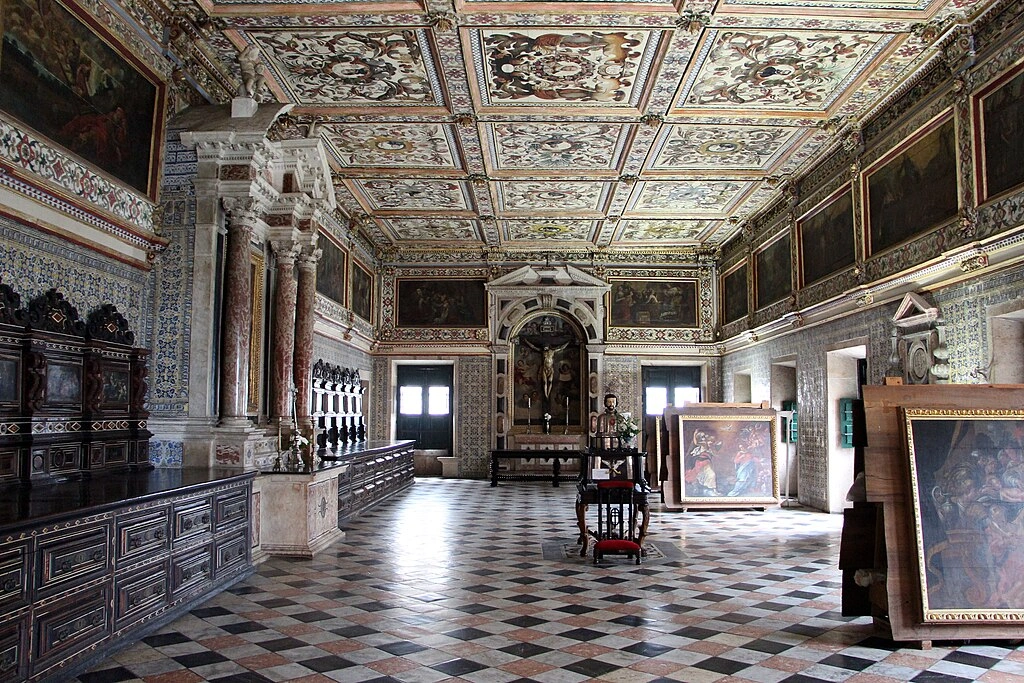
The baptistery of the church features a remarkable baptismal font carved from a single block of lioz limestone, showcasing both the craftsmanship and the symbolic importance of the space. Adjoining it is the sacristy, completed in 1694 and facing west toward the Bay of All Saints. Often referred to as “Brazil’s most exquisite”, the sacristy is a masterwork of Baroque art and architecture. An anonymous diarist in 1703 described it as having “walls, floors, and a ceiling of jacaranda wood with fine paintings; extraordinary furniture, cabinets and gilded closets; with true perfection of joinery.” Inside, three Baroque altars made from multicolored Italian marble serve as focal points. These are surrounded by large statues and paintings, while the walls are adorned halfway up with 17th-century Portuguese azulejos (painted tiles). A large rosewood chest, crafted by Luís Manuel de Matosinhos and Cristóvão de Aguiar, stands out for its intricate ivory and tortoiseshell inlays, and for its inset paintings attributed to the Dutch-Italian painter Gherardo delle Notti. Above this chest hangs a series of grand Old Testament paintings, and the coffered ceiling is richly painted with Mannerist floral motifs and portraits of Jesuit martyrs and apostles. Another highlight is a 17th-century sacristy cabinet with copper panel paintings depicting the life of Jesus, arranged around a central altar. Altogether, the sacristy embodies a harmonious blend of Portuguese, Italian, and Jesuit artistry, representing one of the finest examples of Baroque religious interiors in the Americas.
Museum of Sacred Art and Catacombs
Located above the sacristy, the church’s former library is now home to the Museum of Sacred Art. This area is accessed via a tiled passageway, leading to a space with a striking illusionistic ceiling painting attributed to Antônio Simões Ribeiro, depicting allegorical figures of Time and Fortune. The museum preserves and displays a rich collection of religious artifacts, contributing to the site’s cultural and historical significance. Beneath the main altar, a marble slab conceals a staircase that leads down to an ancient catacomb, a hidden chamber rediscovered during restoration efforts. Within the catacomb, and also in the Chapel of Saint Ignatius of Loyola, human remains were found, including thirteen skulls, offering a mysterious and poignant glimpse into the church’s long history.
Protected Status
Due to its immense historical, architectural, and artistic value, the Cathedral of Salvador including the museum, sacristy, and surrounding structures was declared a heritage site by Brazil’s National Institute of Historic and Artistic Heritage (IPHAN) in 1938. It was officially registered under the Book of Historical Works (Inscription 77) and the Book of Fine Arts (fls. 14), with the protection directive dated May 25, 1938. This designation ensures the preservation of one of Brazil’s most important colonial religious complexes for future generations.
Feast Day
Feast Day : 06 August
The feast day of the Cathedral Basilica of Salvador (Catedral-Basílica Primacial de São Salvador) is celebrated on August 6th. This date honors the Feast of the Transfiguration of the Lord, which is the dedication title of the Cathedral. Since the cathedral is named after São Salvador (Holy Savior), the Transfiguration where Jesus revealed His divine glory is the liturgical feast connected to the church.
Church Mass Timing
Thursday : 8:30 AM
Saturday : 08:20 AM
Sunday : 10:00 AM
Church Opening Time:
Monday to Friday : 09:00 AM, 12:00 PM, 01:00 PM, 04:30 PM.
Saturday, Sunday : Closed
Contact Info
Address : Primatial Cathedral-Basilica of Saint Salvador
Largo Terreiro de Jesus, s/n – CEP:, Salvador – BA, 40026-010, Brazil.
Phone : +55 71 3321-4573
Accommodations
Connectivities
Airway
Primatial Cathedral Basilica of the Most Holy Saviour, Salvador, Brazil, to Salvador International Airport, distance 25 min (24.7 km) via Av. Luís Viana Filho.
Railway
Primatial Cathedral Basilica of the Most Holy Saviour, Salvador, Brazil, to Tamburugy Subway Station Av. Luís Viana Filho, distance between 23 min (20.5 km) via Av. Luís Viana Filho.