Introduction
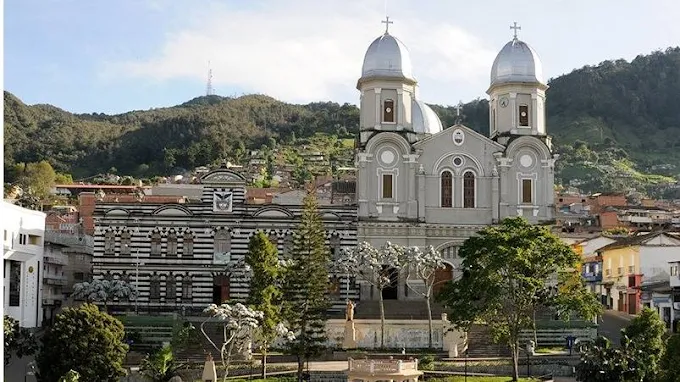
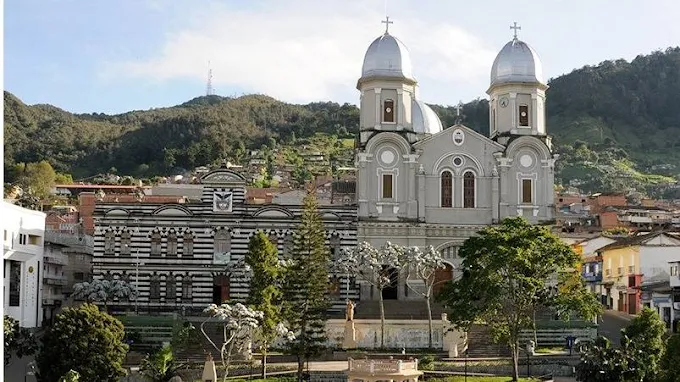
The Minor Basilica of Our Lady of Mercy is a Colombian basilica of Catholic worship in the municipality of Yarumal (Antioquia). It is the seat of the parish of the same name and belongs to the ecclesiastical jurisdiction of the diocese of Santa Rosa de Osos. The temple is dedicated to the Virgin Mary under the invocation of La Merced or Las Mercedes, being the patron saint, and San Luis Gonzaga is the owner. The basilica is in the Neo-Renaissance style and has a rectangular floor plan. Its interior is divided into three longitudinal naves: the main or central one and two lateral ones. The main façade is made up of two towers topped with domes, joined by a section that frames the central nave. The building was constructed to accommodate a larger temple on the site of the original Yarumal church. Begun in 1866, its construction faced numerous difficulties. The massive funding required for the project, the civil wars of the late 19th century, the collapse of part of the temple in 1890, and the 1938 earthquake delayed its completion until 1944, the year of its consecration. During its construction, the Chapel of San Luis (which originally housed the church of the old cemetery) served as the parish church. The church houses several artistic elements, among which the canvas of the Virgin of Mercy dating from 1789 stands out, possibly of Quito origin and considered miraculous. There is also the main altar in the form of a temple or half canopy, built in marble of various colors, it is 12 meters high and weighs 70 tons. Also noteworthy is the pavement of the testero, which has artistic drawings made in marble. In 1998, the Yarumal Municipal Council declared the temple of La Merced along with the chapel of San Luis (although that is how it is known, its real name is Chapel of Carmen), as real estate of cultural and architectural interest of the municipality. On August 12, 1999, Pope John Paul II granted the temple the title of minor basilica. Since 2000, the church preserves the remains of the poet Epifanio Mejía , author of the Antioquian hymn .
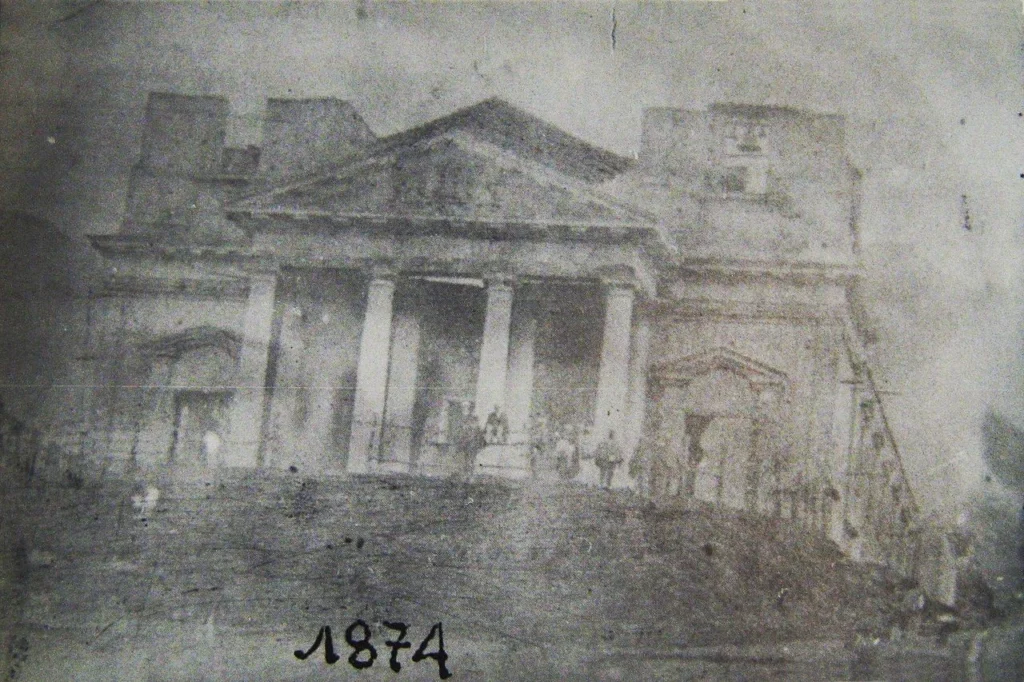
During the construction process, many difficulties arose. The devastation of the civil wars that Colombia suffered during the last quarter of the 19th century, the vast scale of the project and the massive funding it required, the collapse of part of the church under construction in 1890, and the 1938 earthquake all caused the church to take more than eighty years to complete.
Beginning and difficulties in the 19th century
Yarumal, originally named Saint Luis of Góngora, was founded in 1787. It had a straw chapel from the beginning, where the priests from Santa Rosa de Osos held religious ceremonies that the new population occasionally attended. In 1790, the parish of Saint Luis of Góngora was established (now the parish of Our Lady of Mercy). By 1850, it was obvious that a larger church needed to be built, as the town had 3,000 inhabitants and the old building was too small. On 20 December 1860, Father Julián Palacio gathered the townspeople in the square, informed them of this need, and urged them to provide all the help they could. He then formed the first committee to begin work on the church. In a meeting held on 15 January 1861, Father Julián Palacio suggested that they begin work on the church in April of the same year. In the same meeting, he authorised the first purchase of boards for the rammed earth walls so that they would be dry when they went into use. As it was a large project, people soon began to offer their services to work on the church. On 5 February 1861, Gregorio Álvarez offered his services as bricklayer and director of the work for two reals and three pesos a day. On the sixth of this month, Father Julián Palacio planted the first stone and began to raise funds. Meanwhile, a request was filed for the bishop from the Diocese of Antioquia to authorize construction. On 2 March 1861, the townspeople received a message back, providing the license for the new church. The bishop urged the committee to be as organized as possible so that construction would proceed smoothly, and so the board drafted seven chapters of regulations. The work was financed by alms, collections, mandatory contributions, raffles, bazaars, and the sale of farms that some benefactors had donated to the Church. On 4 July 1865, Santos Sánchez offered his services to direct the architecture and masonry work for five pesos a day, but was not approved. On this same date, a meeting was scheduled with Policarpo Rivera to make an offer to buy land with the intention of establishing a factory to supply tiles for construction. Rivera donated this land for free, as well as the rights to build a shed and use the mud, with the only condition that the land be returned when construction was finished. At the same time, the committee hired labor from some Sepultura villages’ lime kilns. On 25 August of the same year, José María Zapata Muñoz was hired to direct the architecture and masonry work, at a rate of four pesos a day, with the agreement that he would also provide paintings and statues. Four years later he was joined by Floro Hernández, and on 18 July 1869, by Francisco Arroyave and Francisco Puerta. On 2 April 1866, demolition of the old church was begun by Gregorio Álvarez. The land beneath the former church belonged to the parish and was adjacent to land belonging to the municipality, located north of Bolivar Square (today Epifanio Mejía park). Neither area had precisely defined limits. Both parties agreed to demarcate the properties much later.
On the same day the former church was demolished, Father Julián Palacio sent an official letter to the judicial vicar, Valerio Antonio Jiménez, which explained the need to demolish the former church in order to build the new one, and requested permission to build the Chapel of Our Lady of Carmen (now known as the Chapel of Saint Aloysius). The license for this arrived from Marinilla on 17 April 1866. On 1 July 1866, the Julián Palacio sent a request to the Ecclesiastical Government, explaining that as the former church had been demolished, the cemetery chapel needed to be expanded. Initially the former cemetery lot was to be sold to finance the new cemetery, but the villagers were enthusiastic to expand the chapel, and proposed that the money be used to buy the land in front of the chapel to form a small square. The application was approved by Monsignor Valerio Antonio Jiménez. On 14 February 1868, Pope Pius IX ordered the seat of the Diocese of Antioquia, which had operated there since 1828, to be moved to Medellín under the new name Diocese of Medellín and Antioquia. Yarumal Parish remained under its ecclesiastical control. With the chapel expanded and remodeled, Julián Palacio requested and was approved by Bishop José Joaquín Isaza Ruíz to bless the chapel where Mass was being held, since the main church was not yet finished. On 4 February 1873, the Diocese of Antioquia was restored, and the parish of Yarumal was returned to its jurisdiction. The seat in Medellín returned to simply being called the Diocese of Medellín. In 1876, construction was forced to a halt by the political–religious civil war from 1876 to 1877. The board made the decision to restart the church’s construction on September 1, 1881. They contacted architect José María Zapata to begin on 1 December, and hired Manuel Antonio Misas to provide six thousand bricks for 38 pesos. However, Misas and the board had their differences, and the agreement was canceled, with the board paying a fine of 24 pesos to avoid legal action. José María Zapata arrived in Yarumal from Medellín in the first week of December 1881 to take charge of the project, fulfilling his agreement with the board and with Father Aldemar Palacio (priest from 26 September 1875 to 5 August 1895) In June 1884, priest Uladislao Ortiz and Marco A. Mejía, sent the board a letter in which they requested approval to begin building the right tower of the church, without affecting the work being carried out within. They were approved to give 3,000 pesos, which was the approximate cost of the tower. This date marked the beginning of many problems, with construction constantly starting and stopping for reasons including more unrest, lack of finances, and the urgency of building a bridge over the Nechí River to join Medellín and the neighbouring villages.
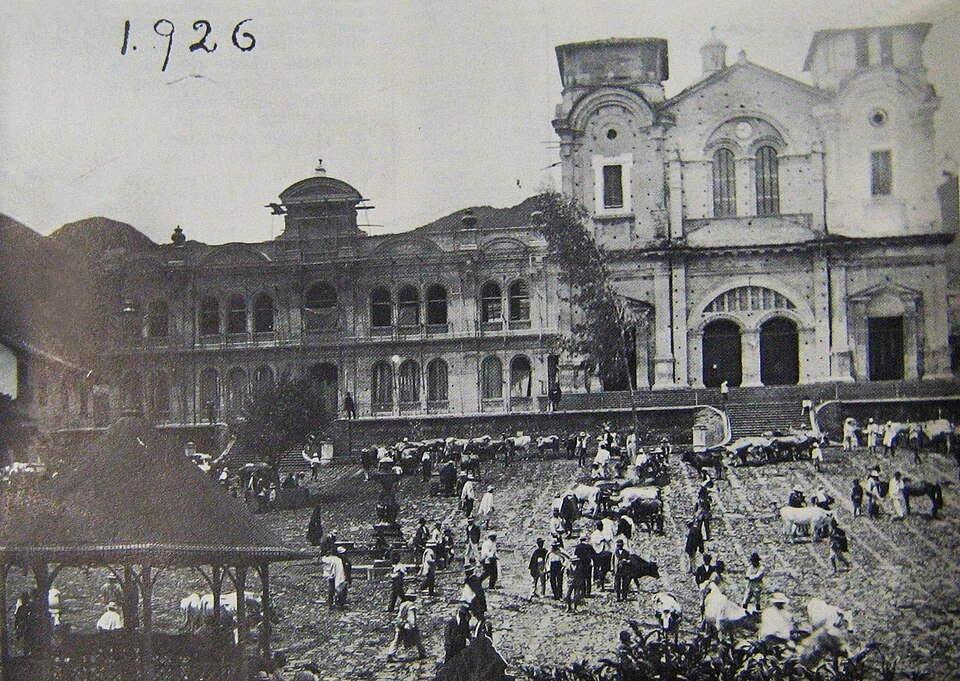
On 18 June 1889, when one of the sacristies was already finished, Bishop Jesús María Rodríguez authorised the priest to celebrate Mass and administer the Sacrament of Penance in the church while it was under construction. He ordered work to resume on August 17, the same year, during the pastoral visit. In addition, he approved the oratory and permitted religious services to continue while construction was finished. On 25 January 1890, the work was again stopped, this time because senior officer Ricardo Pérez and architect Zapata retired without prior notice. Several days later, José María Zapata Muñoz resigned as the director of construction, and on 6 February of the same year the portico and the dome of the temple collapsed while under construction. In a meeting on 15 February, the board accepted Zapata’s resignation. They thought the collapse might have been caused by one of two things: structural problems with the design or work breaks that made the construction unstable. This misfortune was not received well by the community, who blamed those in charge of the project. Following these complaints, the board called a public meeting on 17 February 1890 in which all members resigned, leaving the public free to elect new and more able members. The village people responded to this by urging the board not resign, after which the members decided to retain their positions. Two days later, the board met to assess the situation, select an architect to examine the building, determine what needed to be demolished, and assume responsibility for the work. Zapata never returned to Yarumal.The frame of the church was designed by Victoriano Palacio, and reviewed on 21 May 1894 by Tomás Vásquez, who found it satisfactory. However, because of the earlier collapse, the board resolved to have the project examined by an engineer. Until it was approved, all carpentry was to remain suspended. They concentrated on the tower’s construction in the interim. Heliodoro Medina hired Heliodoro Ochoa to evaluate the project because he was authorized to locate the aforementioned engineer. On 10 August 1894, a well-attended meeting was held. The engineer recommended not building the portico because of his concerns regarding its stability. The board and townspeople agreed that the portico not be built, and hired Ochoa to design the front face of the building. Ochoa later suggested that the rear of the church be roofed in wood, instead of the original stone dome. This proposal was approved by majority vote. After this, Ochoa examined the previous construction and found the carpentry and masonry work to be stable. But not all news was positive. The work was once more put on hold on February 21, 1895, due to difficulties collecting funds. The only ones who continued to work although at half speed were the masons, with goal of storing the materials until work was restarted. On the same date, all members of the board were asked to resign. Beginning on 4 August 1895, the work on the temple remained practically paralysed. Funds had run out, and left with no alternative, the board ordered the church be condemned on 12 October 1895. After seeing the state of the building, Father Ildefonso Tirado began to hold religious ceremonies in the new church on 11 May 1899 to try to encourage the population to donate. The Thousand Days War, one of Colombia’s bloodiest civil wars, began that year.
20th century
The 20th century seemed to begin with better luck. In February 1900, they began to build wooden grilles for the stained glass windows of the church. On 27 December of the same year, the Board authorised Díaz to begin work on the bell tower. On 15 February 1901, construction began on the wooden side doors; work on the main door did not begin until 20 July 1903. On 20 May 1901, the Daughters of María congregation installed the altar of the Immaculate Conception that they had commissioned with the board’s approval in 1898. Heliodoro Ochoa was brought back to Yarumal from Medellín to continue his work, and along with Juan Nepomuceno Gómez, worked on to create the latches for the bell tower and buildings. On 22 July 1901, Victoriano Palacio was chosen to direct the tiling of the church. The works were again stalled until July 1903, when they were once again resumed due to the Bishop of Antioquia, Manuel Antonio López de Mesa, visiting nearby. By this time, Victoriano Palacio had been commissioned to install the altar, work on the moulding around the door in the chancel, create two holy water fonts, and build the bell tower. The bishop was hurt to learn that work on the church had been put on hold and that they had resumed construction only because he was there. He put some of the blame on the board members, but he also blamed the war in part. Consequently, he decided to appoint a brand-new board and fire all board members. He also was quick to recognise that Yarumal needed two churches due to its population and importance, and ordered the newly established board to not only focus on work on the new church, but also on maintenance of the cemetery chapel. The dome, according to Ochoa’s calculations, needed a total of 210 large planks and 700 small ones, as well as 12 hundredweights of copper and 2 of tin. On November 22, José Mara Hoyos proposed putting up a temporary altar in one of the side naves with an image of Saint Joseph. On 6 January 1906, it was discussed and agreed upon that the tiling of the building would be started. In this same meeting, Carlos Mejía Vargas, backed by other doctors, said that due to health concerns, all religious ceremonies should be moved to the chapel in the old cemetery, and the priest agreed. The effects of the cheap materials became clear in June 1908. Ochoa was called upon as one of the towers began to exhibit structural issues. He responded from Medellín with some advice to repair the tower: primarily, to reinforce it with wood. On December 24, Ochoa arrived in Yarumal and went to the church’s construction site with the entire crew. The Board followed all the recommendations, except those suggesting the bells be taken down, believing that the changes that had been made in the tower provided sufficient support.
On 21 April 1914, priest Leónidas Lopera Roldán ordered construction to begin on the atrium under the direction of José López and Jesús María Saldarriaga, and with designs by Joaquín Pinillos. The following year, Roldán commissioned the altar, which for many years served as the main altar, from craftsmen in Carvajal. On 5 February 1917, Pope Benedict XV issued the papal bull Quod catholicae, which created the Diocese of Santa Rosa de Osos, splitting the former territory of the Diocese of Antioquia. After this, the Yarumal parish became a part of the new episcopal seat.In the night of 4 February 1938, an earthquake caused serious damage to the church. The walls were damaged, the foundation of the main arch in the central nave settled, and cracks formed in the apse. Father Gerardo Martínez Madrigal immediately requested technical advice from architects and engineers, who visited to inspect and undertake photographic studies. The evaluations produced very different results. The walls could be reinforced with iron strips, or they could be torn down and replaced with a new concrete arch supported by new columns, according to some. The pastor chose to make the repairs suggested by Jesús Mejía, which involved rebuilding damaged portions brick by brick. On February 11, 1944, Bishop Miguel ngel Builes dedicated the Church of Our Lady of Mercy following the completion of the repairs. In 1947, Father Francisco Gallego Pérez purchased by the first organ for the church, a Hammond organ for 7,000 pesos. It was delivered on 16 July, and was blessed on 14 September. Raul Bohórquez was hired by Efram Jiménez, the priest from 9 March 1953 to 24 March 1968, to use nickel silver to decorate the temple’s towers. Jiménez also obtained the current marble altar, which was consecrated on 7 June 1955 by Builes. He also bought the current church organ from Walcker Orgelbau of Ludwigsburg, Germany for 102,000 pesos. The Hammond organ was sold for 25,000 pesos to the Chapel of the Theological Seminary of Santa Rosa de Osos. Meanwhile, the cemetery chapel began to deteriorate; in 1992 Father Luis Enrique Restrepo Muñoz established a board to work to restore it as a historical site. On 23 November 1998, the municipal council of Yarumal declared the Church of Our Lady of Mercy, along with the Chapel of Saint Luis, to be architectural landmarks. On 12 August 1999, under the leadership of Father Gilberto Melguizo Yepes, the temple was given the title of Lower Basilica.The consecration was performed in a ceremony chaired by the bishop of Santa Rosa de Osos, Jairo Jaramillo Monsalve. Yepes also ordered the replacement of a church lamp that had fallen, and obtained the stained glass windows, three new bells, a new baptismal font, and the picture of Blessed Mariano of Jesús Euse Hoyos. The temple’s terrible-looking marble tiles were restored by him. Additionally, in an initiative by Yepes and the Municipal Council of Culture, in August 2000 the remains of poet Epifanio Mejía were moved from the San Pedro Cemetery in Medellín to the Basilica. The gravestone was designed by Martín Villegas Alzate of Yarumal.
Urban context
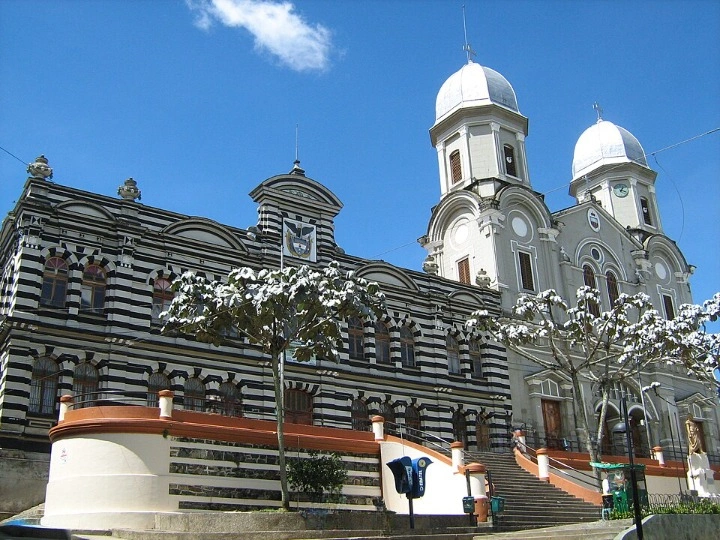
The basilica is located on the north side of Epifanio Mejía Park, in the founding area of the municipality, in the “El Centro” neighborhood. This park is full of historical and cultural symbolism, epicenter of the main religious and civic events of the municipality. Formerly called Plaza de Bolívar, in memory of the liberator Simón Bolívar, it was renamed in honor of the poet and composer of the Antioquia Anthem, the Yarumaleño Epifanio Mejía , whose remains lie in the temple. Yarumal is a municipality with about 34,865 people. It has three urban parishes: Nuestra Seora de la Merced, La Inmaculada, and El Carmen. It also has four rural parishes: Cedeo, Ochal, El Cedro, and Llanos de Cuivá. The temple remains the dominant structure in the urban landscape and an easily recognizable landmark because its municipal seat is comprised of 20 neighborhoods with buildings that typically do not exceed five floors. In addition, as the urban area is located on sloping terrain, and the basilica is on the upper part of the park, it acquires a visual effect of greater height, increasing its hierarchy.
There is a mix of housing, business, and service use in the vicinity of the park, the streets that surround it, and the land around it. Standing out next to the basilica are the Rosenda Torres School, a building designed by Belgian architect Agustín Goovaerts; the municipal palace; and several other architecturally significant buildings.
Architecture of Basilica of Our Lady of Mercies, Yarumal, Colombia
Architect : José María Zapata, Heliodoro Ochoa.
Architectural style: Renaissance Revival architecture.
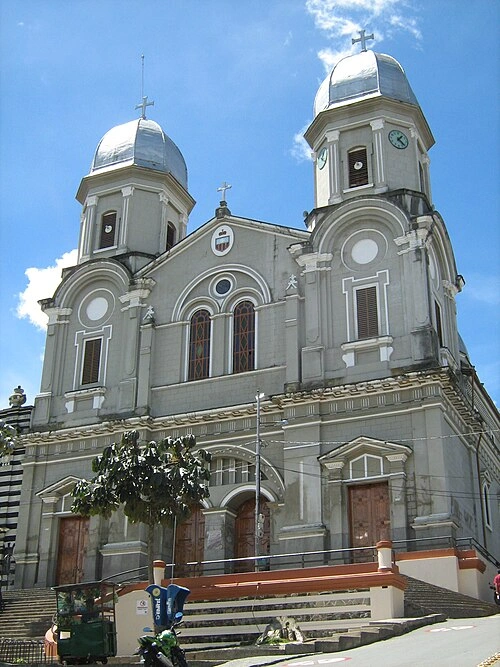
The basilica was built in the Neo-Renaissance style, one of the styles of Historicist architecture, developed mainly in the 19th and early 20th centuries , and which aimed to recover the architecture of times past. The building has a rectangular floor plan and its different spaces are clearly defined. It has three longitudinal naves (the main or central one and the lateral ones), in turn crossed by a kind of transept or transversal nave, which protrudes slightly at the sides, but without forming a cruciform floor plan. The meeting between the latter and the central nave generates the crossing over which the dome rises.
Exterior
On the exterior of the temple, the volumetry of the building is clearly identified with the layout and spatial composition of the interior; its shape allows the different bodies that compose it to be clearly distinguished. In addition, only the main and eastern façades directly face the public space, since the rectory is located at the back of the church, and the Rosenda Torres School is located on the western side, but neither of these buildings exceeds it in height. The main façade has a direct view of Epifanio Mejia Park on its north side. It is completely symmetrical, consisting of two towers topped with domes, joined by a body that frames the central nave. It has three entrances, one central and two lateral, each of which coincides with the longitudinal naves of the temple. The different sections of the temple can be seen on the side façade. The tower can be distinguished, followed by the longitudinal sections of the naves (the central nave and the lowest side aisle); then there is the transept wall, which has the same height as the central nave, and its eastern wall protrudes slightly from the side aisle wall. Above the transept, the dome can be seen, followed by the continuation of the naves. This façade has an entrance that leads directly to the right side aisle. Clay tiles are used to construct the church’s roof. The central nave and transept have a gabled roof, while the side aisles have a single-pitched roof.
Interior
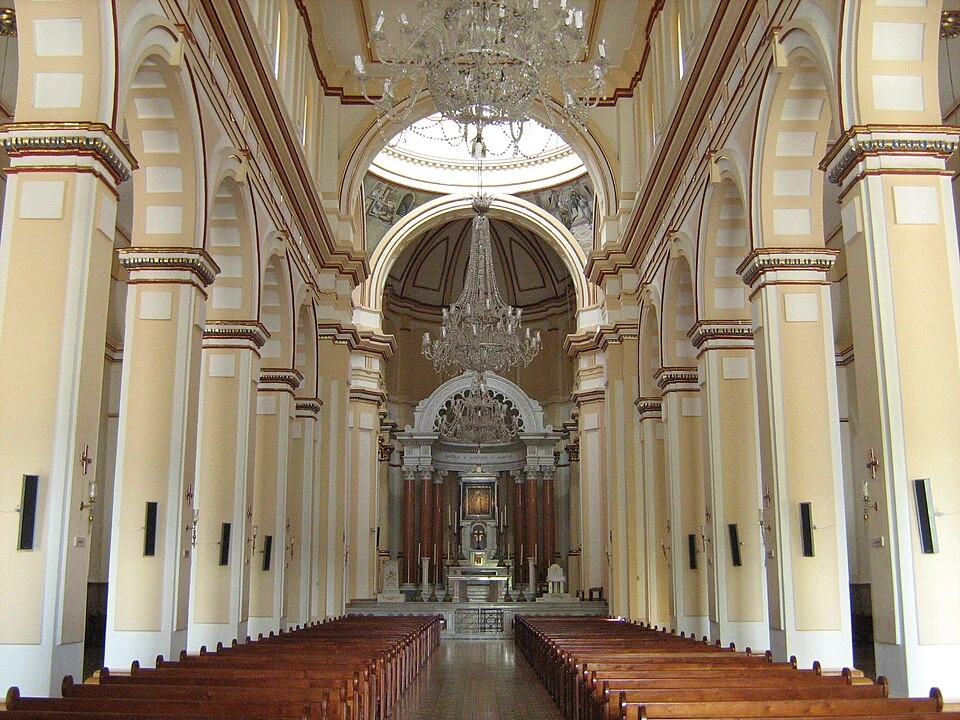
At the foot of the temple we find three areas, which precede or begin the naves, which are: the two areas that are under the towers and the sotacoro (the latter is the area located under the high choir); these three areas do not communicate with each other, since they are separated by walls, that is, the pronave is not formed as is usual in temples where the towers of the facade are aligned with the side naves. There are four paintings of the stations of the cross in the sotacoro, and there are also two paintings of the stations of the cross in the areas below the towers. The central nave is considerably wider and taller, and is separated from the side naves, between the sotacoro and the transept, by two arcades on each side, made up of two series of seven pillars each (14 in total), which are joined by semicircular arches . These pillars have a square base and are made up of a base, a body that would be like the shaft, and then, as a capital, it has a cornice on which the arches rest above these arches, in the upper part of the central nave, there is a wide entablature on either side, serving a purely decorative purpose. Above this, on either side, there are two series of six windows aligned with the axis of the arches, illuminating the room. The windows are located on either side of the nave, a flat ceiling that conceals the roof structure. Three massive and eye-catching crystal chandeliers hang from it. The transept area has a square floor plan and each side has the same width as the central nave, framed at each corner by four large pillars that support the dome raised by a drum with 8 windows through toral arches. The side aisles are almost the same length as the central nave, on their outer wall they have two series of 6 windows each longitudinally, separated by a decorative cornice, the lower series is larger and has artistic stained glass windows. On each side wall there are 4 paintings of the Stations of the Cross and two wooden confessionals.
On the south side of the right side wall there is an access door to the church. On the left side wall, also to the south, is attached the chapel of the Fallen Lord, and this in turn communicates, to the north, with the ossuary corridor and to the south with the stairs of the towers and the upper choir. The side naves also have a continuous flat ceiling, which hides the structure of the roof, and from which hang two glass lamps on each side. What has been called the transept or cross nave, as already mentioned, protrudes slightly to the sides, without forming a Latin cross plan. It opens east-west and has the same width and height as the central nave. The transept precedes the main area of the temple, which is highlighted by a marble communion rail (railing) and raised three steps. In addition, the area of the crossing next to the presbytery is raised another four steps, highlighting the altar area in the temple. Images can be found in niches on the transept’s western and eastern walls, as well as a number of windows that let light into the interior. In the western sector of the transept is the baptismal font, and in front of it, in the north wall, there is what apparently was an access that was converted into a kind of “large niche” that houses a high relief painting of the baptism of Jesus , and above it is a chrismon, a monogram of the name of Christ. Last but not least, the main temple areas are the presbytery and reserve altar chapel. The reserve altar, which was previously the primary altar, can be found in this chapel at the end of the right side nave. It is a rectangular enclosure that is raised four steps. Seven steps separate the presbytery from the rest of the temple. It is the main part of the central nave and has a vaulted apse that covers that part. In the presbytery are the altar in the form of a half baldachin, the sacrificial table, the parish priest’s seat, and the ambo, all in marble.
Materials and structure
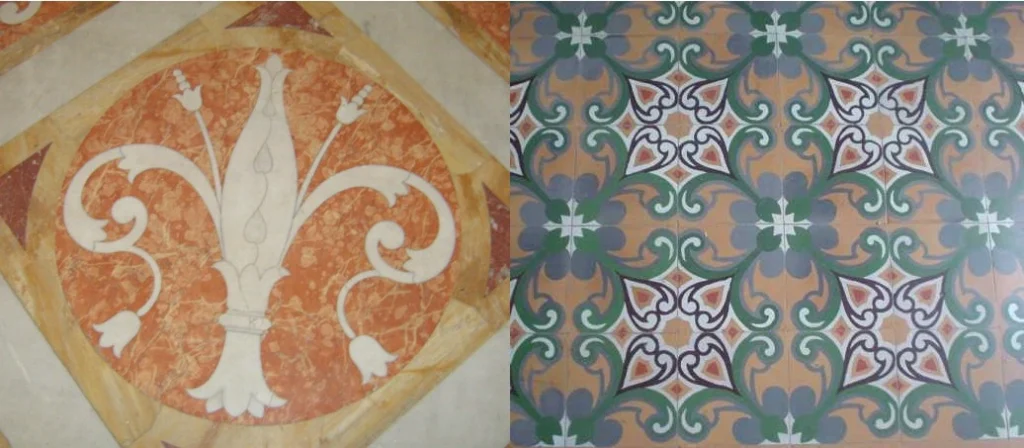
Much of the basilica is built of solid brick, and only some sections of the side walls are made of tapias, likewise, both materials are plastered both outside and inside, and the exterior plaster is characterized by simulating blocks of different sizes. The bricks were glued with mortar, a type of mortar made of lime (which acts as a binder), sand and water, which when dry acquires a hard constitution, but of less resistance and impermeability than cement; this material was used in the temple because at the beginning of construction cement-based mortars were not used. Despite this, the towers were rebuilt following the 1938 earthquake, and cement was used to glue the bricks this time because it was already a construction material in Colombia at the time. Structurally, the facades function as load-bearing walls that transfer all the weight to the foundations, which in turn transfer the weight to the ground. The nave pillars, which have a square base and measure 100 centimeters on each side, have walls that average 80 centimeters thick. The foundation was made of stone joined with brick.The roof of the temple is made up of a wooden structure and baked clay tiles. The main dome has a brick drum, and the rest is a wooden structure covered with copper sheets. The domes of the towers are also made up of a wooden structure covered with copper sheets. However, the fact that these sheets appear silvery on the outside is interesting. The pavement of the presbytery and the reserve altar, that is, the end wall of the temple, is made of marble of different colors. Except for the steps in the Yarumal temple, which are made of white marble, its design is similar to that of the Church of Bello and features fleur-de-lis designs and marble inlays. On the other hand, the pavement of the naves is made of pigmented cement tiles, also known as artisanal hydraulic tiles or hydraulic mosaic. These tiles combine to create a mosaic of phytomorphic and geometric motifs that are repeated in yellow, green, white, gray, and red tones. The tiles were made by “Mosaicos Triunfo”. This kind of tile was very popular from the beginning of the 20th century until the middle of it. It had a lot of different patterns, colors, and motifs, and it was cheap compared to other kinds of tiles. People liked it a lot. During the time of Monsignor Gilberto Melguizo Yepes’s parish priest, the marble pavement was restored due to settling and subsidence. To stabilize it, cement grout was injected into the affected areas. The pavement was then polished and buffed, restoring its former splendor.
Elements
The basilica has several elements that stand out for their design, function, material, or historical value; among the most important are:
Painting of the Virgin of Mercy
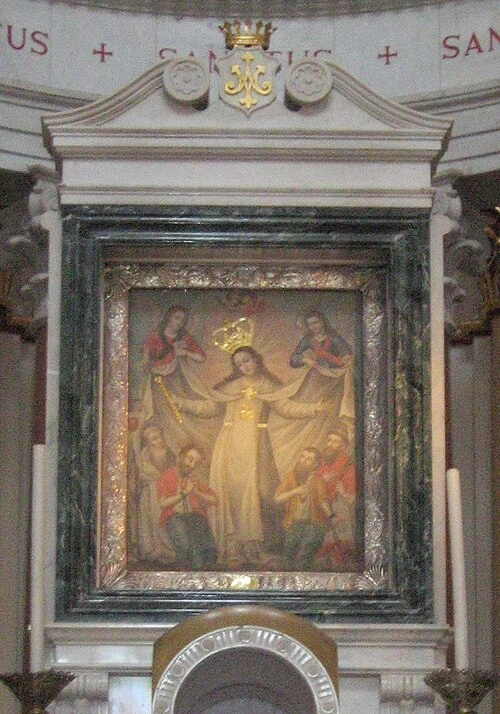
Yarumal’s devotion to the Virgin of Mercy dates back to the municipality’s inception. The records of the approval of the establishment of San Luis de Góngora, which was given on December 21, 1787, from Medelln by Visitor Juan Antonio Mon y Velarde from the Province of Antioquia, indicate that the colonists were devoted to the Virgin of Mercy and declared her to be their protector and patron saint. This passage suggests that the people of San Luis de Góngora, which is now Yarumal, already had a strong devotion to the Virgin of Mercy and were familiar with her because of where they came from. When she was declared the patron saint, the need was evident from the moment the municipality was founded to acquire a picture of her for the early church. Therefore, Nicolás Valencia, a native trader from Rionegro and wealthy colonist along with the secretary of the village mayor judge Francisco Leonín of Estrada, commissioned a painting, which appears to be from a Quiteño painter. The aforementioned image was finished in 1789 and given to the parish. In 1790, the picture of the Virgin of Mercy was solemnly installed by the Priest of Santa Rosa de Osos, Nicolás Francisco Agudelos, when he visited the chapel of the emerging San Luis of Góngora. On 27 January 1792 the bishop of Popayán, Ángel Velarde y Bustamante, visited Yarumal and confirmed Virgin of Mercy as the patron saint. In 1915, when Father Leónidas Lopera inaugurated the wooden altar, he retired its ancient frame, and without separating the canvas from its frame, put the image in the upper niche of the altar. It remained in this state until Father Julio Ortega paid for a new frame and protective glass for the first time in 1930. Gerardo Martínez Madrigal was the one who, before the Second Marian Congress in 1942, ensured that the painting of the Virgin of Mercy had a hammered silver frame, manufactured in Santa Fe de Antioquia. He also got a gold crown, a filigree brooch, and a shield that Carlos Herrera made in Santa Fe de Antioquia. Because parishioners gave their jewelry for this purpose, the necessary materials were donated, and the labor only cost 950 pesos. In total, the work cost 2,000 pesos. Total weight of the three gold components is 108 grams. The crown contains 24 gemstones and three pearls. There was also great interest in adding shoes and a golden belt Virgin shod and belt of gold. The ore required for this was given to the goldsmith, but no more was heard from him after this.
In Huila, Priest Martnez was ordained as the bishop of the Roman Catholic Diocese of Garzón. Father Francisco Galician Pérez, his successor, first removed the painting from its original frame on August 28, 1942, with the intention of photographing it and transferring it to the new silver frame. It was a great surprised when discovered on the reverse of the painting was the caption: “True portrait of the miraculous image of Our Lady of Mercy, redeemer of captives. Nicolás Valencia’s present. Year 1789, a Hail Mary by the painter”. This confirmed that Valencia was the one who commissioned the image. On September 23, 1942, during the Second Marian Congress in Yarumal, Miguel ngel Builes, bishop of Santa Rosa de Osos, blessed the jewels a crown, a shield, and a gold brooch that were then attached to the canvas. The picture of the Virgin of Mercy was carried solemnly to the parish church and placed in the niche of honour, in the wooden altar from 1915. To protect the jewels, 3 millimetres (0.12 in) glass was installed, costing 70 pesos. The women of Yarumal contributed the 11.5 kilograms of silver that make up the frame. In the top part, it shows shield of the Virgin of Mercy, and in the bottom, in gold, “The parish of Yarumal of its exalted patron saint in the Second Marian Congress”. In 1987 during the bicentennial of the foundation of Yarumal, the painting was canonically crowned by the Diocese of Santa Rosa de Osos, and also received the title of “Perpetual Mayor of Yarumal”. In 1998, in an initiative by Monsignor Gilberto Melguizo Yepes, a belt and gold sceptre were placed on the image. There are other versions or legends of the origin of the painting that are false, as they have inconsistencies and lack historical sources. According to one of the most common versions, a traveler from Medelln arrived in Yarumal and offered for sale a canvas depicting the Virgin of Mercy. He left it at the “Contento” hotel, which is now the Seminary of the Missions of Yarumal. He was unable to sell it, so the parish took it under their protection. This legend is contrary to the historical facts, as the painting is mentioned in the documents from the first ecclesiastical visits as being in the early church of San Luis de Góngora. Furthermore, this version is inconsistent with the caption on the reverse of the picture.
Altar
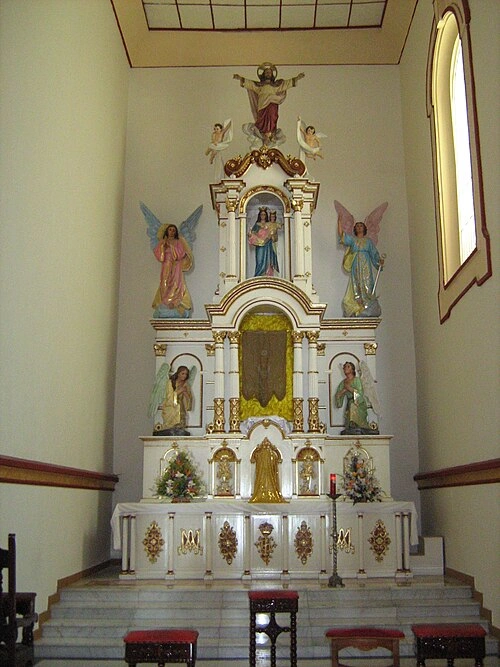
The Daughters of Mary congregation gave the La Merced temple its first altar, which was meant to be used to honor the Immaculate Conception. The temple board authorized this brotherhood in 1898 to order its construction, and its installation took place on May 20, 1901. In 1915, Father Leónidas Lopera commissioned an altar from the Carvajales cabinetmakers, which served as the main altar for a long time. The patron saint’s alcove was so small that it was necessary to mount the painting outside the niche so that the entire structure could be seen. Sometime later, it was decided to purchase a new marble altar for the Marian year of 1954. In order to determine which firm would carry out the work, bids were requested from Ermenegildo Bibolotti’s “Marmolería Artística” in Medellín; from “Tommasi Tommaso & Cía.” in Pietrasanta, Italy; from Giusseppe Bresciani Meccheri’s “Marmolería Colombo-Italiana” in Bogotá; and from Franco Lucarini of U. “Marmolera Italiana” in Medelln, owned by Luisi Eredi, was selected. On February 19, 1954, after the project plans were known and analyzed, the contract was signed. Later, on June 10, the factory foreman, the priest Benedicto Soto Mejia, extended the contract with the same house to build the presbytery’s pavement, side chapel’s pavement, and steps for 25,300 pesos. The idea was for both the altar and the pavement to be inaugurated between September 15 and 20, 1954, on the occasion of the Marian Congress in Yarumal, an event to which several prelates, clergy, and faithful from the region’s municipalities were invited. Later, the representative of the house, Franco Lucarini, informed Father Jiménez that there were problems completing the construction of the altar and the communion rail, as Italy was paralyzed by a series of strikes. Therefore, the Levite informed him of the great harm to the parish if this was not done and implored that all means be exhausted to avoid delaying the inauguration. Unfortunately, the established date could not be met, since on September 19, 1954, the steamer Etna departed from Italy with part of the work. The trip lasted approximately 25 days by sea and took 10 days for the nationalization procedures and for the transfer to Yarumal. After that, the remaining work continued to be shipped by sea, with the final shipment arriving on December 15. 18 trips were required to transport all of the material from Cartagena to Yarumal. These trips transported a total of 184 boxes with a gross weight of 100,820 kilos, of which 83.41 percent represented the marble’s net weight. The cost of transport from the coast to Yarumal via Caucasia was $9,997.01 pesos. On February 1, 1955, the assembly and mounting work of the work began, for which Manuel Rave Ángel and his son Gilberto were hired at a price of 16,000 pesos. These people were considered suitable for this task, since they were the ones who had carried out the assembly of the marble altar of Santa Rosa de Osos in 1936.
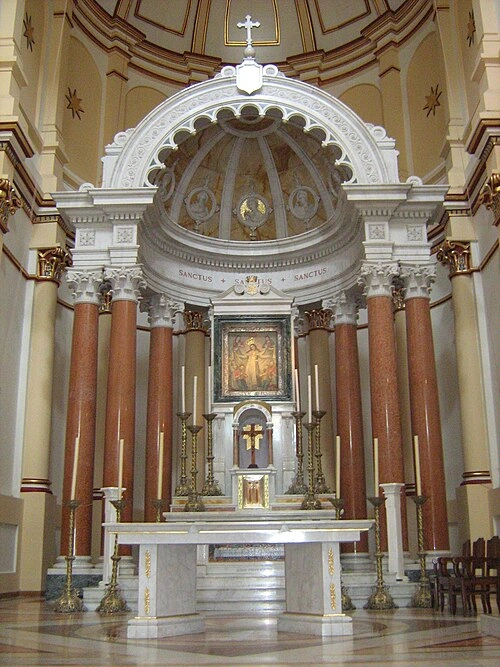
When the work on the altar began (February 1, 1955), the relics of Saints Teódulo, Marcial , Modestina and Amanda were removed from the altar stone consecrated in 1944 , to be placed on the marble altar on the day of the new consecration. In the meantime, they were kept in a metal chest, protected with the episcopal seal of Monsignor Miguel Ángel Builes, who gave them into the custody of the parish priest. On February 7, 1955, construction began on the foundations that would support the altar, made of concrete and one meter thick. The erection of the temple’s eight columns, each weighing three tons, began on Saturday, February 19, and ended on the 26th of the same month. On March 2, the capitals of the eight columns were put in place; on March 17, the entablature that connects the capitals, the five medallions that represent the four evangelists, and the saint named Aloysius Gonzaga, were added. On March 31, the cross crowning the marble altar was placed, and for the first time, on Holy Thursday, April 7, the “monument” was made under the canopy. By April 19, the communion rail was fully completed; on the 21st, the altar of the Blessed Sacrament was ready, with the Venetian mosaic painting of the Supper by Leonardo da Vinci; on the 28th, the display case was finished; and on the 30th, the painting of Our Lady of Mercy was installed in the dressing room. During the work’s installation, no mishaps occurred. Finally, the marble altar was consecrated on June 8, 1955. At 7:00 a.m., Bishop Builes, accompanied by the clergy, the Seminary of Missions, and the parish priest Efraim Jimenez, celebrated the consecration mass. The altar was filled with the relics of Saints Theodulo, Marcial, Modestina, and Amanda during the two-hour ceremony. On April 10, 1955, a contract worth 1,600 pesos was signed with Antonio Burgos Rendón of Medellín to build an indirect lighting system. To create greater splendor for the altar, a red carpet was also purchased. Later, on August 24 of that year, the 1915 altar was replaced with the wooden altar from the reserve chapel. The move took place between August 26 and September 3, work carried out by Eugenio Salazar, but the table was not moved because it was in poor condition. The Catholic Church abandoned the practice of celebrating mass with its back to the public following the Second Vatican Council’s liturgical reforms. As a result, parish priest Roberto Arroyave Vélez was in charge of procuring the current “Altar of Sacrifice,” which was also made of marble and was dedicated on September 18, 1970, by Bishop Joaqun Garca Ordóez.
Characteristics of the marble altar
The altar’s body is 12 meters (39 feet) tall, 7 meters (23 feet) wide at the base, 70 tons (77 short tons) in weight, and it cost $23,000. It has two semicircular rows of eight monolithic columns. Each is 6 metres (20 ft) and 55 centimetres (22 in) in diameter. The columns are Corinthean, fitting with the general architectural style of the church. The semicircular entablature rests on the capitals, made up of the architrave, frieze, and cornices. A semi-dome with ornaments in high relief on its east side A shield bearing the initials “I.H.S.” a monogram of Jesus Christ’s name can be found in the center. The dome is topped with a cross. Five medallions representing Aloysius Gonzaga, the parish’s titular saint, and the Four Evangelists can be found at the base of the semi-dome. These medallions are placed on a background of Venetian mosaic. The half dome and columns form a sort of canopy which shelters the altar, church tabernacle, a shrine for the Virgin of Mercy made of green marble and topped by a monogram and a ducal crown, and the throne of the saint which is also decorated and enclosed in frames. In the far part of the altar is a reproduction of the Leonardo da Vinci’s The Last Supper in Venetian mosaic.
Organ
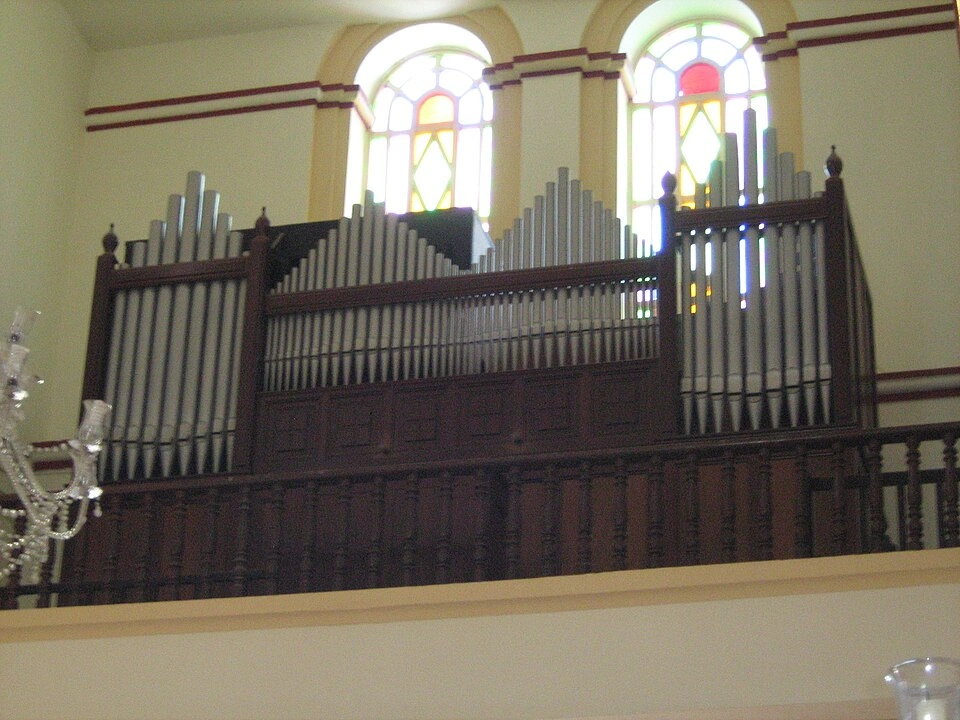
The interest in purchasing a musical instrument to accompany the religious celebrations traces back to 1880, when Father Aldemar Palacio received on 3 June a letter from Jesús María Rodríguez, Provisor of the Bishop of Antioquia. The letter ordered the purchase of an organ because it stated that every church in the diocese needed to have a musical instrument. However, due to the economic difficulties caused by the construction of the church, the purchase was postponed. The Presbyter Emigdio A. on October 11, 1900, Palacio advised the Board of Works on the Church that a musical instrument was required. The Board of Manufacturing unanimously decided to contribute 1,000 pesos toward the cost of the organ, up to a total of 1,500 pesos when the instrument was purchased. A Hammond organ was purchased by Presbyter Francisco Galician Pérez in 1947 for 7,000 pesos, and the teacher Cabral unveiled it on July 16. It was blessed by the parish priest on 14 September. The current pipe organ was obtained by the priest Efraím Jiménez from Oskar Binder & Cia. Ltda. of the city of Bogotá, which served as E.F.’s sole representative in Colombia. Walcker of Ludwigsburg, Germany. The company, which was established in 1785, had previous experience fabricating tropical-climate organs of this kind. To provide a quote, a delegate from the firm moved to Yarumal to study the style and acoustics of the church, for which he suggested a pipe organ with 17 registrations, or 1020 pipes in total. It was valued at 102,000 pesos to be paid over three years. Father Jiménez requested permission to approve the contract from Bishop Miguel Ángel Builes, who allowed it and congratulated to the priest for his initiative.
The agreement was signed on February 19, 1961, by Oskar Binder, the organ seller’s delegate, Benedicto Soto Mejia, the chief of building, and the Presbyter Jiménez. The pipe organ, weighing four tonnes, was sent from Bogotá by way of Sonsón on 6 March 1963. It arrived in Yarumal three days later, and it was put in the basilica through the “Door of the Pardon”. Its installation began on 11 March, overseen by Oskar Binder, and it debuted on 19 March, the Day of Saint Joseph. The instrument was blessed from the pulpit by Bishop Builes before beginning the liturgy on Sunday 24 March. For 25,000 pesos, the Chapel of the Conciliar Seminary of Santa Rosa de Osos received the Hammond organ. The E.F.Walcker organ is composed of 17 stops spread among two manual keyboards, each with 61 keys, and a keyboard played with the feet to produce low bass notes. All the keyboards are in a console, which is separated and put in front of the organ with sight of the altar. These keyboards control 1,020 pipes of varied length and calibre. The organ is an orchestra in and of itself, with instruments like trumpets, bombards, oboes, clarinets, flutes and human voices. It is made of varnished and sealed mahogany. An electrical fan powers the organ, and a 14-volt dynamo supplies the motor with continuous current. Of the 32 organs in Antioquia, the basilica’s is the eighth largest in area and volume.
Stations of the Cross
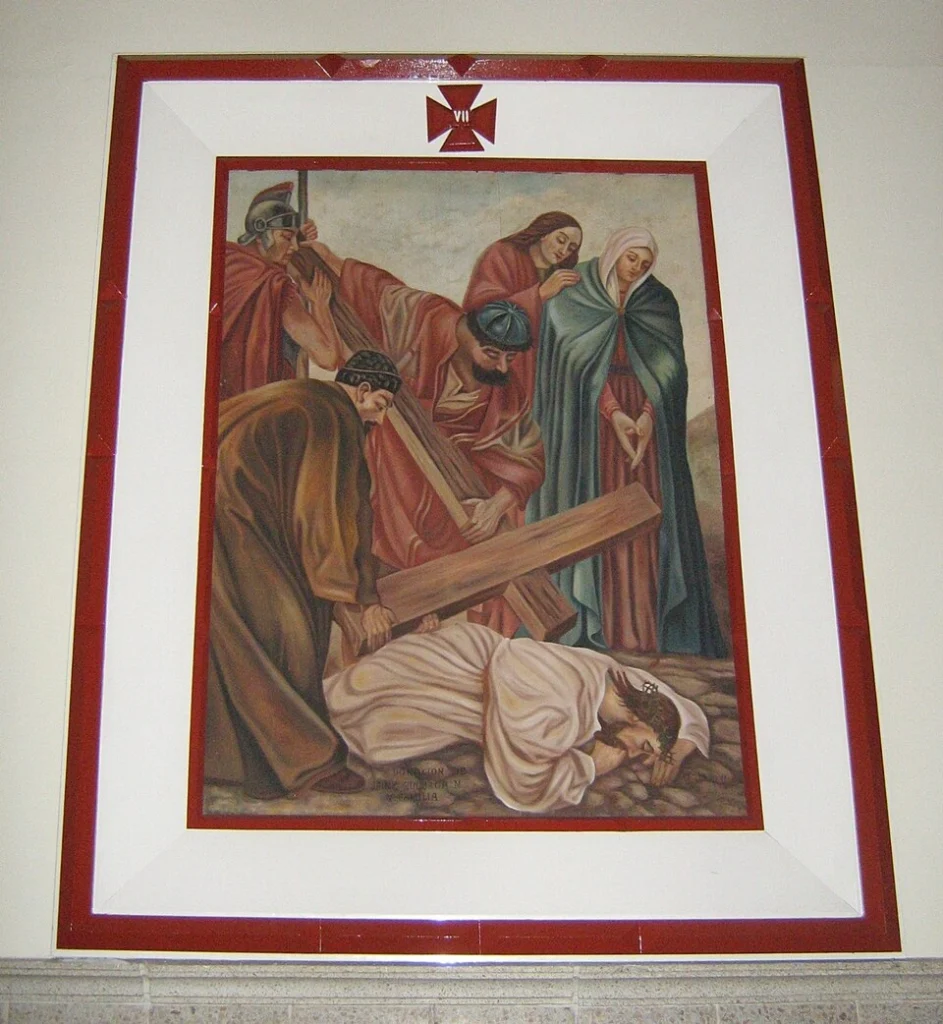
One of the first representations of the passion and death of Jesus Christ in the Temple of Our Lady of Mercy were the oil paintings of 50 x 60 cm. that Barbara Palacio de Mejia, wife of Tomas Mejia, maternal uncle of Father Benedicto Soto, obtained and donated to the parish, and in turn, Father Francisco Gallego Perez donated them to the chapel of the Pontifical Seminary of Missions where they still remain. This Stations of the Cross was canonically erected by J. Buenaventura Marin on October 7, 1903, and having as witnesses the priest and vicar Emigdio Palacio. The images of the Stations of the Cross currently displayed in the parish church were made in 1945 and 1946 when the parish priest Francisco Gallego Pérez commissioned the artist Mariela Ochoa U. from the city of Medellín, to paint 14 oil paintings. Father Gallego brought a collection of illustrations from Germany, and the images were copied from there. The following individuals paid the sum of one hundred pesos for each of the works, as noted in each one: Carmen E. Roldán; Teresita Jaramillo Medina and Julia widow of Hernández; Rosa Palacio widow of Restrepo; Vicente Villegas and Merceditas Rivera de Villegas; Anita Torres de Orozco; Jesús Antonio Hoyos and Julia Salazar Lopera; Jaime Zuluaga M; Pbro. Natalio Sánchez, Benedicto Soto Mejia, Luisa Ramrez, Emilio Orrego’s widow, Jess Vásquez, and Félix Antonio Roldán B. ; Juan B., Andrés Hoyos and sisters, and Josefina Díaz widow of Soto..
Stained glass
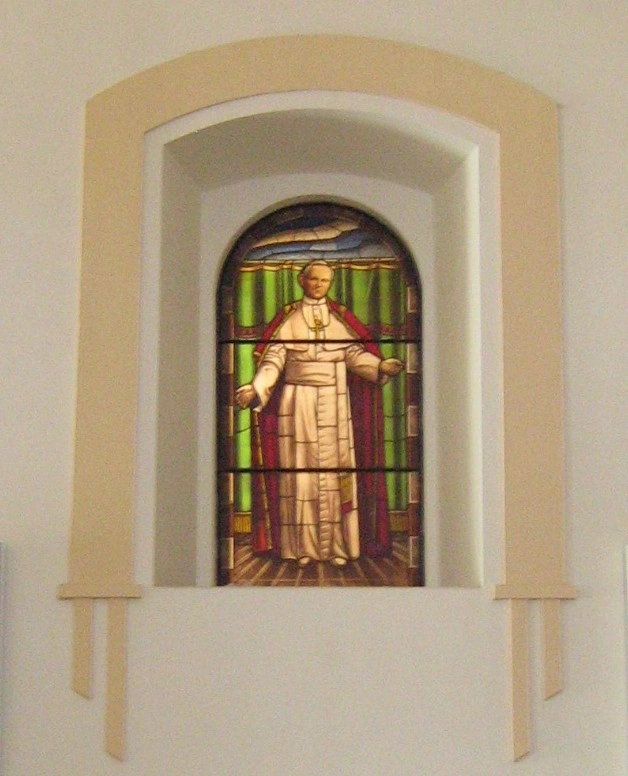
The church began with simple stained glass windows. Monsignor Melguizo Yepes decided to obtain some artistic stained glass windows to adorn the building. They were commissioned from an artist from Cali and made from cathedral glass. There are 11 in total with different figures and drawings, and they cover the lower series of windows in the external walls, between the transept and the towers. The rest of the windows continue to have the simple stained glass. In the western wall facing the Rosenda Torres School are five stained glass windows. From north to south, they depict Jesus with his apostles; Saint Francis Xavier, patron of missions; Pope John Paul II, who beatified Father Mariano and granted the church the title of lower basilica; Mariano de Jesús Euse Hoyos, blessed by the Catholic Church, who was born in and coadjutor of Yarumal; and Saint Joseph. Six stained glass windows line the wall of the eastern nave, which faces the street. From north to south they depict Baby Jesus and the Holy Family; the Good Shepherd; the birth of Jesus Christ; the Trinity; the part of the gubernatorial decree that declares the Virgin of Mercy to be the perpetual mayor of Yarumal; and a replica of the Quiteño painting of the Virgin of Mercy.
Crystal lamps
The current church lights were acquired between 1959 and 1960 by Father Efraim Jiménez. A representative of a Medellín-based dealership initially offered them for demonstration purposes. Two crystal chandeliers were received and temporarily installed without any obligation. The first of these to be permanently installed was on 23 October 1959. Its dimensions: 3.20 m high and 2.30 m wide. The idea was that by the end of the year two more would be placed in the central nave and that by Easter 1960 smaller ones would be placed in the presbytery , the reserve altar, the side naves and in the triumphal arches that support the dome of the basilica, for a total of 13 crystal chandeliers from the Baccarat house , which cost 60,000 pesos . On February 11, 1960 the last chandelier was placed.
Clock
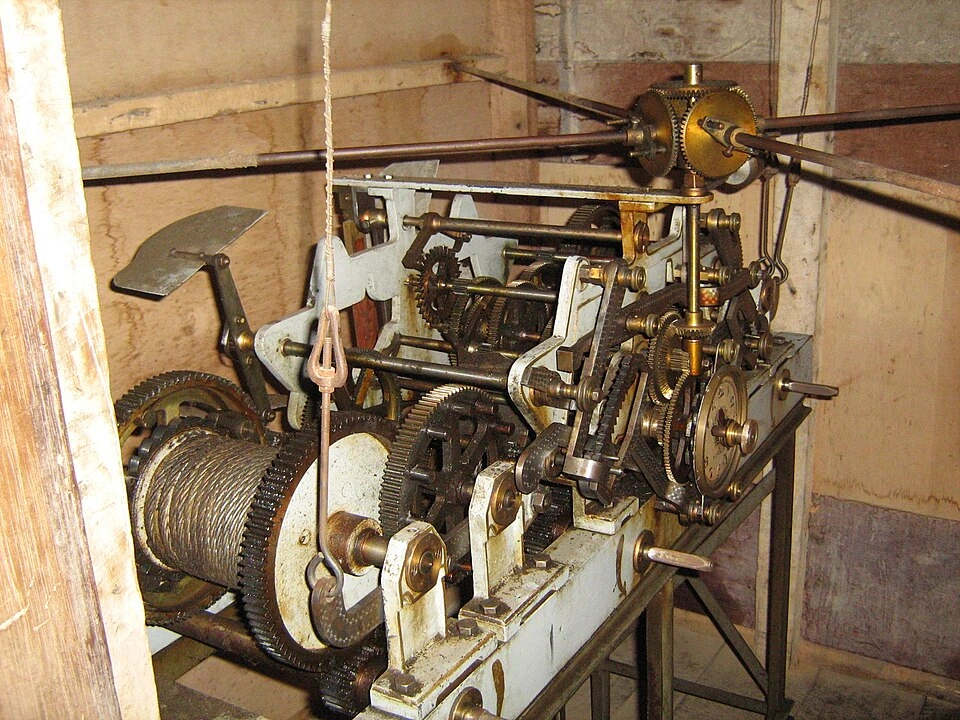
The first clock for the temple was given to the temple by José Mara Daz on December 2, 1882, while the church was still being built. It was originally installed in the tower above the “Door of the Pardon”, as this was the first tower that was built. Was relocated in 1920 to the circular space between the central door’s windows. It remained there until May 24, 1966, when a brand-new four-faced clock from Vitoria, Spain, took its place. The day before it was installed, during the evening mass, Bishop Miguel ngel Builes gave the clock a solemn blessing. The thought at that time was to place the old clock in the cemetery of Carmen. The clock has its own bells that ring every fifteen minutes for this reason. The mechanism of the clock automatically sounds the bells by pulling ropes which in turn move hammers to strike the bell.
Bells
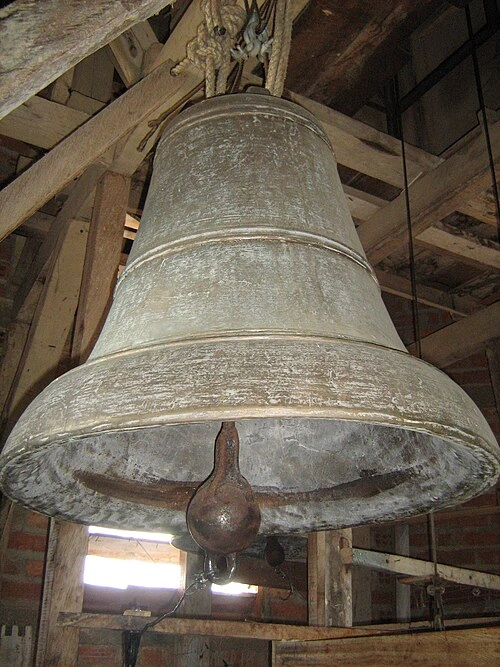
The old temple bells were in poor condition, as they had cracks that reduced their sound, so Monsignor Melguizo Yepes managed to buy new ones, which is why he dismantled the damaged bells from the right tower and sent them to the Tristancho workshops, located in the Ucuenga area, 4 kilometers from the urban area of the Nobsa municipality (Boyacá ), where they were melted to make new bells. The Tristanchos are a family of bell makers with a long history in Colombia, as they are a dynasty that has been making bells for more than 250 years.The technique they use is called lost mold, since the mold for a bell is only used once and then breaks. Therefore, no two bells are alike. A bell is entirely handcrafted and requires two months of labor. The process begins with the creation of the mold, which is made of three distinct types of clay and horse manure. [15] Next, a guadua frame is constructed, and layers are applied and left to dry. This process is repeated several times. After that, sheep fat is applied as a release agent and the mold’s inside and outside are turned to form the bell. After that, a counter mold is placed and heated, allowing the mold and counter mold to be removed while the fat is absorbed. The mold and counter mold are then fired, so that when they are adjusted again, the vacuum is created that will be filled with the molten materials. Copper and tin are melted in clay ovens using only dry firewood as the only fuel during the casting process at temperatures of 1,200 degrees Celsius. Because it only takes three seconds to fill a 300 kg bell’s mold, the bell is cast in a single piece and in a single instant. And, after casting, it is left to cool naturally for two days, and then polished by hand. They are three large bronze bells, which cost $7,500,000 pesos, were inaugurated by Monsignor Melguizo during the patron saint festivities of 1997, and are baptized, from largest to smallest, with the names of La Merced, San Luis and Benedicto, with a weight of 500, 310 and 300 kilograms, respectively. They are manually operated from the bottom of the tower by means of ropes that move the clappers inside each bell, which are used to announce religious events.
Baptismal font
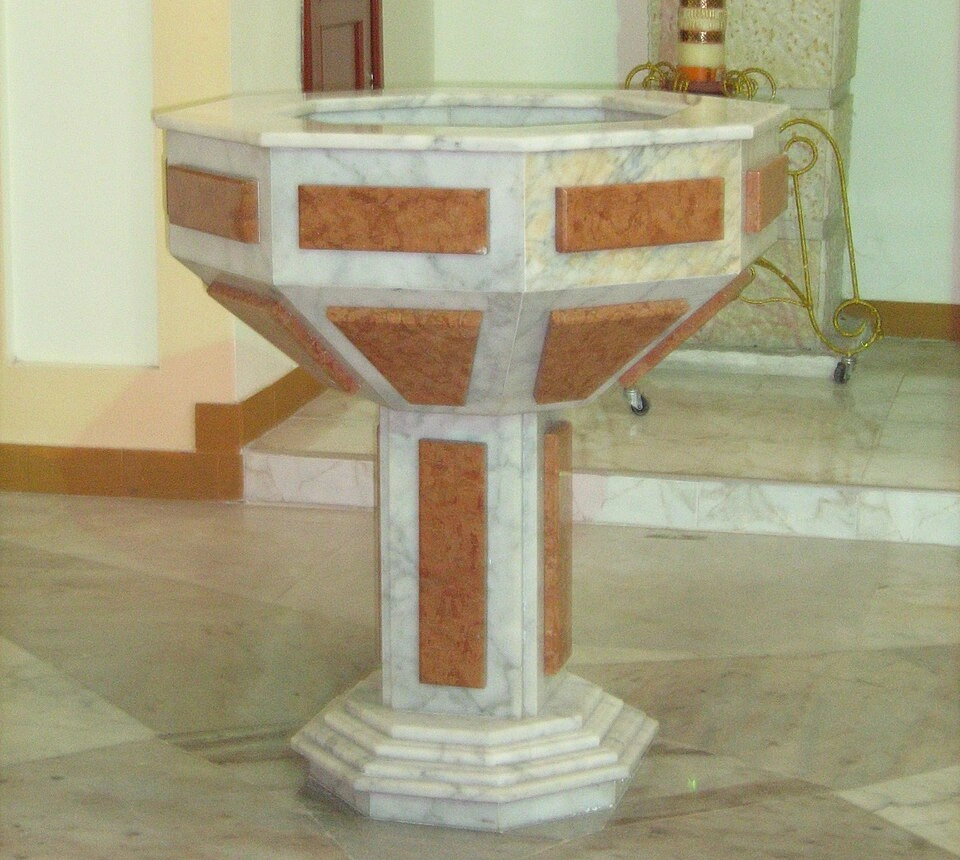
There were four baptismal fonts in the temple of Our Lady of Mercy. The first one was decorated with a picture of the Holy Trinity and was on the spot that is now the chapel of the Fallen Lord. The second baptistery was built by Gallego Pérez, a little further back, in a place equidistant between the sanctuary of the Fallen Lord and the chapel of the Virgin of Perpetual Help. The third baptismal font was located at the end of the left side aisle of the temple, was obtained on the initiative of Father Roberto Arroyave who in 1975 contracted its elaboration in Bogota stone (a type of sandstone ) with the firm “Enchapes Sacatín”, for a cost of 80,000 pesos. Monsignor Gilberto Melguizo Yepes acquired the fourth and current baptismal font, which is in the same location as the third. It is made of marble, has a stepped base with an octagonal floor plan from bottom to top, and a pillar with a square base supports the concave octagonal container in which the water is deposited.
Holy water fonts
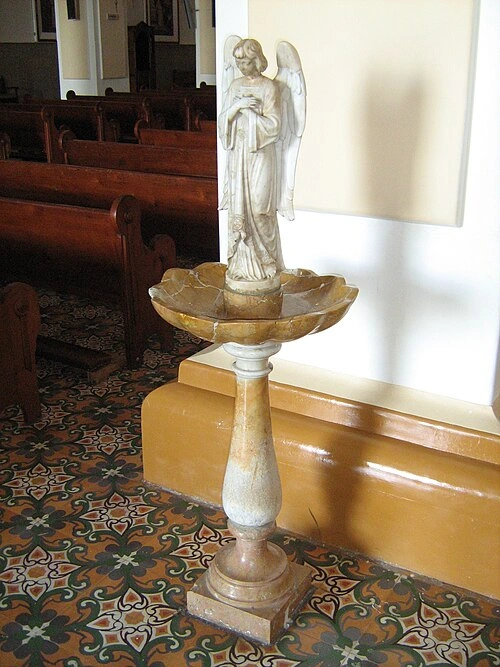
The two fonts of holy water were purchased by Father Ernesto Acosta Arteaga in 1945 from the Marmolería Artistica of Hermenegildo Bibolotti. They are made of marble and are 160 centimetres (63 in) height. Each has a base, column, and basin to hold the water, and in the middle of this basin is a statue of an angel.
Candlesticks
In 1924, the priests Rafael and José Manuel Yepes Carvajal provided the temple of Our Lady of Mercy with 12 French candelabras of heroic size (1.50 meters high) that were used in the Eucharistic vigils from June 1 to July 16 and which ended with the feast of the Virgin of Carmen. Father Luis Enrique Restrepo Muñoz subjected them to a restoration process in his first five years of service. Currently they remain for much of the year at the foot of the main altar.
Pulpit
The basilica had a pulpit made by Mr. and Mrs. Carvajales Martínez. It had a perfect finish imitating marble with four allegorical applications of the evangelists. It was demolished on January 25, 1971. The rose windows are preserved in the Monsignor Juan N. Rueda Traditional Museum.
Art
Before the Second Vatican Council the church of Our Lady of Mercy, as was usual, had a large variety of art. As a result of the provisions from the council, these were removed on 18 July 1967. Between the works that were removed are: the paintings of the Holy Family, the Sacred Heart, the Immaculate Heart of Mary, Saint Joseph, Saint John Eudes, Saint Roch, Saint Thérèse of Lisieux, Saint Tarcisius, Our Lady of Mount Carmel, the Infant Jesus of Prague, the Infent Jesus of the Small Flock, the ancient Quiteño painting of the Virgin of Our Lady of Sorrows and the Child Mary. Some remained for a time before being removed, the patron saint Our Lady of Mercy, the titular Saint Aloysius Gonzaga, Our Lady of Perpetual Help, the three pictures of the Ordeal, the Our Lady of Fátima, Saint Augustine of Hippo, Saint Antonio, the embrace of Saint Francis of Assisi, Saint Nicholas of Tolentino, the Fallen Christ, and the divine countenance. Some images were still under determination for whether they would be kept or removed: the ones of the Virgin of Carmen, one of the Immaculate Conception (by Bartolomé Esteban Murillo), Christ the King, and the pictures of the Stations of Christ. The final location of the pictures of the Stations of Christ would depend on the considerations of the parish priest and of Bishop Félix María Torres Parra; finally they were placed on 14 August 1967, and work on decorating the church was about to finish. The pictures that are currently found in the church are: the Immaculate Conception, the Virgin of Carmen, Saint Francis of Assisi embracing Christ on the cross, the Sacred Heart of Jesus, Saint Joseph, and the Blessed Mariano de Jesús Euse Hoyos. All of these images are located in the transept. The painting of the Fallen Christ is located in the chapel, and in the reserve altar are the paintings of Mary Help of Christians, Salvator Mundi, and six angels.
The Fallen Christ
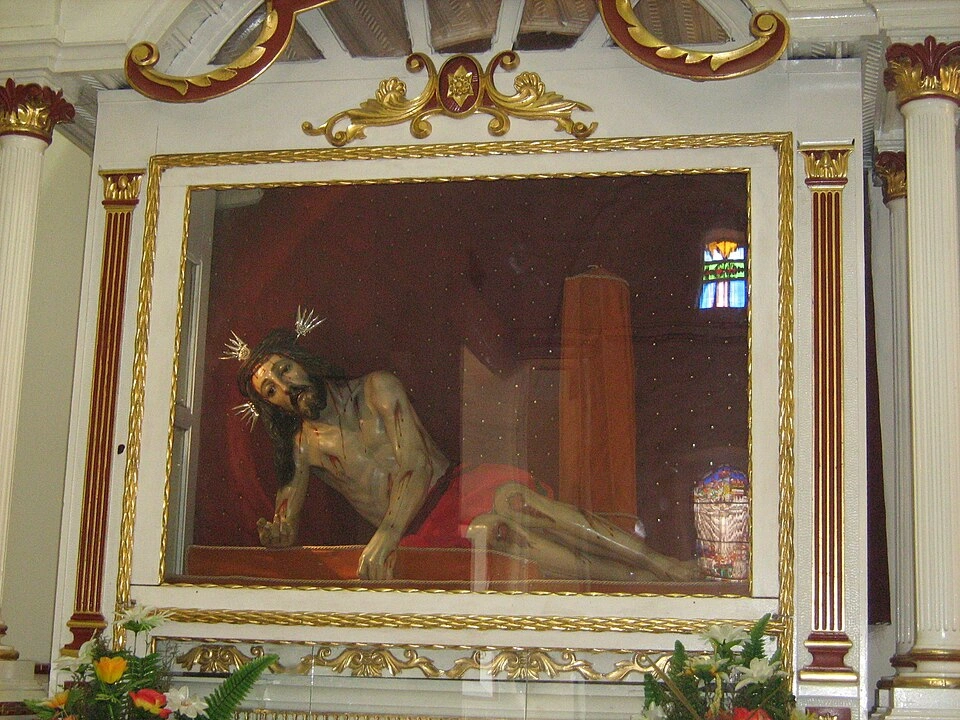
The primitive temple of Yarumal had the image of the Lord of the Column, which appears referenced in the inventory of 1845, but today there is no more information about it nor is its whereabouts known. Since the parish of La Merced lacked an image that represented any scene from the Passion of Christ, Bishop Miguel Ángel Builes ordered, in 1935, the parish priest to obtain an image of the Fallen Lord to have it in the temple and thus could be venerated by the parishioners. In compliance with the provisions, Father Gerardo Martínez Madrigal began the work of adapting the chapel that exists next to the presbytery and on September 10, 1938 he concluded the payment of 1,020 pesos for the altar built by Misael Osorio. The statue of the Fallen Lord was carved by Constantino Carvajal in 1935 for 400 pesos. The part corresponding to the urn is the work of Francisco Gómez Estrada, who made it for a value of one hundred pesos. To cancel these expenses, the contribution of Floro Roldán and his wife Pachita Penagos was important. In 1935, the veneration of this image was solemnly inaugurated, during the Eucharistic Congress and patron saint festivities. Currently, the image of the Fallen Lord is located in a chapel at the foot of the church, adjacent to the left aisle, which formerly housed the baptistery.
Virgin of Transit
Fernando Ramírez and his wife Elena Rivera, originally from Sopetrán, had obtained a Barcelona image of the Virgin of the Transit , of the Dormition or of the Assumption, as it is also known, since the end of the 19th century. One of the children of this marriage, who had the same name as his father, expressed the wish that when his sister Carmen Ramírez Rivera de Botero died, the image would become the property of the parish. The woman died on March 22, 1955, and in compliance with her will, on that date Germán Ceballos Ramírez handed over the artistic and religious piece to the parish. In addition, this family gave a dowry to cover the expenses of her festivities. The Virgin of the Assumption symbolizes the ascension of Mary, body and soul, to heaven. This belief dates back to the time of the apostles, but it was not established as a dogma of faith by Pope Pius XII on November 1, 1950. Her feast day is celebrated on August 15.
The Little Girl Mary
This image arrived in Yarumal on January 6, 1963. It was carved by Josué Giraldo Mejía in his workshop in Medellín and represents three advocations of the Blessed Virgin: that of the child Mary, that of the Heart of Mary and that of Our Lady of the Rosary. It is a well-made sculpture, wearing a blue suit, without a cloak, from whose hands hangs a rosary. She is crowned by a garland of pink roses that symbolize the joyful mysteries; she wears another crown of red roses around her heart representing the sorrowful mysteries and a third crown of yellow roses surrounds her feet to represent the glorious mysteries.
Altar Crucifix
On the night of January 8-9, 1958, an unbalanced person set fire to the altar, and in the process the Christ was destroyed. A new one had to be obtained, which was donated by Antonio Hoyos Mejía. The cross was ordered to be made in Yarumal to the cabinetmaker Alfonso Areiza Medina for twenty pesos, and on this cross, in Medellín, the artist David Pérez made the Christ for a value of 300 pesos. The work was delivered on Holy Thursday, April 3 of the same year, and on Good Friday it was exposed for public veneration during the afternoon liturgical celebration. This Christ is characterized by carrying the three golden powers that belonged to the Divine Child Jesus of Prague, donated by Mercedes Ramírez Rivera. The cross has a characteristic glow generated by the copper plating, carried out by order of the parish priest Roberto Arroyave. This glow was made in imitation of the image of the Lord of Miracles, which is a crucifix, located in the Basilica of San Pedro de los Milagros.
Feast Day
Feast Day : 24 September
The Basilica of Our Lady of Mercy in Yarumal, Colombia, is a prominent religious site dedicated to the Virgin of Mercy, whose feast is celebrated on September 24. Originally consecrated in 1944 and later elevated to the status of a minor basilica in 1999, the church is renowned for its stunning Renaissance Revival architecture and its collection of historic religious artworks.
Church Mass Timing
Monday to Saturday : 6:00 AM, 10:00 AM, 6:00 PM.
Sunday : 7:00 AM, 9:00 AM, 10:00 AM, 11:00 AM, 12:00 PM, 4:00 PM, 6:00 PM, 7:00 PM.
Church Opening Time:
Monday to Saturday : 05:45 AM, 07:00 PM.
Sunday : 05:45 AM, 08:30 PM.
Contact Info
Address : Minor Basilica of Our Lady of Mercy
a 19-44, Cl. 19 #19-2, Yarumal, Antioquia, Colombia.
Phone : +57 604 8536033
Accommodations
Connectivities
Airway
Basilica of Our Lady of Mercies, Yarumal, Colombia, to ose Maria Cordova International Airport, distance 2 hr 56 min (134.5 km) via Route 25.
Railway
Basilica of Our Lady of Mercies, Yarumal, Colombia, to Sabaneta Itagüi, distance 3 hr 11 min (134.0 km) via Route 25.