

Introduction
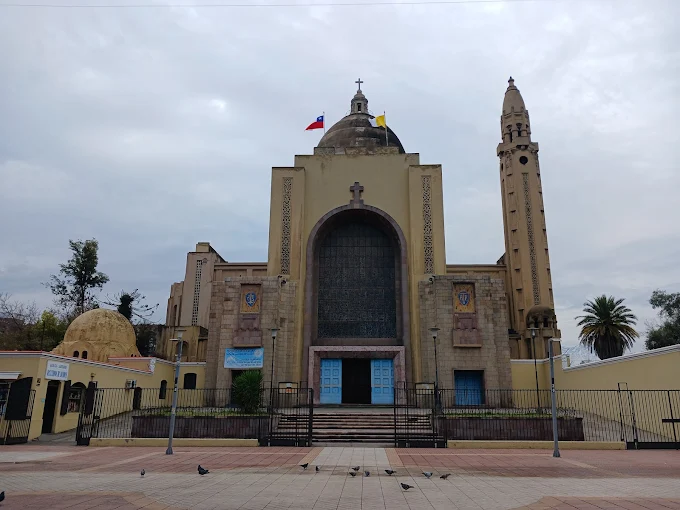
The Basilica of Our Lady of Lourdes, also called the Basilica of Lourdes, is a Catholic temple dedicated to the Virgin Mary, located in the commune of Quinta Normal in the city of Santiago, Chile. It is part of the homonymous sanctuary along with the Grotto of Lourdes. Its construction was completed in 1893 and replaced in 1929 due to the increase in pilgrims caused, in part, by the creation of the magazine El Eco de Lourdes in 1901, distributed throughout the country, and in general by the great devotion to the Virgin Mary. The basilica was completed in 1958. It is the second tallest religious temple in the country, after the Votive Temple of Maipú, and is in turn one of the 400 tallest churches in the world .
Origins and Historical Context
Bernadette Soubirous, a fourteen-year-old girl of humble origins, experienced a series of apparitions of the Immaculate Conception on February 11, 1858, in the Massabielle grotto in Lourdes, France. According to history, the Virgin appeared incognito 18 times, of which, in the thirteenth apparition, she ordered Bernadette to build a chapel in her name for pilgrims to process to. This request was denied by Father Peyramale, parish priest of Lourdes at the time, because he did not know the name of this mysterious lady, which was revealed to Bernadette in the sixteenth apparition. The name was the Immaculate Conception. These events, which had a great impact, were recognized by the Holy See in 1862. The grotto became known as a pilgrimage site, and a sanctuary was built, which currently receives 6 million people each year. The sanctuary consists of the aforementioned grotto and the basilica built by Monsignor Laurence, the bishop who welcomed the revelations made to Bernadette by the Immaculate Conception. Thanks to this story, which caught the attention of Father Jacinto Arriagada, the idea and construction of a shrine to Our Lady of Lourdes in Santiago, Chile, imitating the original grotto of Lourdes, began to take shape. This eventually became the current shrine in Quinta Normal, which, in addition to the grotto, houses the great basilica of Our Lady of Lourdes. Various events are held there, especially on February 11th in commemoration of the apparition of Our Lady of Lourdes in France, and on December 8th, the Feast of the Immaculate Conception.
In 1876, thanks to Father Jacinto Arriagada’s devotion to building a temple in honor of the Virgin of Lourdes, inspired by the original located in France, the Ecclesiastical Authority signed a decree authorizing its construction in Santiago. To carry out this temple were used land adjacent to Quinta Normal Park donated by Alejandro Vigouroux, a wealthy neighbor of the sector who owned the property. It is here where the construction of the Church began in 1880 and ended in 1893, and the replica of the original Grotto, “it is an exact replica of the historic Grotto of Massabielle in France. although the central part reproduces the original Grotto as is, in its lateral extensions it presents differences, on the left side the paintings by the Chilean artist Pedro Jofré, which tell the story of the 18 apparitions, and on the right side the Water Fountain in memory of the Lourdes spring, which was inaugurated on February 11, 1908. Over time, devotion to the Virgin Mary expanded, causing an increase in pilgrims visiting the sanctuary. The old temple was reduced in size, and it was decided to build a larger one in its place. The construction of the new temple began in 1929 and was made possible thanks to the help of humble donations from people to the church and the publication of the magazine “El Eco de Lourdes” (since 1901) which served as a means of dissemination to collaborate, these donations could be a bag of cement, iron, bricks, among others, the Basilica being finished in 1958. Its inauguration was presided over by Monsignor Alfredo Cifuentes, Archbishop of La Serena. In 1992 the Basilica of Lourdes was proclaimed a “minor basilica” by Pope John Paul II , and later in 2000 it was named the “Permanent Jubilee Temple” of the western zone of the Archdiocese of Santiago by the Cardinal Archbishop of Santiago, Monsignor Francisco Javier Errázuriz. Due to the earthquake of February 27, 2010, the Basilica suffered damage to its interior, to the stained glass windows and the dome, as well as the Grotto, which suffered damage to the bell tower and niches that tell the story of the apparitions of the Virgin to Bernadette and part of the Convent that is located next to the Basilica. The restoration of the Basilica, grotto and convent is currently being managed by Lucía Muñoz de Saldaña, treasurer of the Cultural Corporation of Rengo, and María Antonia Pulgar Saldaña, Coordinator of Infrastructure and Heritage. Also in attendance were the Ingal S. A. Construction Company, Claudio Cortez, monument restorer, and Ana Anselmo, stained glass restorer. Representing the Cultural Corporation was María Antonia Pulgar Saldaña, and representing the Assumptionist community were Fathers Martín Nace, Héctor García, Aldo Gajardo, and H. Ramón Gutiérrez.
Architecture of Basilica of Our Lady of Lourdes, Quinta Normal, Chile
Architect : Andrés Garafulic, Eduardo Costabal.
Architectural style: Gothic Revival architecture.
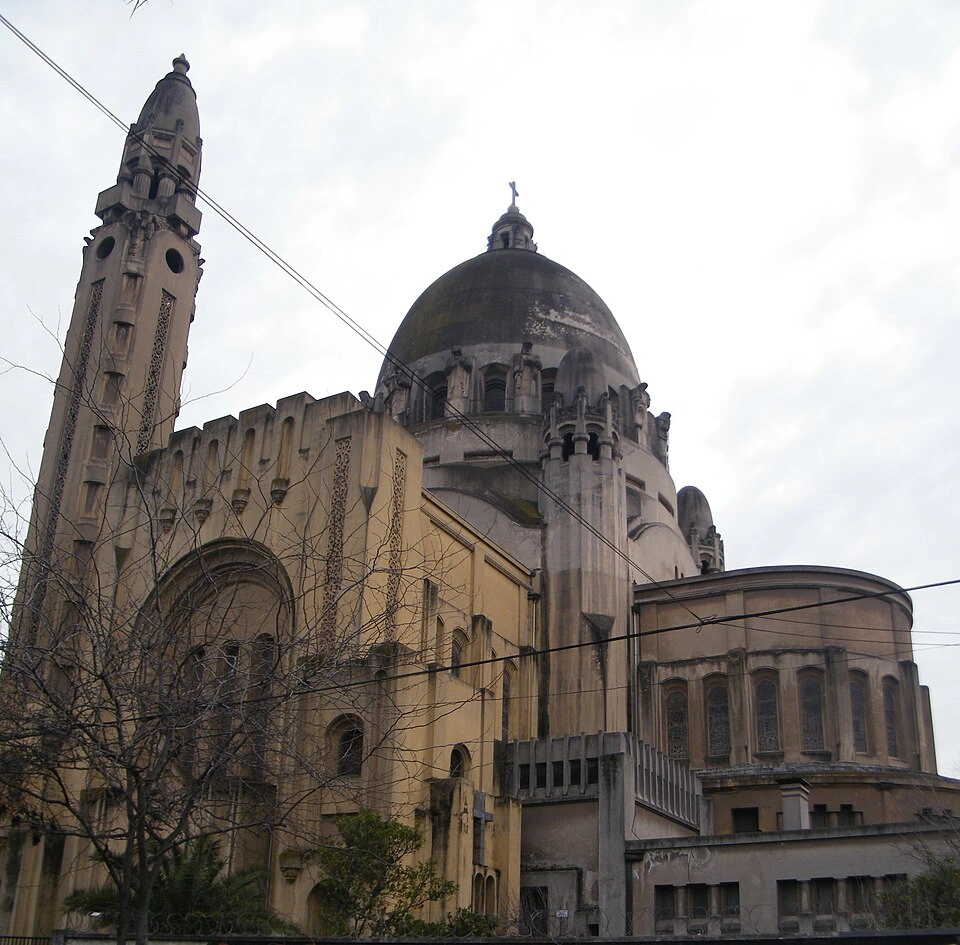
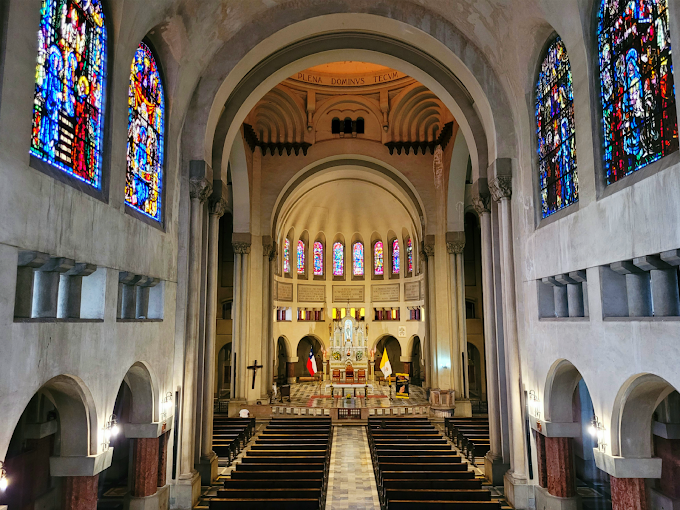
The first thing to notice about this imposing basilica is its large dome, 70 meters high, and its lateral bell tower, visible from the surrounding area in the Quinta Normal district. This church was the first in Chile dedicated to the devotion of the Immaculate Virgin Mary, and it has been administered by the Assumptionist religious until today. Its initial construction was completed in 1893. This part constituted the lateral axis, which is currently the transept of the Basilica. Its expansion began in 1929, being complemented with a vertical axis corresponding to the central nave and side aisles. This expansion was made possible thanks to donations and the participation of the architects Andrés Garafulic Yancovic and Eduardo Costabal Zegers. The texture of the building is refined and geometrical in the Art Deco style. It presents Byzantine elements that incorporate mosaics as ornaments and structural solidity, which can be appreciated in the entrance, similar to a fort. It also presents Gothic contributions, with tall sculptures in the central nave, although evidently geometrized; and pointed arches in the side naves, also called pointed arches and ribbed vaults. In addition, it is possible to see semicircular arches that separate the central nave from the side naves, some pillars made of red marble with unadorned capitals, others made of concrete with various sculptures on their capitals. Made of reinforced concrete, red marble slabs located inside, carved with the initials of the families that contributed materials for its construction, reddish stone and light stone of the façade, the Basilica is made up. Its floor plan in the shape of a Latin cross has four different levels. The first, on the lower or underground level corresponds to the set of vaults and crypts of the Assumptionist Religious; the second is at street level, the access, which includes the Basilica, Convent and Grotto that is in front of the Basilica. The third level is the second floor of the Basilica and the fourth with a corridor of windows around the internal dome and access to the interior void between domes, which is accessed by a staircase, this interior space generated between both exterior and interior domes cannot be appreciated either inside the basilica or outside of it. In 1958, this second stage of the Basilica was inaugurated and blessed by Cardinal José María Caro.
Structure
Basically, a base is created in the shape of a Latin cross, 3 meters deep. A series of pilasters that are attached to thick walls are constructed around it. In addition, a succession of pillars form the interior that separates the side aisles from the main nave. The second floor and, ultimately, the entrance to the basilica are formed by their corresponding architraves, which rest on these pillars. A large triumphal arch and a main nave with a presbytery were planned during the first phase of construction. The main and side naves share three doors. Near the church entrance, there are two apsidioles on the right and the current crypts and former baptistery on the sides. On the left, only the confessional, and on the second level, the access to the bell tower. The dome is supported in the center by four pillars that are twice as thick. Later, to maintain the predominance of the dome, a transverse axis was built, maintaining the same interpretation and forming the current central nave with stained – glass windows in the upper lateral areas and side aisles. Unlike the first part, this one is larger in scale with a larger apse. The side entrance connects a new entrance to the Convent and the access to the second level, which leads to the choir stalls and service corridors. This also provides access to the third level, a corridor that surrounds much of the dome, culminating in the access to the void between the interior and exterior domes.
Specific characteristics
Initially, the Basilica was planned to have extensive ornamentation on its exterior. The plan, on the other hand, was limited to highlighting the interior and adding only the necessary elements because of concerns that it might be dangerous during earthquakes.
Dome
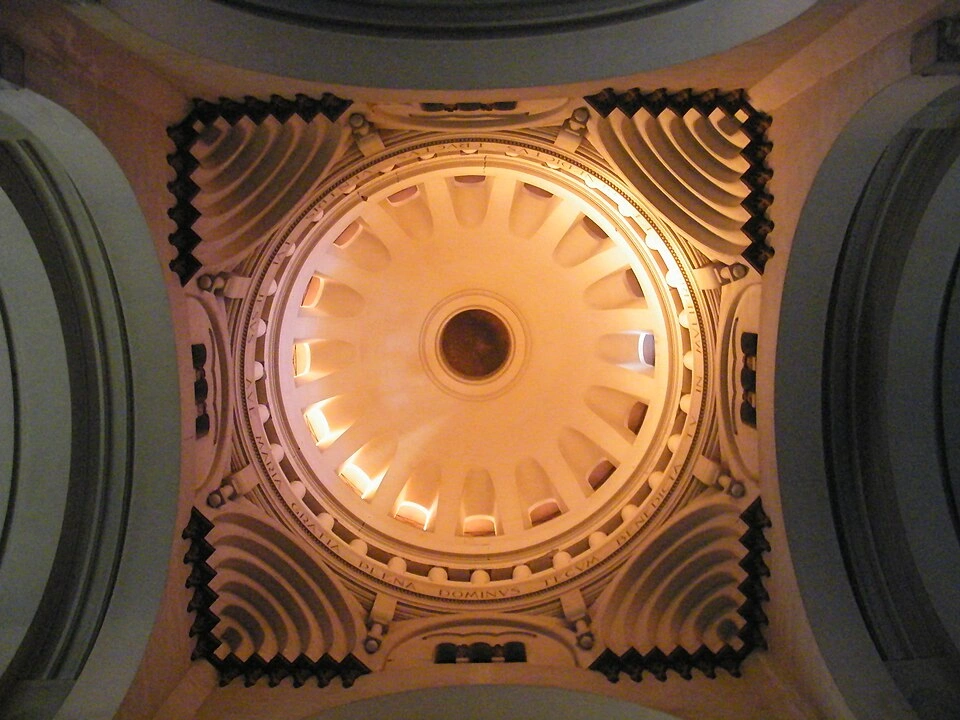
The Basilica of Lourdes stands out for its large dome, which reaches 70 meters in height. Above the Basilica’s transept, one can see what one might think is the great exterior dome, but it is not, as this system is composed of two independent domes that leave a void between them. The outer dome above the smaller inner dome is distinct from the larger outer dome below it. With both domes moving independently, this construction system may be able to respond to seismic requirements. Additionally, the inner dome serves as a fictitious ceiling to keep the void left by the outer dome from getting any larger. There are semicircular arched windows in the drum of the inner dome, and above these are smaller windows that represent the space between the inner and outer domes.
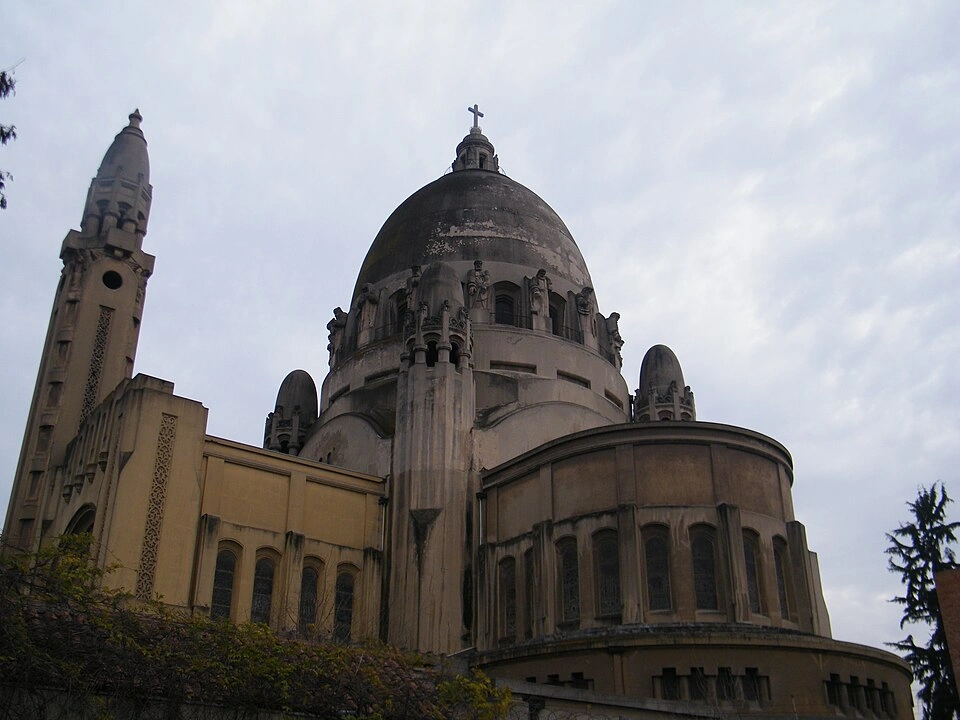
16 prophets/guardians of the great dome
Surrounding the main dome are the sculptures of 16 prophets, which belong to biblical characters, which have a height of 3.50 m. These sculptures, along with all of the others that decorate the Basilica, are attached to the curved walls. They were created by the Antofagasta sculptor Lily Garafulic and took two years to complete.
Minor domes
The function of these smaller domes, 40 meters high, surrounding the main dome is to complement the entire structure. These domes are decorated around the edges with gargoyles sculpted by Lily Garafulic.
Sculptures
As previously mentioned, the sculptures in the Basilica of Lourdes were made by the sculptor Lily Garafulic. Her works include figures on the pillar capitals, stone iconographic images of the four evangelists carved in the pulpit , sculptures on exterior walls, as well as the 16 prophets of the main dome, gargoyles on smaller domes, angels and fretwork on the bell tower, etc. The construction technique used was formwork and iron frames. In addition to these sculptures, she made the mosaics of the four evangelists on the floor of the baptistery, now the right side crypt of the apse.
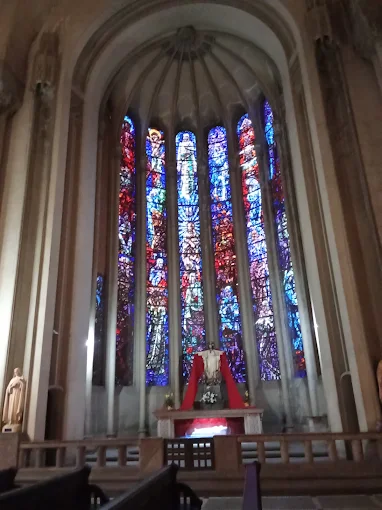
Stained glass windows
Inside the basilica are the stained-glass windows, 650 m² in total, by the French artist Gabriel Loire, who also created the mosaic of the Last Supper located in one of the apses . These windows are made of glass, iron, and cement, with a smooth, opaque surface on the outside and hammered on the inside. The treatment of glass allows for different shades of light, maintaining the intention of a rough and imposing façade with a warm and welcoming interior. The use of light and color defines the compositional and representative nature of the images of Jesus and the Virgin Mary, among others. The stained-glass windows immortalize the image of the family tree of the kings of Israel, culminating with Jesus in the arms of Mary in the upper window of the entrance; the 15 mysteries of the rosary in the former left apse; the apparition of Our Lady of Lourdes to Bernadette in the current right apse; the life of Mary in the central nave; 14 saints of the church on the main altar; and 16 devotions to Mary in the transept, among others. These stained-glass windows were damaged in the 1985 earthquake and were subsequently restored by their designer. These windows also fell off in the earthquake of February 27, 2010, and are being restored to their original design using the same technique.
Feast Day
Feast Day : 11 February
The Basilica of Our Lady of Lourdes in Quinta Normal, Santiago, Chile, celebrates its feast day on February 11. Known for its Gothic-Byzantine style, double-shell dome, and stained-glass windows, it is a key site of worship and pilgrimage.
Church Mass Timing
Monday to Friday : 12:00 PM, 7:00 PM
Saturday : 9:00 AM, 12:00 PM, 5:00 PM, 7:00 PM.
Sunday : 9:00 AM, 10:30 AM, 12:00 PM, 5:00 PM, 7:00 PM.
Church Opening Time:
Monday to Friday : 10:00 AM, 08:00 PM
Saturday : 08:00 AM, 06:00 PM.
Sunday : 10:00 AM, 06:00 PM.
Contact Info
Address : Basilica of Lourdes
Santo Domingo 3747, Quinta Normal, Santiago, Región Metropolitana, Chile.
Phone : +56 2 2773 3595
Accommodations
Connectivities
Airway
Basilica of Our Lady of Lourdes, Quinta Normal, Chile, to Arturo Merino Benitez International Airport (SCL) – Av. Armando Cortínez Ote, distance 15 min (14.2 km) via Autop. Costanera Nte..
Railway
Basilica of Our Lady of Lourdes, Quinta Normal, Chile, to Baquedano Railway Station, distance between 18 min (7.7 km) via Av. Alameda Libertador Bernardo O’Higgins.