Introduction
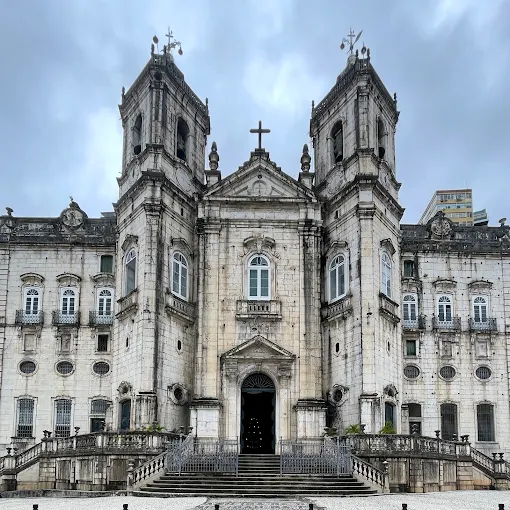
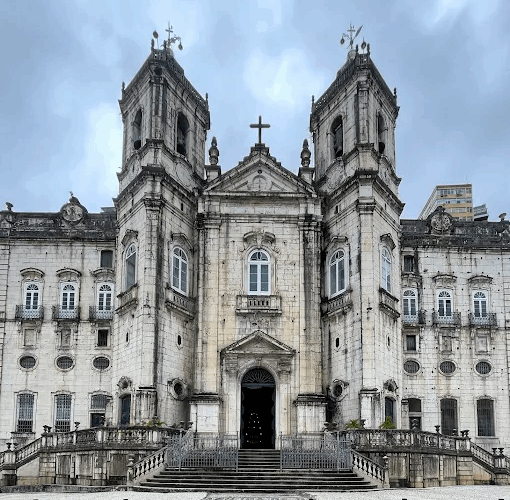
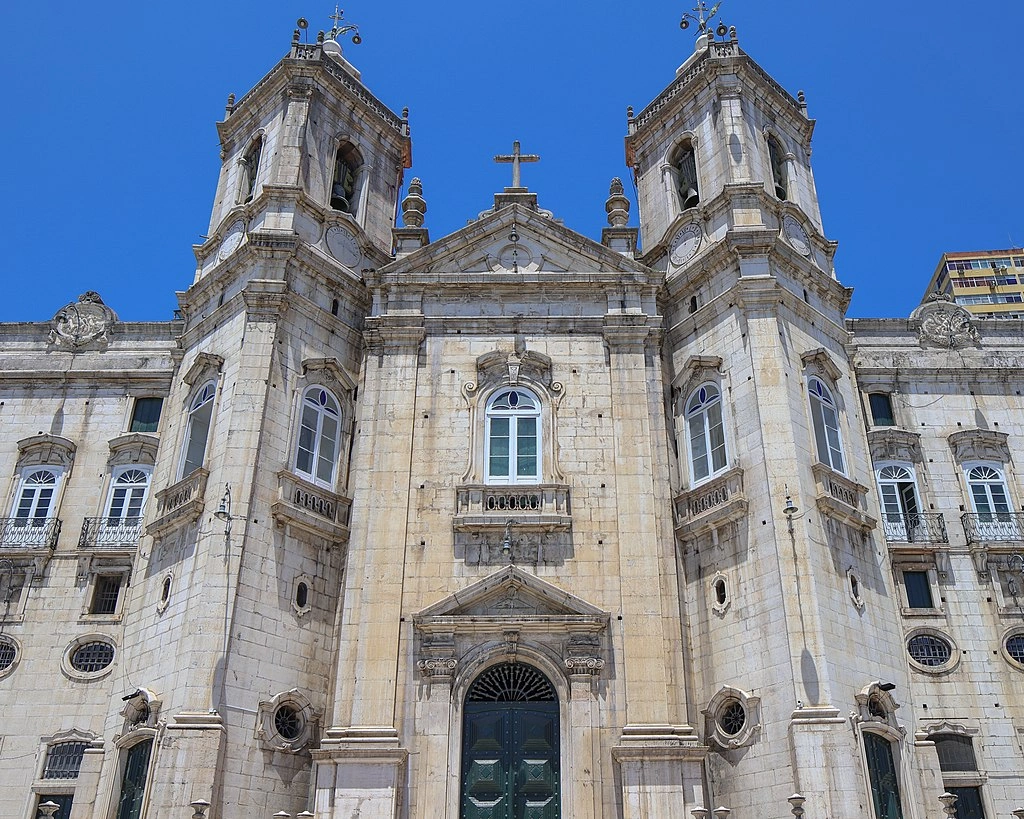
The Basilica of the Immaculate Conception (Portuguese: Basílica Nossa Senhora da Conceição da Praia), or the Basilica of the Conception, is a church in Salvador, Bahia, Brazil. It is affiliated with the Catholic Church and was built in 1623, making it one of the oldest parishes in the Roman Catholic Archdiocese of São Salvador da Bahia. It was the first church built by the first governor-general of Brazil, Tomé de Sousa. The current structure was prefabricated in Portugal and assembled in Salvador; its construction began in 1739 and ended in the mid-19th century. The art historian Germain Bazin classifies the church as Portuguese in design, rather than part of the Bahian tradition of religious structures of the 17th and 18th centuries. Its monumental façade is a hybrid of Baroque and Neoclassical styles, and is based on church façades of the period in Portugal. The building was designed by Manuel Cardoso Saldanha; the master bricklayer and architect Eugénio da Mota prepared the stonework in Portugal and accompanied it to Salvador. Its elevation to the status of basilica took place in 1946. Pope Pius XII declared Our Lady of Conception the sole patron of the State of Bahia. Robert C. Smith described the structure as the “first and most complete expression in Brazil of the new Baroque style that succeeded Mannerism in Portugal in the early years of John V’s reign.” The Portuguese art historian João Miguel dos Santos Simões stated that “Among the remarkable examples of 18th-century architecture that the Portuguese built on Brazilian soil, this one, honoring the patron saint of the Kingdom, stands out in historical importance and majesty.”
Location
The Basilica of the Immaculate Conception faces directly northwest onto the Bay of All Saints. The church once sat on the shore of the bay, and parts of the church, notably the chancel, were built directly into the cliff between the lower and upper city. Prior to its elevation to a basilica, it was known as the Igreja da Nossa Senhora da Conceição da Praia, or literally “Our Lady of the Conception of the Beach.” Landfill and extensive port expansion of the cidade baixa, or lower city of Salvador, was carried out in the 19th century. The church no longer sits directly on the bay, but rather faces a facility of the Brazilian Navy. The port facilities of the 19th century were replaced by high-rise buildings and a commercial center in the 20th century, in contrast to the Baroque-style structure.
The spatial context
The Church of Our Lady of the Conception of Praia is located on Conceição da Praia Street, in the Comércio neighborhood of Salvador. The church is also surrounded by the Montanha and Preguiça slopes, with its main access being via Contorno Avenue. The building was built near the Port of Salvador, at the foot of the mountain that connects the Upper and Lower cities. The building is embedded in the rock. The church’s facade faces northwest, causing direct sunlight in the afternoon. However, this doesn’t necessarily imply thermal discomfort, as the building receives a constant sea breeze. There’s little natural surroundings, limited to the sea, a few trees in front, and shrubs on the mountaintop behind the church. Surrounding the church are some well-preserved old houses, used for commercial purposes, featuring various colors like beige, blue, and yellow, creating a contrast with the surroundings. Others are in a state of disrepair and urgently in need of restoration. The building’s projected dimensions are approximately 2,562 square meters (58.50 meters by 43.80 meters). The building is approximately 26 meters high, generating a total volume of almost 67,000 cubic meters. The monument is open to the public, which means it is constantly occupied. During Mass times, the building is almost fully occupied. Ten employees maintain and clean the church daily.
Early history
The current church is the third structure constructed on the site. The first governor-general of the Portuguese colony of Brazil, Tomé de Sousa (1503–1579), established a primitive settlement and chapel in 1549 on the site of the current church during the initial stages of Salvador’s construction. Father Manuel da Nóbrega (1517-1570) and six Jesuit clergymen personally built a small mud-walled chapel at the base of the slope between the current upper and lower city. An image of the saint that Tomé de Sousa brought from Portugal was housed in the chapel, which was dedicated to Our Lady of the Conception. The church was christened the Conception of the Beach (Conceiço da Praia) by sailors and traders who arrived in Brazil. The location is close to the ocean and served as a place of worship. The name remained throughout subsequent reconstructions.
17th century
The population growth of the Cidade Baixa and the area near the port of Salvador necessitated the construction of a larger church. Marcos Teixeira de Mendonça (1578–1624), a bishop and resistance leader against the Dutch attacks against Brazil, expanded the structure in 1623. It received a new name, Matriz da Nova Freguesia de Nossa Senhora da Conceiço da Praia, and the money for it came from wealthy Portuguese merchants who lived nearby.
18th century
The Santíssimo Sacramento da Imaculada Conceição, a fraternal order, decided to completely rebuild the church in 1736. The military engineer Manuel Cardoso de Saldanha planned the church and Manuel Vicente, a master stonemason, supervised its construction. The master bricklayer and architect Eugénio da Mota prepared the lioz stonework in Portugal and accompanied it to Salvador. The import of lioz stonework from Portugal for use as architectural elements in Brazil began in the 16th century; it additionally served as ballast for Portuguese ships travelling to Brazil. The Cathedral Basilica of Salvador, formerly the Jesuit church of Salvador, is the first building in Brazil to be entirely made of lioz. This church is the second. It is the only Portuguese church in Bahia, according to art historian Germain Bazin, and its design is distinct from that of other religious structures in the region. Construction on the church began in 1739 but was delayed in 1758 by a financial downturn in Bahia. The woodcarver Lourenço Rodrigues Lançarote completed the elaborate side altars in 1765; he had earlier completed similar work in the Church of the Third Order of Mount Carmel. Between 1765 and 1773, Joo Moreira de Esprito Santo completed the high altar. The Archbishop of Bahia, Frei Manuel de Santa Inês Ferreira (1704-1771), dedicated the newly constructed building on December 8 of that same year, despite the fact that it was not yet finished. In 1769, Eugénio da Mota, “aged and nearly blind,” returned to Lisbon. 1773 marked the completion of the structure, but not of its interior decorative elements.
19th century
Four Portuguese masons succeeded Da Mota. The completion of the central section and left wing of the church in 1820 marked the end of major construction of the structure. By 1820 the fraternal order had spent 208,234,000 Portuguese réis on the church, making it one of the costliest in Bahia. The massive staircase in lioz and right wing of the structure were completed in 1850. The church of the Immaculate Conception received the title of minor basilica by the Apostolic Letter “Coruscantis sideris” of the 7 of October 1946, by decision of the Holy See.
Architecture of Basilica of the Immaculate Conception, Salvador, Brazil
Architect : Manuel Cardoso de Saldanha
Architectural style: Baroque architecture.
The church’s design shows clear influence from Alentejo architecture in Portugal, featuring a three-part structure divided by long aisles running lengthwise. On the left side, there’s access to a charming courtyard with a fountain. From this courtyard, a marble staircase leads up to the hall used by the church’s brotherhood. Inside, the church follows a transitional architectural plan. It has side chapels typical of the 17th century, while the aisles have superimposed tribunes (gallery-like spaces above), a design more common in the early 18th century. These tribunes are accessed through what are called “blind galleries,” somewhat similar to the triforiums seen in medieval European churches. The nave itself is octagonal, marking a shift from the rectangular style popular in the 17th century to the polygonal shapes favored in the 18th century. This space inside is notable for being the first complete example of Dom João V’s Baroque style in Brazil, with the nave’s ceiling painted in the illusionist Italian Baroque tradition.
Façade and Exterior Features
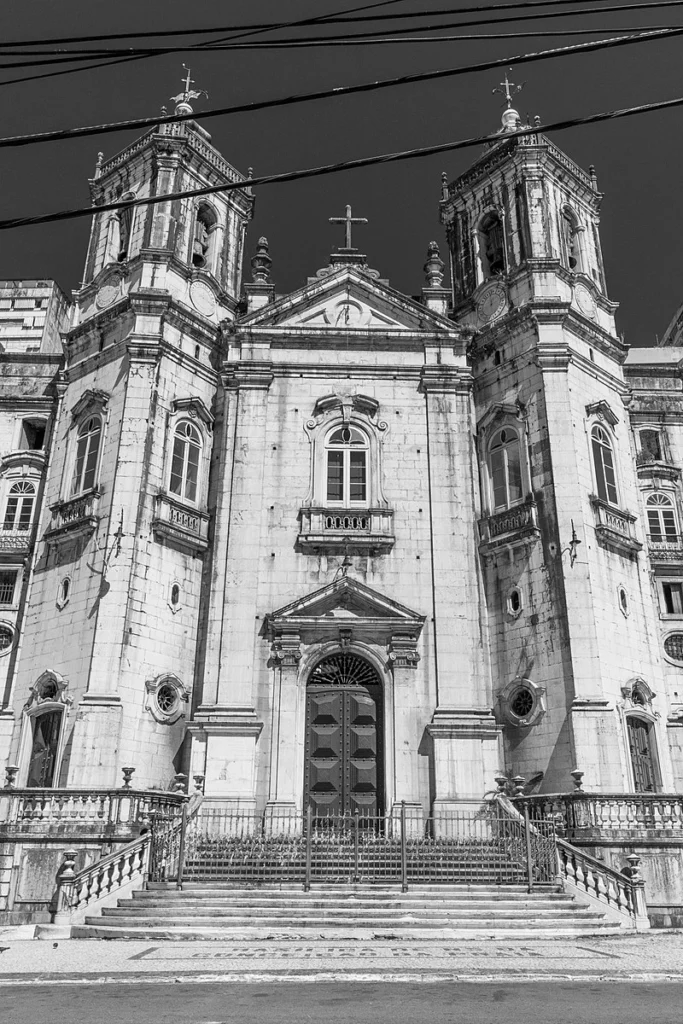
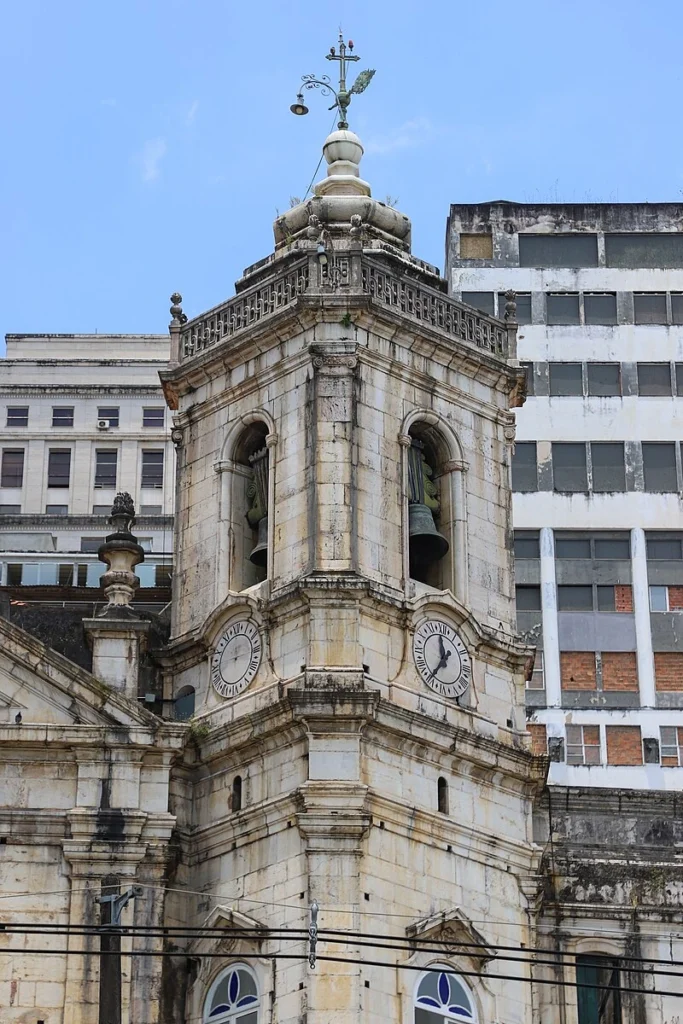
The façade of the church is monumental and features a neoclassical style with rich Joanine (King João V) decorative details. Its two towers are placed diagonally, which is unusual and gives the building a sense of movement and depth. The façade is very tall and narrow, which makes the whole structure appear elongated. The three doors, the four windows on the main façade, the top cornices of the towers, and the bays along the side aisles are all examples of curved architectural details. Oval windows on the walls of the nave and chancel soften the stonework and add elegance.
Interior Space and Altarpiece
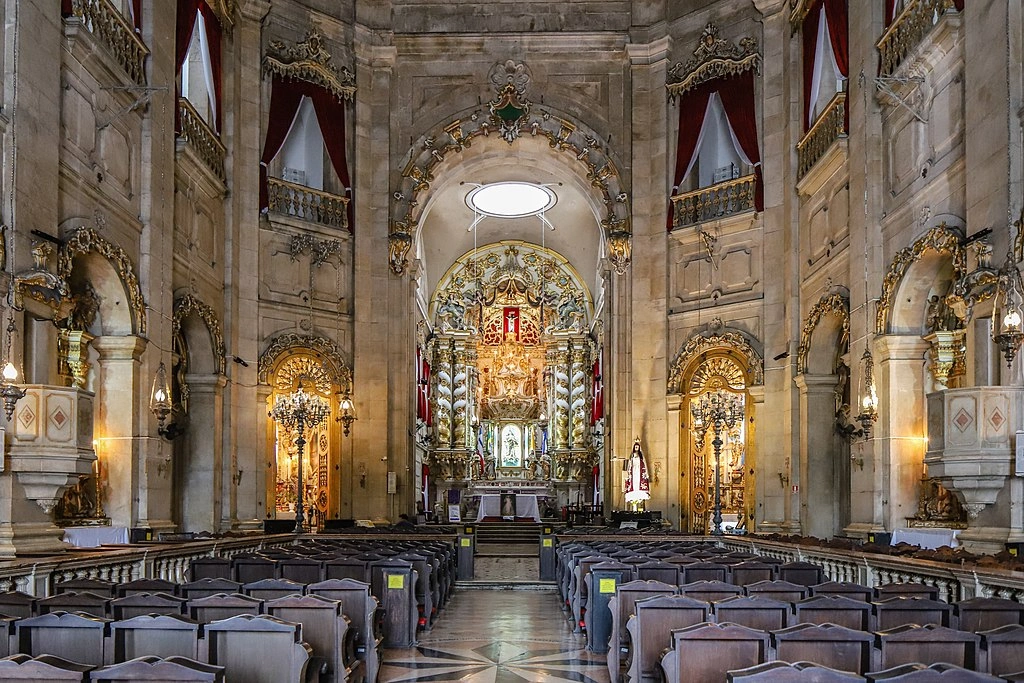
Inside, the church feels spacious and open. The nave measures roughly 28.5 meters long and 19.8 meters wide, ending with a three-sided polygonal area at the far end. Along the nave, there are three deep, square-shaped side chapels on each side, each housing an altar. The lower nave is lined with a series of twelve matching arches, which create a rhythmic flow leading to a massive arch over the chancel. Above, the arches of the tribunes on the upper floor continue this sense of harmony and balance. Some say the nave resembles a grand ballroom, others compare it to a warehouse, but its open, airy shape is undeniably impressive.
Additional Architectural Features
The church follows classic Luso-Brazilian architectural traditions. Two corridors run along the wings of the building from the entrance to the chancel at the back. The chancel itself is richly decorated, with its walls covered in large rectangular panels extending up to round windows (oculi) on the side walls. During the day, natural light floods the space, especially highlighting the high altar beneath a ceiling lantern. At night, modern lighting fixtures illuminate the church.
Bells and Natural Light
The church has 16 bells, historically used as an alarm system for Salvador’s citizens since the 18th century. After falling silent around 1990, they were restored and reactivated in 2021, now ringing daily at noon and 6 pm, and playing hymns during special events. Natural light is a key part of the church’s design. A cupola above the chancel allows sunlight in, and the building faces west, catching light from the Bay of All Saints through its many doors and windows
Interior Decoration and Art
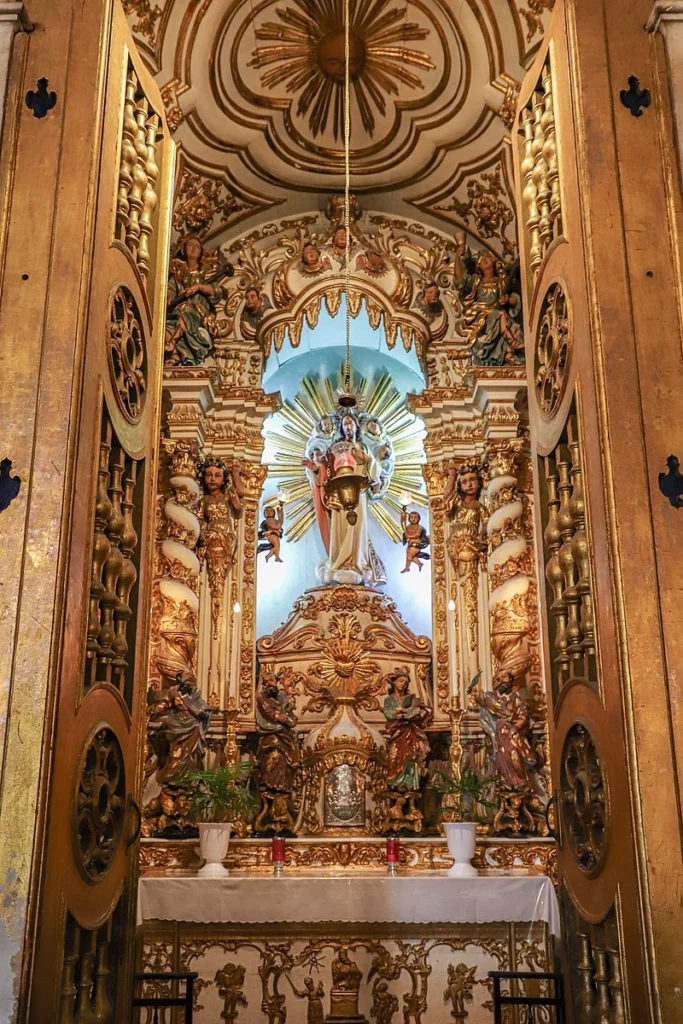
The church’s interior, which was partially altered in the neoclassical style in the 19th century, is the first complete example of John V of Portugal’s Baroque architecture. The high altar is elaborate, featuring a silver altar with an image of Our Lady of the Conception in the center and massive Solomonic columns. Between 1765 and 1773, master carver Joo Moreira do Esprito Santo carved the high altar out of cedar. The high altar’s gilding is primarily the work of Domingos Luiz Soares. The Italianate Solomonic columns, which are white with gilded floral garlands and acanthus details, resemble those of the baldachin of St.Peter’s Basilica. Natural light is provided to the chancel and high altar by a copula and two massive oculi in the ceiling. The chancel additionally has a rich collection of baroque-style furniture in jacaranda wood and candlesticks and lamps in silver. The only baroque elements in the church’s interior are the lateral portals and the Italianate-style portals between the nave and chancel.
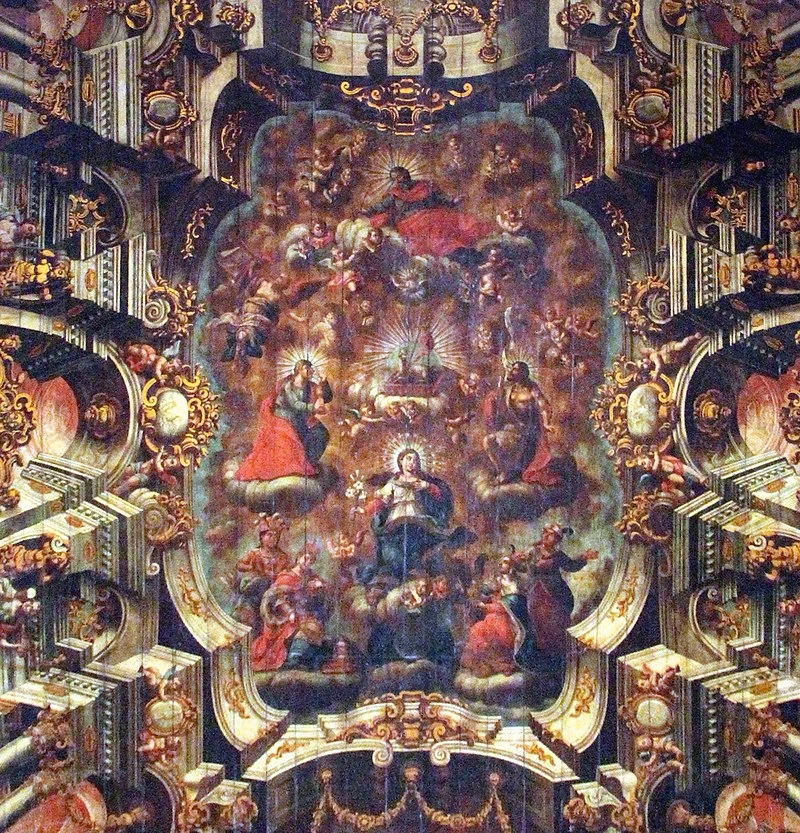
Nave ceiling
The ceiling of the nave has a large-scale painting of Our Lady of the Conception. It was painted in the Italianate Baroque illusionist style and by José Joaquim da Rocha (c. 1737–1807). The painting was executed in oil on wood between 1772 and 1776. João Miguel dos Santos Simões considers it Rocha’s most important work.
The construction system
This is a prefabricated church made of Lioz stone from Portugal that was shipped to Brazil in numbered sections. As previously mentioned, Eugênio da Mota was specifically hired to put together the “architectural puzzle,” and his stay in Brazil was extended until the work was finished. The process of preparing building pieces in Portugal was not limited to elements requiring the intervention of specialized artisans, but also often included the simplest foundations supporting the walls. The church’s almost unadorned limestone walls are divided by a grand order of Doric pilasters, supporting the royal gutter around the entire nave. Like so many other important colonial buildings, the Conceição da Praia church offers its façade as a major attraction. The building’s exterior is made of imported stone, while the interior is made of lime and irregularly shaped stone that has been white-painted. The nave and chancel are entirely clad in limestone, whose hues project warmth throughout the interior. A courtyard with a marble fountain is adjacent to the church’s two sacristies, separated by two storage rooms. The left wing ends with a sweeping staircase; the other wing is of less interest, except for the vaults of the meeting and storage rooms. The original wooden flooring was replaced by contemporary flooring made of polychrome Portuguese marble in the nave.
Details and finishes
The star-shaped marble floor is two-tone, alternating between white and red. The carved doorframes of the nave hint at the quality of the exterior window lines. Above the lintels, paintings hang in intricately designed wooden frames with Rococo details from the 1760s. The same applies to the arch valances, which stylistically lead to the carved lambrequins and gilded balustrades of the upper nave, adding relief and animation. The high altar is also made of carved and gilded wood. The left corridor leads to a courtyard with a fountain, where a wide marble staircase leads to the brothers’ room. The ante-sacristy features garland-style tiles from the 18th century, and the sacristy features tiles from 1960. The sacristy features a marble tile with a shell-shaped basin. The painting on the nave’s ceiling is a vast canvas traditionally accepted as the work of José Joaquim da Rocha. It belongs to the category known as “perspective” or illusionist painting, as it seeks to deceive the viewer’s eyes with false architecture and illusory space. The painting’s subject is the glorification of the Blessed Virgin of the Immaculate Conception, who appears crowned with stars, above her particular symbol the new moon. At her feet are four women festively dressed to pay homage to her. The two on the left represent America and Europe. On the right, Asia and Africa complete the group of the four parts of the world. Above the Virgin is the Holy Trinity, with the Agnus Dei adored by Saint John the Evangelist and the Holy Precursor.
Side Chapels
The church has eight side chapels in total three on each side of the nave and one on either side of the high altar. The chapel to the right of the high altar is dedicated to the Holy Christ, known as the Capela do Santo Cristo. Along the left side of the nave, starting from the far left, there’s the Chapel of Saint Joseph, followed by the Chapel of Our Lady of Sorrows, and then the Chapel of Saint John the Baptist, which also features an image of Our Lady of Fátima below it. On the right side of the nave, from left to right, you’ll find the Chapel of Our Lady of the Rosary with an image of Saint Pantaleon beneath it, and the Chapel of Saint Anthony, which includes an image of Saint Joseph below. Each chapel holds its own special significance and contributes to the rich spiritual atmosphere of the church.
Baptismal font
A large-scale baptismal font sits in a niche at the rear of the nave. It is of rare marble of the Arrábida region of Portugal, and is a dark reddish-brown color. The walls of the niche are lined with blue, yellow, and white azulejos.
Patio
A lateral corridor on the north side of the nave leads to an interior patio with a fountain. The lateral corridor is simple and decorated with azulejos of the 19th century, while the patio and its elements are entirely constructed of lioz. The patio has a staircase leading to the meeting room of the Brotherhood.
Protected status
The Basilica of the Immaculate Conception was listed as a historic structure by the National Institute of Historic and Artistic Heritage in 1938. It is listed in the Book of Historical Works process no. 112-T, inscription no. 126.
Feast Day
Feast Day : 08 December
The feast day of the Basilica of the Immaculate Conception in Salvador, Brazil, is celebrated on December 8th. This date honors Our Lady of the Immaculate Conception, the patron saint of the state of Bahia and of the basilica itself. It’s one of the most important religious festivals in Salvador and draws large processions and public celebrations.
Church Mass Timing
Monday, Thursday to Saturday : 7:30 AM
Tuesday : 7:30 AM , 6:00 PM
Wednesday : 7:30 AM , 12:00 PM
Sunday : 8:00 AM , 10:30 AM
Church Opening Time:
Monday to Friday : 08:00 AM, 12:00 PM, 02:00 PM, 04:00 PM.
Saturday, Sunday : Closed
Contact Info
Address : Basilica of Our Lady of the Conception of Praia
R.da Conceição da Praia, S/N – Comércio, Salvador – BA, 40015-250, Brazil.
Phone : +55 71 3038-6250
Accommodations
Connectivities
Airway
Basilica of the Immaculate Conception, Salvador, Brazil, to Salvador International Airport (SSA), distance 45 min (26.1 km) via Av. Luís Viana Filho.
Railway
Basilica of the Immaculate Conception, Salvador, Brazil, to RFFSA Largo da Calçada – Calçada, distance between 9 min (3.8 km) via Av. Jequitaia.