Introduction
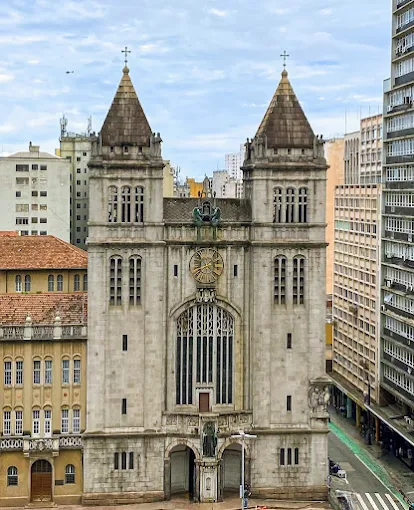
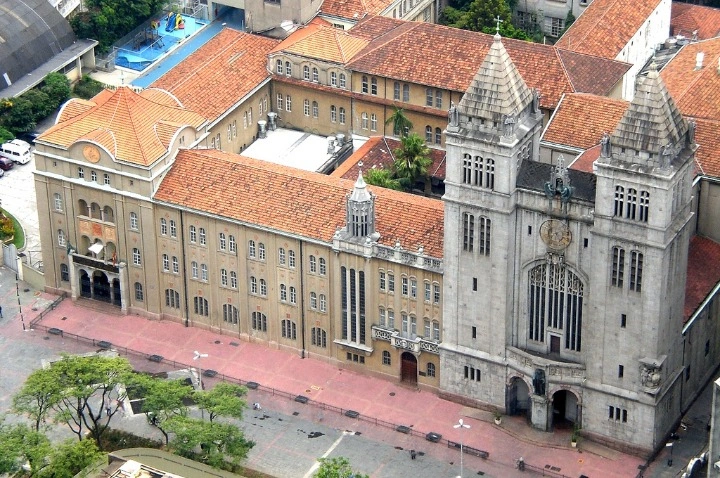
Monastery of Saint Benedict (Portuguese: Mosteiro de São Bento) is a Catholic temple located in São Paulo, Brazil. Established on 14 July 1598, the current church was built between 1910 and 1914 by the German architect Richard Berndl. It is formed by the Basilica of Our Lady of the Assumption, the College of São Bento and the School of Philosophy of São Bento. Currently, around 45 monks reside in the monastery, where they dedicate their lives to the ora et labora tradition. The Basilica of Our Lady of the Assumption contains a choir for the Divine Office in the monastic rite, celebrated daily by the monks, and Mass in the Roman rite, both with Gregorian chant. In May 2007, the monastery hosted Pope Benedict XVI on his first visit to Brazil.
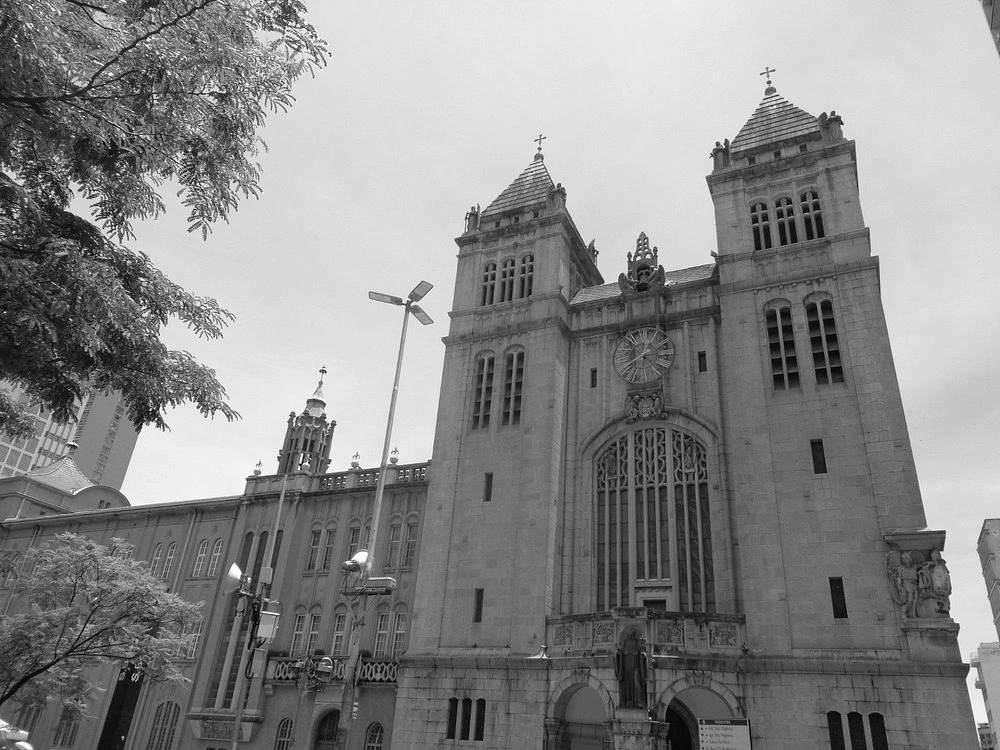
The foundation of the Monastery of Saint Benedict dates back to July 14, 1598. According to documents from the time, Captain-Major Jorge Correia granted two sesmarias, which would become the basis for the Benedictine temple. The land granted was located between the rivers Anhangabaú and Tamanduateí, stretching on one side to the Anhangabaú Valley and on the other to the current 25 de Março. The monastery was founded by Friar Dom Mauro Teixeira, a disciple of Father Joseph of Anchieta who met the cacique Tibiriçá and built a church in homage to Saint Benedict in the same location as his house. On April 15, 1600, the City Council officials validated the letter of sesmaria to Friar Mauro Teixeira. In 1634, the work was completed. Initially, the chapel was dedicated to Saint Benedict. Afterwards, at the request of the governor of the Captaincy of São Vicente, Francisco de Sousa, the patron saint changed to Our Lady of Montserrat and, in 1720, to Our Lady of the Assumption. In 1641, after the end of the Iberian Union, John IV, then Duke of Braganza, was crowned King of Portugal. In São Paulo, a group of largely Castilian settlers wanted to prevent the captaincy from recognizing the new king and offered Amador Bueno the title of King of São Paulo. He declined the offer and retreated to the Monastery of Saint Benedict to protect himself from the popular fury. With the help of the monks, tensions cooled and John IV was recognized by the people of São Paulo as the new King of Portugal. In 1650, the structure of the monastery underwent a renovation sponsored by the bandeirante Fernão Dias Pais, known as the “emerald hunter”. Gratefully, the monks awarded him the privilege of being buried in the chancel of the monastery church, along with his relatives and descendants; his remains still rest in the central nave of the temple. The clay sculptures of St. Benedict and St. Scholastica, made by Friar Agostinho de Jesus and displayed on the main altar of the church, date from the same period. In the first half of the 19th century, a law passed by the imperial government ordered the extinction of novitiates in Brazil, which prevented the entry of new monks and caused the monastic community to become almost extinct. The collapse caused by the act led to plans to transfer the monastery to the public treasury. Abbot Dom Miguel Kruse, a German religious, renovated the monastery and reversed the situation. In 1903, Kruse founded the College of São Bento (Colégio de São Bento) for secondary education and in 1908 he created the School of Philosophy (Faculdade de Filosofia). The colonial church and monastery were demolished on Kruse’s initiative to build a more modern building. The current temple, designed to match the city’s urbanization process, was erected between 1910 and 1922 according to a design by architect Richard Berndl, a former professor at the University of Munich, and decorated by Benedictine Adalbert Gressnigt.
Former monastery properties
The lands that today make up the Jardim São Bento neighborhood, located in the Casa Verde district of São Paulo’s North Zone, were part of the monastery’s extensive properties. For centuries, these lands were used to support the Benedictine community through activities such as agriculture and livestock, which were essential for the monks’ self-sustenance. As time passed and São Paulo’s urban growth increased, the monastery began selling off some of its land. This process was common among many religious orders that, throughout the 19th and 20th centuries, ceded land for the development of residential and commercial neighborhoods. It was in this context that Jardim São Bento emerged, a neighborhood named after the monastery due to the historical legacy of its former owner. In 1948, its ownership transitioned to Camargo Correa S/A. This event marked the beginning of a series of changes in the use of land in the region, through the subdivision of the area surrounding Sítio Morrinhos (Chácara de São Bento), an architectural complex built during the 18th century and consisting of the main house and some annex buildings. This gesture served to preserve the memory of the place, while adapting to the growth and urban needs of São Paulo.Today the area constitutes an upscale horizontal residential neighborhood , marked by tree-lined streets, with a curvilinear layout and named as an ode to the Catholic Church and the Order of Saint Benedict , examples: Monte Cassino ( Battle of Monte Cassino / Abbey of Monte Cassino ), Núrsia ( Benedict of Núrsia ), São Mauro , Frei Machado, São Plácido , Santo Anselmo , São Bruno , São Plácido , Dom Miguel Cruze, Dom Domingo de Silos, Padre Angelo Siqueira, Tibães ( Monastery of Tibães ), among others.
Architecture of Monastery of Saint Benedict (Saint Paul), Sao Paulo, Brazil

Architect: Richard Berndl.
Architectural style: Romanesque Revival architecture.
The monastery’s architecture typically originates from the 17th century. Construction work on the current Monastery of São Bento took place between 1910 and 1922, following the design of the German architect Richard Berndl, a native of Munich. The general style follows the tradition of Germanic eclectic architecture. Most of the interior decoration, such as the murals, was planned and executed by the monk D. Adelbert Gresnigt (1877-1956), a Dutchman who arrived in Brazil in 1913 especially for this responsibility. Adelbert originally came from Maredsous Abbey in Belgium. Gresnigt was a follower of the Beuron School of Art, a Benedictine school of art that influenced artists such as Gustav Klimt . The Beuron School or Beuron School of Art followed the aesthetic theory for religious art developed by the architect and sculptor Desiderius (Peter) Lenz, a graduate of the Munich School of Art. The founding of this School of Art within the walls of the Beuron Monastery in Germany was carried out by Lenz (its theorist), the painter Gabriel Wüger (1825-1890), and Abbot Mauro Wolter (1825-1890). The Aesthetic Theory developed by Lenz sought within ancient art (Egyptian, Greek, Sumerian and Babylonian) an artistic practice that would allow contact between the believer and God. He believed that ancient peoples had this knowledge and used it in their temples, but that this knowledge had been lost. His canon followed a mathematical principle in its production. Some medallions on the walls of the side naves were painted by Thomaz Scheuchl, a German painter. Also noteworthy are the sculptures of the 12 apostles in the nave, created between 1919 and 1922 by the Belgian sculptor and painter Adrien Henri Vital van Emelen (1868–1943), from the Lycée des Arts et Décorats . The sculptural ensemble dates from 1921 and is located on a beam above the chancel, by Anton Lang (1875–1938). Finally, the high altar itself is made of marble from the Lake Maggiore region of Italy. In 1922 the bells and clock were installed.
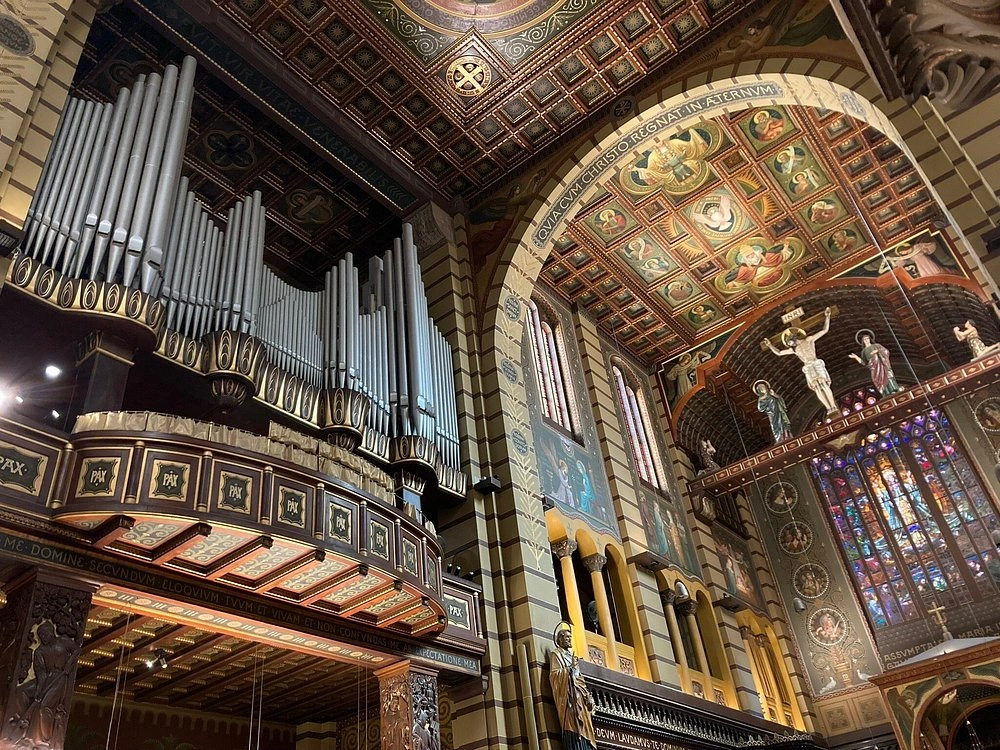
Clock and organ
The clock at the Monastery of Saint Benedict was made in Germany and installed in 1921. It was regarded as the most accurate clock in São Paulo until the advent of quartz crystal clocks. It features a carillon with six tuned bells that chime the full and fractional hours. The church organ dates from 1954 and is also German. It was produced by the Walcker factory and has over 6,000 pipes. It stands on the left side of the transept of the monastery church, supported by two large columns carved from oak created by Heinrich Waderé.
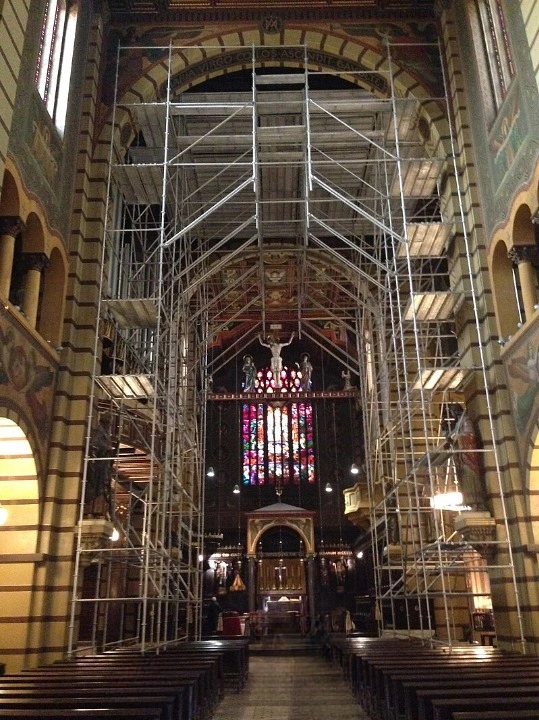
Pope Benedict XVI
In 2006, the monastery underwent improvements to receive and host Pope Benedict XVI , on his visit to Brazil in May 2007.
Conservation and restoration
The monastery follows a plan of preventive conservation, restoration and permanent maintenance. Since 2012, the architectural complex (Abbey Basilica, College and Monastery) and the movable assets (collection) have been cared for by the conservator/restorer, specialist in sacred art and bachelor in museology, João Rossi. Of the restored complex, we highlight the mural paintings, considered jewels of Beuronese art; other works are on display in the Abbey Church; the metalwork, which was cast in Europe and sent to Brazil, is in the same artistic style. Other works that were in the old buildings, such as the 1777 Santo Cristo by São Paulo native José Pereira Mutas, are also on display. Among the complex, one can appreciate the large sculptures of Saint Benedict and Saint Scholastica, both in dried, gilded, and polychrome clay, by the Benedictine Friar Agostinho de Jesus OSB, dating from 1650. Both have been restored, thus exposing the splendor of their originality. The largest conservation and restoration work in the building’s more than 100 years has been carried out with care and meticulous brushstrokes, rescuing the originality and beauty of the sacred art. For over 10 years, work to preserve the complex and its collection has been rigorously carried out. In the group there are large sculptures of Saint Benedict and Saint Scholastica, both in dried clay, gilded and polychrome, by the Benedictine Friar Agostinho de Jesus, dated 1650. Both restored. At the end of 2014 the restoration work was in its final phase.
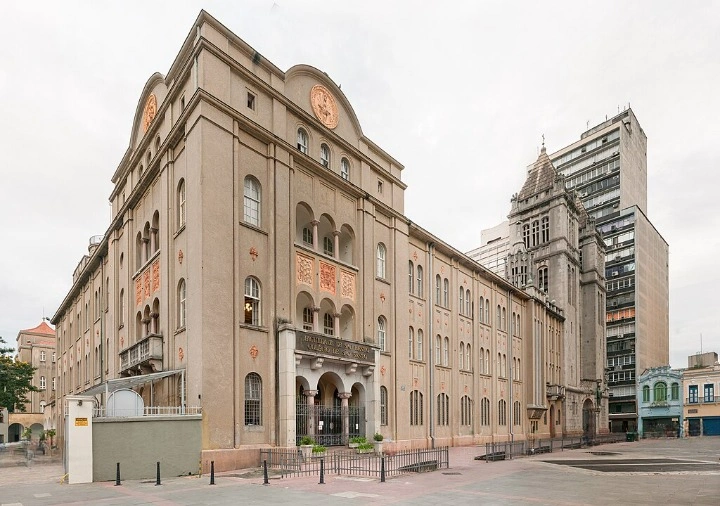
St. Benedict College and Faculty
In July 1900, a new period began in the history of the monastery, when work began on the college (then called the gymnasium), which was completed in 1903, with Afonso d’Escragnolle Taunay among its founding teachers. It was around this time that work began on a new abbey and monastery. In 1910, construction began, designed by architect Richard Berndl of Munich, Germany. Four years later, in 1914, the complex as it is known today was completed, housing the Basilica of Our Lady of the Assumption, the Monastery, and the College of St. Benedict. St. Benedict’s College is one of the leading schools for Chinese students outside of China, so much so that some of its students are of Chinese origin. In 1908, the Faculty of Philosophy was founded, which would be the first in Brazil and the embryo of the Pontifical Catholic University of São Paulo, created in 1946. The Faculty of São Bento still maintains its educational tradition today, offering a degree in philosophy, as well as courses in classical languages, such as Greek and Latin.
Library
The monastery also houses a library with over 100,000 titles, some of which are quite rare. It is believed to be the oldest in the city of São Paulo, dating back to the time when the first monks arrived in 1598. The collection contains 581 titles published before the 19th century, including six rare incunabula. The oldest is a New Testament dated 1496. It also has a curious collection of tiny manuscripts, less than a centimeter long, which contain a biblical passage or a prayer, as well as rare editions of books that were banned by the Catholic Church . The acquisition of books by the Monastery library occurred both through purchase and as an inheritance of books for the monks’ own personal use, which were incorporated into the collection after the monk’s death. It is assumed that, in the 18th century, the Monastery library was also a registry office and archive. Access to the collection is restricted to monks and students, but researchers and scholars may apply for special permission.
Feast Day
Feast Day : 11 July
The Monastery of Saint Benedict in São Paulo celebrates its primary feast on July 11, honoring Saint Benedict’s legacy. This is the traditional date recognized by the Church worldwide. A secondary observance takes place on March 21, marking the saint’s death. Both dates are significant within the Benedictine monastic tradition.
Church Mass Timing
Monday to Friday : 07:00 AM, 01:00 PM
Saturday : 05:50 PM
Sunday : 07:00 AM, 05:00 PM
Church Opening Time:
Monday to Friday : 07:00 AM, 06:00 PM
Saturday : 06:00 AM, 01:00 PM
Sunday : 08:00 AM, 10:00 AM
Contact Info
Address : Monastery of Saint Benedict (Saint Paul)
Largo São Bento, s/nº – Centro Histórico de São Paulo, São Paulo – SP, 01029-010, Brazil.
Phone : +55 11 3328-8799
Accommodations
Connectivities
Airway
Monastery of Saint Benedict (Saint Paul), Sao Paulo, Brazil, to São Paulo/Guarulhos–Governor André Franco Montoro Int’l Airport (GRU), distance 25 min (25.1 km) via BR-116.
Railway
Monastery of Saint Benedict (Saint Paul), Sao Paulo, Brazil, to Tamanduateí Avenida Presidente Wilson – Vila Independência, distance between 15 min (8.9 km) via Av. do Estado.