
Introduction
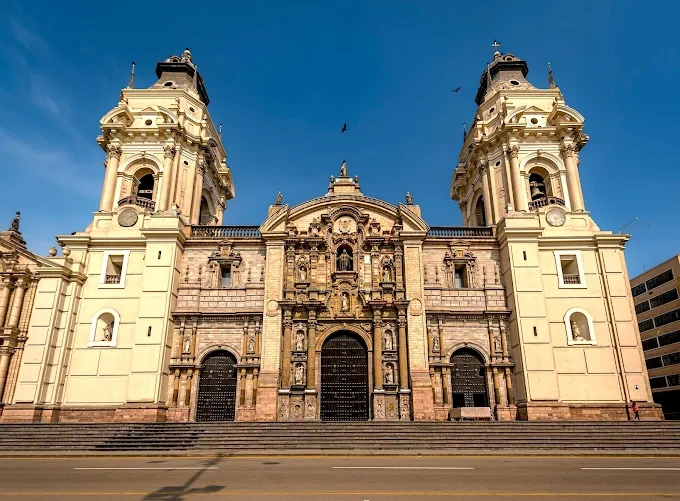
The Basilica Cathedral of Lima, commonly known as the Metropolitan Cathedral of Lima, is a Roman Catholic cathedral in Lima, Peru. It is the seat of the Archdiocese of Lima. Its construction began in 1535 by under Francisco Pizarro and was completed in 1797, having been built in its present form between 1602 and 1797. Its patron saint is Saint John, Apostle and Evangelist, to whom it is dedicated. Located on the eastern limit of the Plaza Mayor, at the second block of the Jirón Carabaya, and is part of the Historic Centre of Lima. The Archbishop’s Palace and Iglesia del Sagrario are located beside the cathedral. It is the oldest and largest church in Peru.
Location in the city
The Cathedral Basilica of Lima occupies the east side of the Plaza Mayor of Lima, on Gradas de la Catedral street, block 2 of the current Augusto Wiese Street (formerly Carabaya Street ).
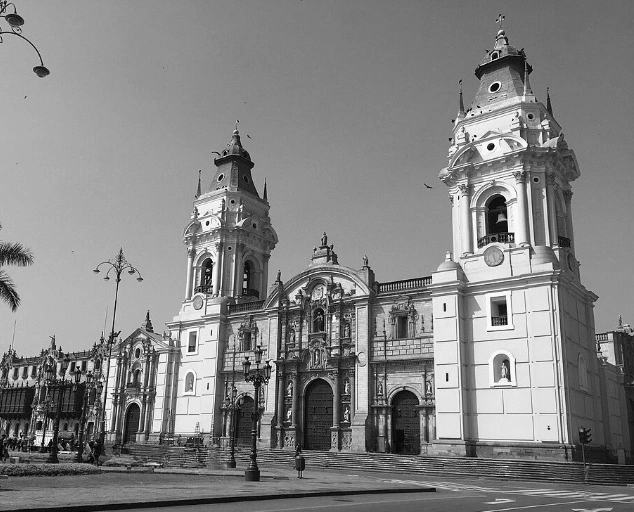
The Lima Cathedral was built on the site of the Inca shrine of the Puma Inti and the palace of the Cusco prince Sinchi Puma, a direct descendant of the Inca Sinchi Roca, once stood. When he founded Lima, Francisco Pizarro designated a plot of land for the church, making Sinchi Puma renounce his property in a document certified by a notary, so that the occupation of the site chosen for the church would not mean usurpation of ownership. In 1535 Pizarro laid the first stone and carried, in a public demonstration of faith and humility, the first timber for the construction of the church (first cathedral), which was made under the patronage of Our Lady of the Assumption, finishing the construction in 1538 and inaugurated on March 11, 1540, placing the Blessed Sacrament for the first time on that day. After the disputes between Diego de Almagro and Pizarro, and after the Viceroyalty of Peru had been established, Pope Paul III, taking into consideration the growth of the city of Lima, issued a bull on May 14, 1541 creating the archdiocese of Lima and elevating the small church to the category of cathedral which began to be built in 1542 during the government of Cristóbal Vaca de Castro . Francisca Pizarro Yupanqui , daughter of the founder of Lima, contributed the considerable sum of five thousand gold pesos for the construction of the new cathedral, which ended up costing fifteen thousand gold pesos, thanking the King of Spain by Royal decree of March 19, 1552. With the changes introduced by the peacemaker Pedro de la Gasca to give it greater prestige, the new church (second cathedral) begun by Cristóbal Vaca de Castro was inaugurated in 1552 by Archbishop Jerónimo de Loayza . This was a small building -9 x 19 m-, very modest and narrow, and for its foundations reddish stone was brought from a quarry in Lunahuaná. The new temple later became patron saint of Saint John the Evangelist.
A cathedral of great dimensions
Later, when the city of Lima became an archbishopric, it was thought that building a new cathedral would reflect the city’s growing population and elevated status. Archbishop Jerónimo de Loayza decided in 1564 on a grand structure that would rival Spain’s most famous cathedrals, like Seville Cathedral, which was then the largest cathedral in Spain. This decision marked the beginning of a change in size. Work began with the demolition of the original adobe walls, but the new construction was never completed. Alonso Gonzales Beltrán, a master builder, was given the task of creating a massive temple with three naves and side chapels in 1564. However, his project, which was influenced by the Seville Cathedral, proved to be too extravagant and costly. When Viceroy Martin Henriquez arrived in Lima in 1581, Toribio de Mogrovejo was Archbishop of Lima. At that time, Viceroy Martn Henriquez ordered the construction of a new cathedral. In 1585, the Trujillo architect Francisco Becerra, who had designed several buildings in Mexico City and Quito, was summoned from Cusco, where he was working at the time, and given responsibility for building the third cathedral. Becerra devised a new plan that was partially inspired by the cathedrals of Jaén and Seville and is regarded as the foundation for the existing structure. The first had three naves, just like the Lima cathedral, and the second had five. However, there are doors in the transepts, three doors on the main facade, and a side courtyard called the patio de los naranjos, just like the Lima cathedral. This side door is on the left. The final design of the cathedral, designed by Becerra, resulted in a Renaissance-style church with a spacious floor plan, three large naves, and two side chapels. Lima Cathedral is a church with three naves, two additional chapels, and a flat end. (…) The three naves are of equal height, as in Jaén Cathedral. The two Peruvian cathedrals’ immediate predecessor was the latter. derived from Art of the Hispanic American People.
According to a letter that Philip III wrote to Archbishop Toribio de Mogrovejo in 1602, the church was still “an old hut, covered with straw with great indecency.” In the letter, Philip III urged Archbishop Toribio de Mogrovejo to speed up the construction process. The first part of the third cathedral was inaugurated in 1604. The church was only half built when Becerra died in 1605. The final plan was created right after the earthquake in 1606, but another one in 1609 threatened to destroy the entire structure by damaging the vaults of the section that had already been built. The Chief Architect, Juan Martnez de Arrona, supported the idea of brick vaults, but several members of the Cabildo, or Municipal Council, thought that covering the temple with wood would be more effective against seismic movements. Tired of finding a solution to the problem, they appointed Bartolomé Lorenzo as Arrona’s advisor. Finally, in October 1625, the naves of the main part of the third cathedral were consecrated. Arrona designed the main gate, which was completed in 1632, and the towers in 1649. The cathedral was severely damaged in the 1687 earthquake, and despite all of the precautions taken during its construction, it was again damaged in the 1746 earthquake and nearly destroyed, necessitating a new reconstruction. In 1758, Viceroy José Antonio Manso de Velasco, who was in charge at the time, directed the construction of a new cathedral on the same site. The current structure is a reconstruction that was carried out by the Jesuit Juan Rher, who was born in Prague, with the assistance of a mulatto architect, following the instructions of Viceroy José Antonio Manso de Velasco. Rher utilized wood and wattle and daub to the fullest in the ribbed vaults, rebuilt the Renaissance stone façade, and made significant progress on the project while leaving the bell towers unfinished for a considerable amount of time. The reconstruction was carried out in three parts, the first culminating in 1755, the second in 1758 and the last in 1778. The priest Matas Maestro rebuilt and finished the cathedral’s current bell towers, which had been left unfinished between 1794 and 1797. The bell known as “La Cantabria” can be found in the left tower. It was cast in Lima and weighs 300 quintals. “La Pursima,” which weighs 150 quintals, and “La Vieja,” which weighs 55 quintals, are on the right. This cathedral was built on the order of Viceroy José Antonio Manso de Velasco. It is the one that is known. However, it is different from the original in many ways because of earthquakes and continuous renovations. So much so that it is impossible to specify its architectural design style to this day. Peru’s first church, which holds the title of There has been a mix of Gothic, Baroque, Neoclassical, and Romantic styles. A substantial change was the relocation of the choir to the presbytery, as well as the removal of most of the original Baroque altars and ornaments. These transformations began in 1804, in keeping with the prevailing neoclassical trends of the time. The alleged remains of Lima’s founder were moved to the cathedral in 1891 and placed in the chapel for the Adoration of the Kings, third from left. There, they rested until the mausoleum was built, where the real remains, discovered in 1977, are now preserved. During the 19th century, the cathedral was not properly maintained, and it was closed in 1893 because of its decaying condition. The exterior of the cathedral was altered by additional renovations in 1897, and the interior of the converted cathedral was dedicated in 1898. It was made a minor basilica on May 28, 1921, and it was given the name Cathedral Basilica of Saint John the Evangelist. The 1940 earthquake caused considerable damage to the cathedral, and a complete restoration project was undertaken, directed by architect Emilio Harth-Terré. The restored opulence of Peru’s first church is due to his expertise in colonial architecture. On this occasion, the Tabernacle portal was replaced, albeit with several differences from the one that existed before 1897.
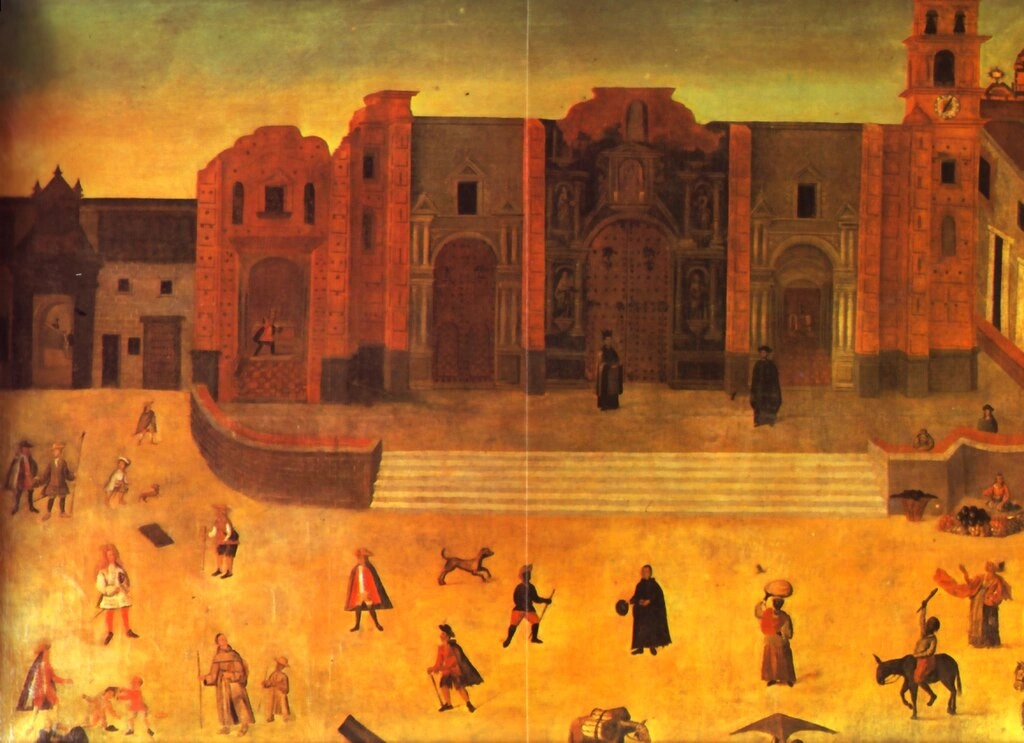
The cathedral in the historic center of Lima
Since 1991, the Cathedral has been included as a World Heritage Site, as it is located in the historic center of Lima , and a visit is a must when visiting Peru .
The Cathedral of Lima today
In recent years, under the pastoral care of Cardinal Juan Luis Cipriani Thorne and with the support of private enterprise, numerous and meticulous restoration projects have been carried out on the Cathedral and its artwork, as well as improvements to its lighting. These projects culminated in 2004, the quadricentennial year of the inauguration of the first part of the third Cathedral. In 2005, new lighting was installed (to enhance the facade at night) as part of the “Tourist Circuit of Light” project, carried out at the initiative of Lima Mayor Luis Castañeda Lossio to improve Lima’s historic center . In addition to the Lima Cathedral, the Government Palace and the Municipal Palace of Lima were also considered to be part of the group of buildings illuminated by the Municipality of Lima and the Endesa group. During the week, the Cathedral offers tourists the religious site as a museum, which houses notable works of art from the colonial era.
Major earthquakes withstood by the cathedral
First earthquake On October 19, 1609, an earthquake struck the City of Kings, damaging all three vaults of the Cathedral. This led to its initial reconstruction, shifting from a Renaissance to a Gothic style. The Archdiocese, Chapter, and Episcopal See were relocated to the nearby Church of La Soledad, which served as the Cathedral for ninety years. Second earthquake On October 20, 1687, another earthquake damaged the Cathedral again, necessitating a new reconstruction, although without any major changes. In 1697, it was officially reopened. Third earthquake On October 28, 1746, a third earthquake destroyed the Cathedral’s naves and columns once more. The Chief Cosmographer Juan Rher helped with the third reconstruction. At the request of Archbishop Diego Antonio de Parada, it was completely rebuilt and reopened in 1778. Between 1794 and 1798, the two towers were rebuilt, and they are still there today. Fourth earthquake Lima had to be rebuilt once more on May 24, 1940, when another earthquake struck. The architect Emilio Harth-Terré was in charge of this reconstruction, which was the final one shown. Fifth earthquake The 1966 Lima and Callao earthquake occurred at 4:41 p.m. on October 17, 1966. It had a magnitude of 8.1 on the Moment Magnitude scale. Sixth earthquake The Ancash department experienced an earthquake on May 31, 1970. It was felt in Lima with an intensity of VI on the Modified Mercalli scale and a magnitude of 7.9 on the Moment Magnitude scale. Seventh earthquake The 1974 Lima earthquake, which occurred on October 3 and had a magnitude of 8.0 Moment and an intensity of VII on the Mercalli scale, reaffirms the Lima ideology’s association of the month of October with earthquakes. Eighth earthquake An 8.0 magnitude earthquake struck off Lima on November 9, 1974, the primary aftershock of the October 3 earthquake. Ninth earthquake On August 15, 2007, the city of Lima was shook once more by an earthquake with the epicenter in Ica, but the cathedral was unaffected.
Architecture of Cathedral Basilica of St. John the Apostle and Evangelist, Lima, Peru
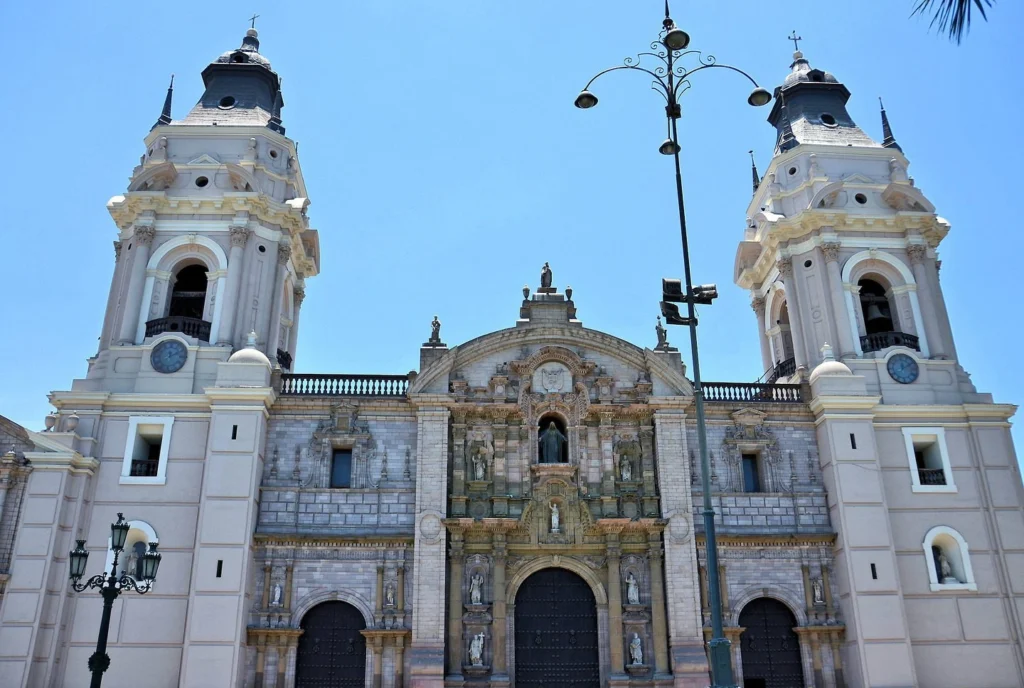
Architect: Francisco Becerra.
Architectural style: Baroque architecture, Neoclassical architecture, Gothic architecture, Renaissance architecture.
Burials: Francisco Pizarro, Turibius of Mogrovejo.
Exterior
The façade of Lima Cathedral is Renaissance in style with Plateresque ornamentation. Its tall towers with slate spires are neoclassical, with stylistic influences from the Escurialense School and Northern Europe. It has three doors, like most cathedrals. The main one (the one in the center) is called the Door of Forgiveness, the one on the right is called the Door of the Epistle , and the one on the left is called the Door of the Gospel . There are also two side doors, one leading to Calle de Judíos (right-hand side) and the other to the Patio de los Naranjos (inner courtyard attached to the Cathedral). At the back of the church ( Calle de Santa Apolonia ) there are two other doors: that of Santa Apolonia and that of San Cristóbal . On the main façade, you can see statues of the Apostles, and in the central niche, the Sacred Heart of Jesus. Currently, at the top, you can see the coat of arms of Peru, in the place where the coat of arms of the city of Lima originally stood, along with the phrase Plus Ultra . Next to the Cathedral are the Parroquia del Sagrario (one of the oldest in Lima) and the Archbishop’s Palace, the seat of the ecclesiastical government of Lima.
Interior
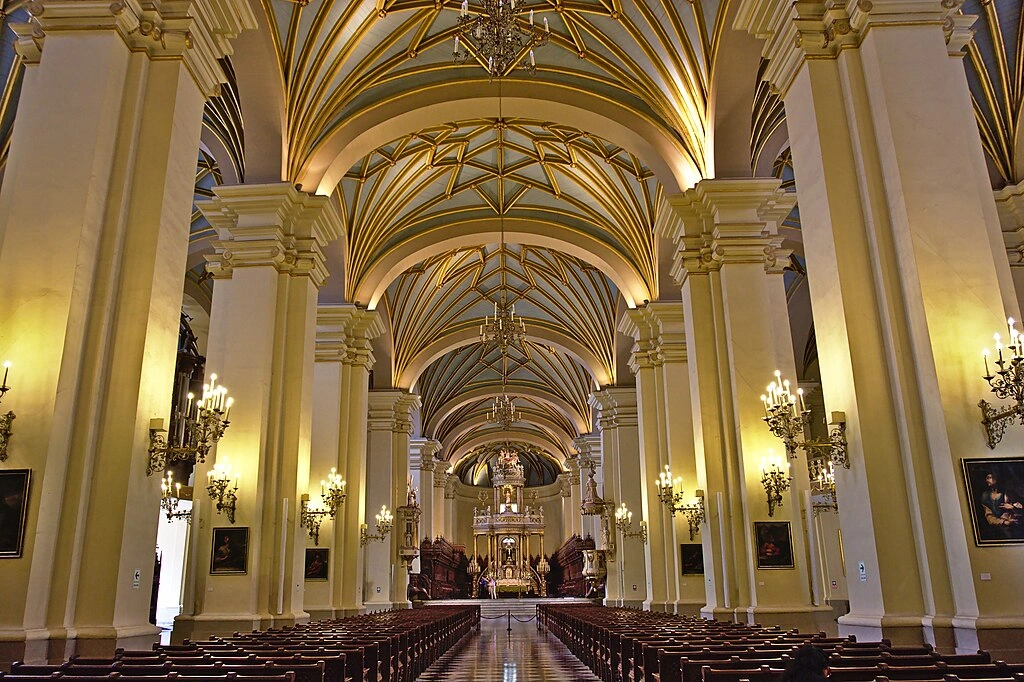
Lima Cathedral displays several styles, from late Gothic and Renaissance to Baroque and Plateresque. Given that it was built in the late 19th century, the architectural style is Renaissance. The layout of the halls is rectangular, similar to Seville Cathedral. Gothic ribbed vaults that resemble a starry sky support the roof. Wood and stucco are used to construct these vaults, which help to support the walls and prevent them from collapsing in the event of an earthquake. The style of its altars was originally Baroque, but some were later replaced with neoclassical ones. Despite being in the Renaissance style, the arrangement of the choir stalls is varied. Some of Peru’s most famous colonial-era sculptors are represented in its chapels and sacristy. The Cathedral itself is a perfect amalgamation of Lima’s various architectural styles from its inception to the present day.
Ships
The Lima Cathedral has three naves and two additional naves where the side chapels open. Along the side aisles, large paintings depicting the Stations of the Cross can be seen. The columns have recently been decorated with twelve paintings that refer to the Twelve Apostles and the Twelve Articles of Faith of the Apostolic Creed. Two plaques at the building’s entrance commemorate John Paul II’s two visits there in 1985 and 1988.
Chapels
Chapel of Our Lady of Hope In the left aisle, in the first chapel, we can see the old baptistery, with its baptismal font. It is home to a stunning sculpture of Virgin Dolorosa, or Our Lady of Hope, who typically presides over the Easter and Lent services in this city and is a part of the Marian procession during Holy Week. The chapel’s previous polychrome covering was discovered during recent restorations and is now on display for visitors. The Holy Family Chapel The ancient polychrome wood carvings of Jesus, Mary, and Joseph can be found in the Chapel of the Holy Family, which is the following chapel. Four wooden panels from the old choir stalls, which predate the current ones, and two large oval paintings of Saints Peter and Paul are also on the walls. The city’s carpenters’ guild once owned this chapel. Los Reyes’ Chapel of the Antigua The next one is currently called the Chapel of the Antigua, like the one located in the retrochoir and which was under the patronage of the University of San Marcos. In the past, students there earned academic degrees. The altarpiece housed in this chapel, in neoclassical style, is attributed to Matías Maestro and is presided over by an image of the Virgin of the Antigua (from the mid- 16th century), patron saint of the University since 1627, and two wooden statues stand out, of San Marcos and Santo Tomás de Aquino, from the old chapel of the university in the current Plaza Bolívar . The altarpiece’s columns are painted in a variety of colors, each one representing the University’s basic faculties. The painting was originally in the retrochoir, which was accessible from the Cathedral’s main entrance.Chapel of the Peruvian Saints The Chapel of the Peruvian Saints is next. There are images of Saint Martin de Porres, Saint John Macias, and Saint Francis Solano, Peruvian saints, as well as Saint Rose of Lima, the first saint of the Americas. It was initially housed in the Belén church, which is now defunct, and was originally dedicated to the Lima saint shortly after her canonization. It houses the tomb of Monsignor Emilio Lissón, the 27th Archbishop of Lima, currently in the process of beatification. The massive pipe organ that the 20th Archbishop of Lima, Francisco Xavier de Luna Pizarro, commissioned was located above the door to the Patio de los Naranjos. It was built in Belgium by the organ builder Hippolyte Loret (1810-1879), was modified by Inocente Foglia around 1900, and has not been used in more than 60 years.
Chapel of the Immaculate Conception
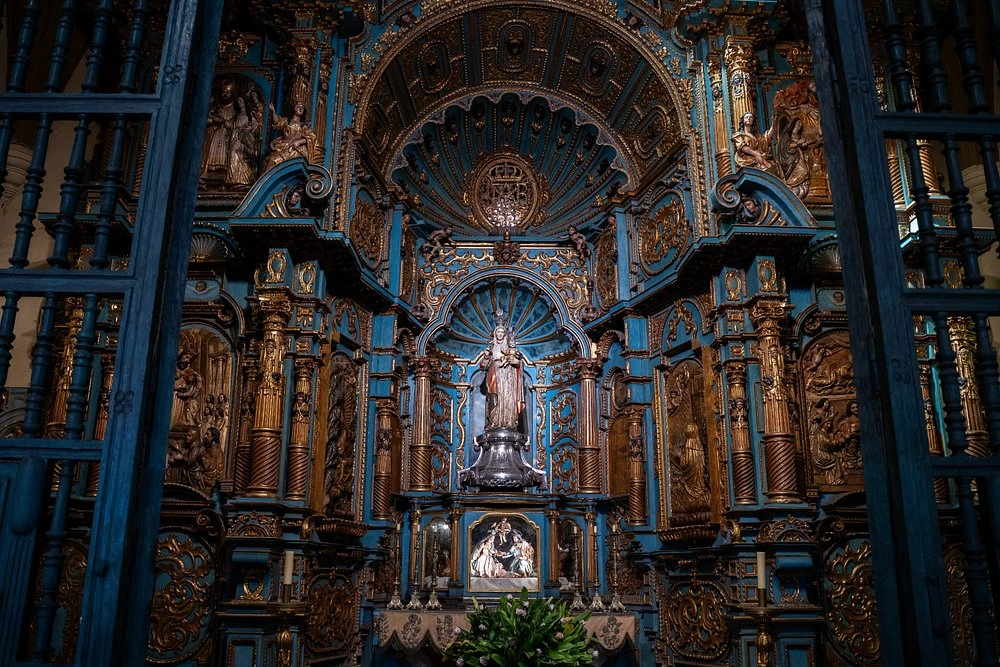
Next comes the impressive Chapel of the Immaculate Conception, now dedicated to Our Lady of Evangelization. This is one of the few chapels that still has its original Baroque altar, as many have neoclassical altars, following the renovations carried out by the priest Matías Maestro and subsequently the destructive restoration in the 1890s. However, he preserved it because it was so beautiful. The altar is presided over by the image of Our Lady of Evangelization, a 16th- century wooden carving sent by Emperor Charles V, which formerly presided over the main altar. It is one of the first images of the Virgin to arrive in the New World. In her right hand she holds the Golden Rose, a papal decoration conferred by John Paul II in 1988 on his second visit to Peru, and which very few Marian devotions hold. On the left wall of the chapel there is a large painting of Saint Josemaría Escrivá de Balaguer, founder of Opus Dei, made in 2005 to mark the 30th anniversary of his death and to commemorate the moment when the saint visited this same chapel in 1974. The painting replaced the altarpiece of the tomb of Archbishop Diego Morcillo, which had been located in that place for more than two centuries and was later relocated to another chapel in the cathedral. The altarpiece also contains figures from a Nativity scene that, according to tradition, was the first in the city of Lima, commissioned by the daughter of Francisco Pizarro. The walls have beautiful tiles, recently restored. Next comes the entrance to the sacristy, where we see, on the left, a 16th – century bas-relief of the Adoration of the Shepherds, one of the oldest pieces in the Cathedral, which presided over the main altar of the first temple. On the right, a painting of the Virgin of Guadalupe. We also see medallions of Our Lady of Sorrows and the Ecce Homo, and carvings of Saint Ambrose and Saint Augustine.
Chapel of the Virgin of Peace
Continuing down the nave is the Chapel of Our Lady of Peace, where the Blessed Sacrament is currently reserved. On the left wall is a painting of Saint John the Evangelist, patron saint of the Cathedral, giving Communion to the Virgin; and on the right is the tomb of the venerable Friar Francisco Camacho.
Choir stalls
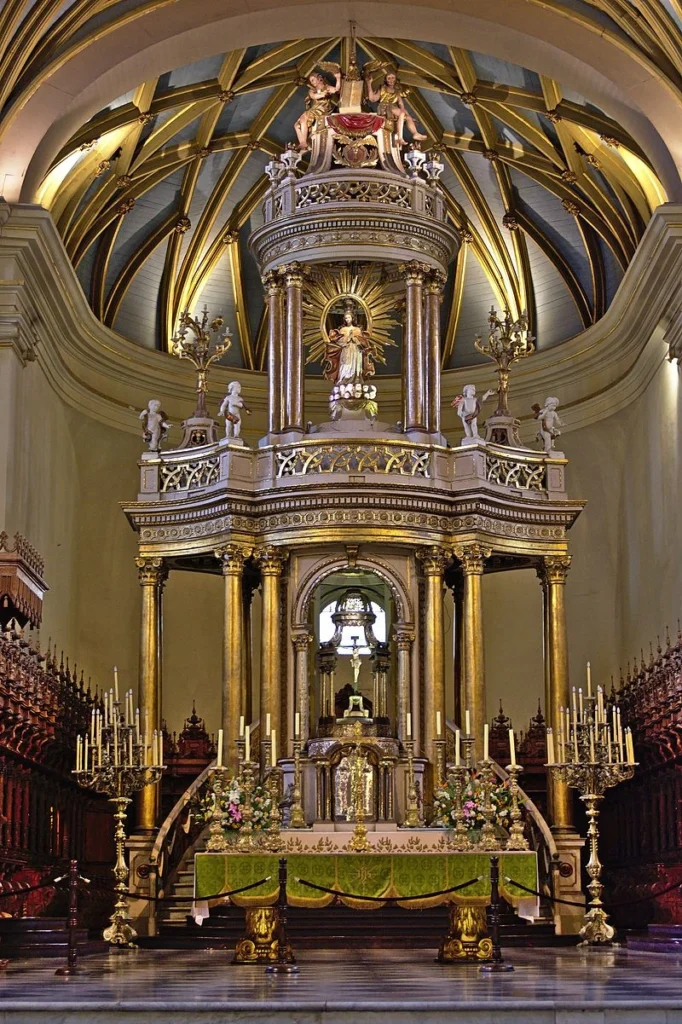
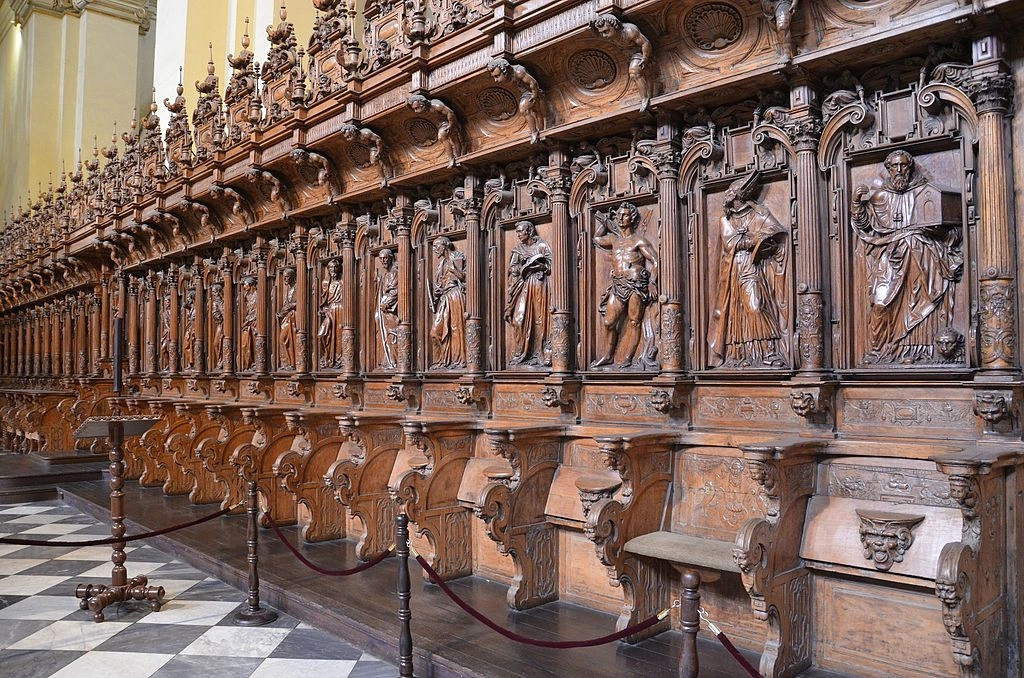
The impressive choir stalls, currently flanking the main altar, were designed by Martín Alonso de Mesa and executed by Pedro de Noguera in the 17th century . Numerous saints, including apostles, doctors, popes, bishops, and virgins, are depicted on the backs. The choir used to be opposite the main altar, similar to where it is now in the Cathedral of Mexico City. The figure of the Redeemer is positioned under a canopy on the back of the Chair, which is in the left stalls. The main altarpiece, in neoclassical style, is presided over by an Immaculate Conception. From Jerónimo de Loayza, the city’s first pastor, to Cardinal Augusto Vargas Alzamora, the city’s last pastor, the crypt of the Archbishops can be found beneath the presbytery. An image of Saint John the Evangelist tops the neoclassical pulpit, and a Paschal Lamb tops the crucifix in front of it. There are four statues of Saints John the Evangelist, Peter, Paul, and James the Greater, two on each side, in the nave’s transept. It is the work of the priest Matías Maestro, who led the renovation of Lima’s old Baroque altars, replacing them with neoclassical ones.
Crypt of Francisco Pizarro
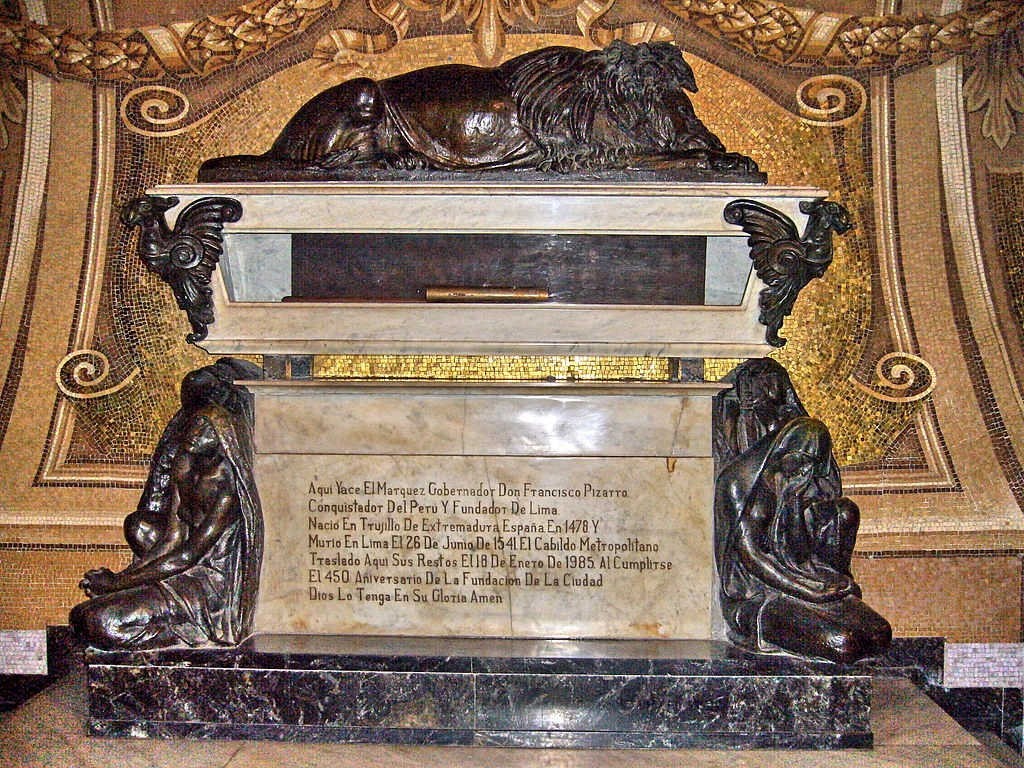
In the right nave, starting again from the entrance, is the crypt of Francisco Pizarro , completely covered with mosaics alluding to the Conquest. The Lima coat of arms is visible on one of the walls. The head appears to be detached from the body on the sarcophagus, possibly as a result of the numerous manipulations to which his remains were subjected. The original body was discovered at the beginning of the 20th century . A small chest with soil from Trujillo, his hometown, is in front of the sarcophagus. In the past, when entering Lima Cathedral, it was always thought that Pizarro’s body was the one presented in a glass urn located on an altar in the Cathedral itself. The right side, close to the entrance, was pointed out by tour guides. A saffron-colored mummified skeleton could be seen on the marble altar. In 1891, on the 350th anniversary of his death, it was decided to publicly display his remains in this location. From that point on, anyone visiting Lima had to stop there. In 1977, the Cathedral underwent a series of interior repairs. A lead box with some blurry inscriptions was accidentally discovered by workers renovating the Cathedral’s crypt. They had no idea that they were the real remains of the Spanish explorer who founded Lima. They found the box in a crevice hidden behind a wall. “Here is the head of the Marquis Don Francisco Pizarro, who discovered, conquered, and placed the kingdoms of Peru in the Royal Crown of Castile,” read the inscription. They also discovered a velvet-lined coffin with a lot of bones next to it. The remains belonged to a woman, two children, and a mature man, whose identity was later confirmed by a team of scientists. In addition, these researchers labored for numerous months to ascertain where these remains came from. In order to gather information about Pizarro’s turbulent political and military life, archaeologists, anthropologists, pathologists, radiologists, chemists, and historians collaborated. Previously housed in this chapel, the Christ of Help altarpiece is now in Santa Ana’s chapel.
Chapel of St. John the Baptist
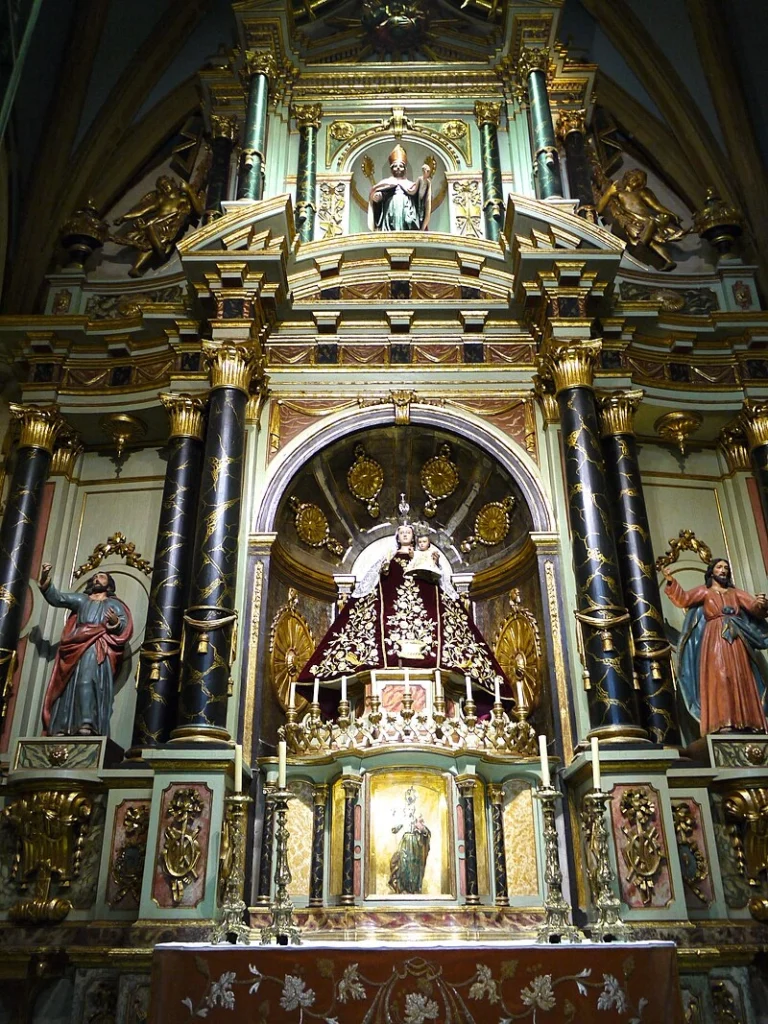
Then there is the Chapel of Saint John the Baptist, whose altarpiece features polychrome reliefs alluding to the life of the saint. It is presided over by a large crucifix, one of the oldest in the Cathedral. Its altarpiece was made by the famous Sevillian sculptor Juan Martínez Montañés, and brought to the New World by ship over several years. It is considered among the finest altarpieces in the cathedral temple, although it originally belonged to the Church of the Immaculate Conception on Jirón Abancay.
Chapel of the Virgin of Candelaria
Next comes the Chapel of the Virgin of Candelaria, whose altarpiece is a masterful work by the priest Maestro. Its style is a transition from Baroque to Neoclassical.
Chapel of Santo Toribio de Mogrovejo
Next is the Chapel of Santo Toribio de Mogrovejo, second Archbishop of Lima and Patron Saint of the Latin American episcopate, whose remains are preserved in the Cathedral (a reliquary with his relics can be seen above this altar). In this chapel, other reliquaries with episcopal vestments of the saint can be seen on the walls. To the left is the tomb of Cardinal Juan Landázuri Ricketts, 30th Archbishop of Lima, and to the right, a large painting depicting the theft of some hosts from the neighboring Parish of El Sagrario (the hosts were miraculously found, it is said, in the neighboring district of Rímac, where the Church of Santa Liberata currently stands. There is another painting there depicting the moment of their discovery). Like the altarpiece of Santa Rosa de Lima, it originally belonged to the now-defunct Church of Belén. Above the side door is the choir gallery, with the organ currently in use. This platform was the result of renovations that took place in the late 19th century and is not part of the church’s original architecture.
Chapel of St. John the Evangelist
Next comes the Chapel of St. John the Evangelist (formerly the Chapel of St. Anne ). On the left wall is the tomb of Nicolás de Ribera y Laredo the Elder, the first mayor of Lima, and on the right is that of José Damián de Ceballos Guerra y Muñoz, Count Consort of Santa Ana de las Torres, above the sepulchral vault of the Dávalos de Ribera family. Its altarpiece is one of the most beautiful in this temple, and its style is baroque-neoclassical. Chapel of the Visitation: Next, we see the Chapel of the Visitation or of the Souls, with the Visitation group presiding over it. On the left is a Resurrected Christ who appears in a triumphal procession on Easter Sunday. Chapel of the Souls: Next is the tomb chapel of the Archbishop of La Plata and Lima and Viceroy of Peru, Friar Diego Morcillo Rubio de Auñón , originally dedicated to the Souls in Purgatory. The tomb altarpiece was originally located on one side of the Chapel of the Conception and displays the authentic image of that chapel, which in turn replaced the carving by Diego Morcillo, which is displayed separately in the same space. Chapel of St. Joseph: Finally, the last chapel is dedicated to Saint Joseph, with polychrome reliefs on the altarpiece alluding to his life. Reliefs from the life of the Virgin are also displayed in this area of the nave. The sculpted group of the Holy Family that presides over the altar is by the sculptor Pedro Muñoz de Alvarado.
Disappeared environments
Chapel of St. Bartholomew
It was located behind the presbytery and separated from it by an ambulatory. The main altarpiece, in the Tuscan order, consisted of three sections and featured a canvas depicting the martyrdom of Saint Bartholomew. In the same area was the tomb altarpiece of the Archbishop of Lima, Bartolomé Lobo Guerrero , with three sections in imitation marble. The sculpture of the Archbishop can still be seen as part of the Cathedral Museum.
Chapel of the Virgin of the Antigua
It was located in the church’s transept. The main altarpiece originally housed the painting of Our Lady of the Ancient, now in the Chapel of the Kings. A 17th- century text describes the original Baroque altarpiece, mentioning the existence of twelve Solomonic columns and thirty paintings of the Virgin, in addition to the painting that is the main altarpiece. The chapel disappeared with the renovations undertaken at the end of the 19th century , along with four other auxiliary chapels of the first one that were located on the sides of the choir.
Sacristy and Chapter House
Returning to the sacristy and entering it, we find ourselves in the antechamber, also called the Zodiac Room , because its walls feature 12 paintings alluding to the 12 signs of the zodiac, painted in the Bassano workshop. Adjoining it is the Monsignor Alberto Brazzini Room, inaugurated in honor of the prelate, who died on May 29, 2001, and was auxiliary bishop of Lima. It displays numerous religious art objects, belonging to him and donated by his family to the Cathedral, as well as some of his episcopal ornaments and jewels. Moving on to the Sacristy , we see the large chest of drawers by Juan Martínez de Arrona , with wooden panels decorated with images of Christ, the twelve apostles, Saint Joseph , and Saint John the Baptist , as well as the twelve articles of faith from the Apostles’ Creed on each panel. Beautiful antique liturgical ornaments are also on display here. Finally, we arrive at the Chapter House, where the members of the Church Council used to meet ( and continue to meet on Saturday afternoons ). On the walls are medallions of all the archbishops of Lima, with a description of each. Also on display here are vestments and ornaments worn by Pope John Paul II during his two visits to Peru, sacred vessels that were gifts from him to the Peruvian Church, and some of the vestments of former archbishops.
Ceremonies
Every year, on July 28th, a Mass and Te Deum are celebrated in gratitude for Peru ‘s independence , attended by the president, his ministers, and the nation’s top authorities. Also on January 18th, a Thanksgiving Mass is celebrated for the city’s anniversary, with the presence of the Mayor. A custom that was rescued by Cardinal Juan Luis Cipriani is to celebrate Mass every Sunday and holy days of obligation at 11:00 a.m. Since 2000 and under the auspices of Cardinal Cipriani, the Lima Cathedral has recovered much of its grandeur, restoring most of its constructive and decorative elements (although some elements are still to be restored, such as some altarpieces), becoming a true center of the liturgical, ecclesial and cultural life of Lima and Peru.
Feast Day
Feast Day : 27 December
The feast day of Saint John the Apostle and Evangelist, the patron saint of the Cathedral Basilica of St. John the Apostle and Evangelist in Lima, Peru, is celebrated on December 27. This date is observed in the Roman Catholic Church to honor Saint John, one of the Twelve Apostles and the author of the Gospel of John, the Book of Revelation, and three Epistles.
Church Mass Timing
Saturday : 9:00 AM
Sunday : 11:00 AM
Church Opening Time:
Monday to Friday : 09:00 AM, 08:00 PM
Saturday : 10:00 AM, 10:00 PM
Sunday : 01:00 PM, 07:00 PM
Contact Info
Address : Lima Cathedral
Plaza de Armas de Lima, Jirón Carabaya s/n, Lima 15001, Peru.
Phone : +51 964 102 774
Accommodations
Connectivities
Airway
Cathedral Basilica of St. John the Apostle and Evangelist, Lima, Peru, to New Jorge Chávez International Airport, distance 23 min (14.4 km) via Vía Expresa Línea Amarilla.
Railway
Cathedral Basilica of St. John the Apostle and Evangelist, Lima, Peru, to Desamparados Station Lima 15001, Peru, distance between 6 min (1.5 km) via Jr. Azángaro and Jr. Lampa.