Introduction
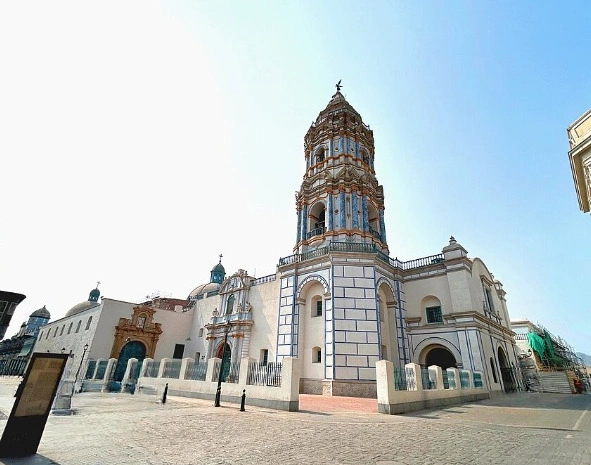
The Basilica and Convent of Our Lady of the Rosary, often called the Convent of Santo Domingo, is a Catholic religious complex located in Lima, Peru. It was built back in the 1530s and is dedicated to Our Lady of the Rosary. You’ll find it right in the Historic Centre of Lima, where it has stood for centuries. This place is especially important because it holds the relics of two of Peru’s most famous saints: Rose of Lima and Martin de Porres. Another interesting fact is that the University of San Marcos, the first university in Peru and the oldest in the Americas, began operating here in the 16th century, inside the convent’s historic chapter house. The complex is situated at the corner of Jirón Camaná (formerly Pecante Street) and Jirón Conde de Superunda (now Veracruz Street). It’s a beautiful example of religious architecture and holds a significant place in Lima’s history.
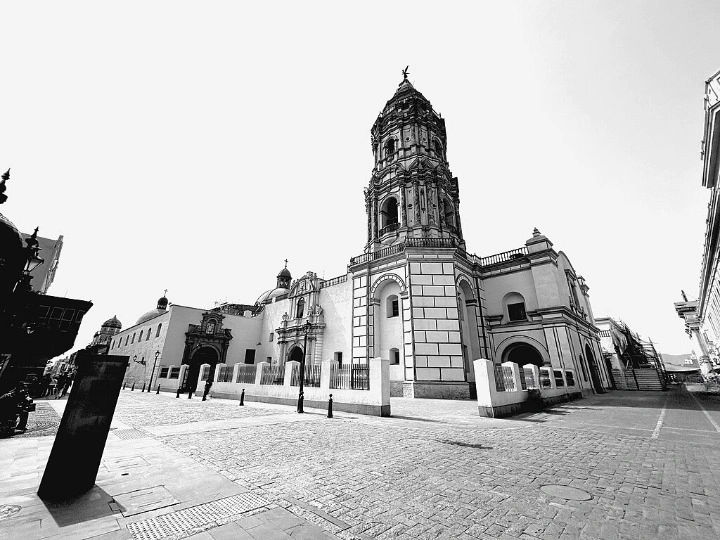
The construction of the Convent of Santo Domingo took about 50 years. Its construction began during the foundation of Lima and concluded at the end of the 16th century. It was the provincial Friar Tomás de San Martín, who began to carry out the construction of the first church of the Order, being later the superior Friar Sebastián de Ayllón that received aid of the King, finishing the work in the year of 1578. The first building was completely destroyed by the earthquake of 1678. A new church was erected by Dominican architect Diego Maroto, and the convent was rebuilt, which had six cloisters and several courtyards before the earthquake of 1687. The church was rebuilt from the transept to the choir, the arches were changed and the number of windows was expanded. As a result, the church acquired breadth, simplicity and uniformity. The materials used in the construction were adobe, brick and calicanto, among others. The quincha served to lighten the weight, to make the structure more flexible and to increase the resistance to the earthquakes, so frequent in this region. Because the earthquakes of 1687 and 1746 the set necessitated further modifications, such as the reconstruction of the tower, the main portal of the church and part of the convent, which included changes in the distribution of the cloisters, which is currently can appreciate. The church was elevated to the category of Minor Basilica in 1930. The structure of the church was some damaged ten years later by an earthquake and restored in the later years. The convent’s apple orchard would be lost to the changing course of the Rímac River.
The small square
It is located in front of the religious complex and has on one side the bronze bust of Dr. Augusto Pérez Aranibar , protector of children and promoter of Social Assistance, was inaugurated by the mayor of Lima Luis Bedoya Reyes in 1965. In its central part, and in front of the Church of Santo Domingo, there is a small bronze monument “A Shoeshine Boy “. The square is surrounded by a building dating from the second half of the 19th century , which has a corner balcony type box, with lattice and glass constituting a typical example of republican architecture.
Architecture of Basilica and Convent of Santo Domingo, Lima, Peru
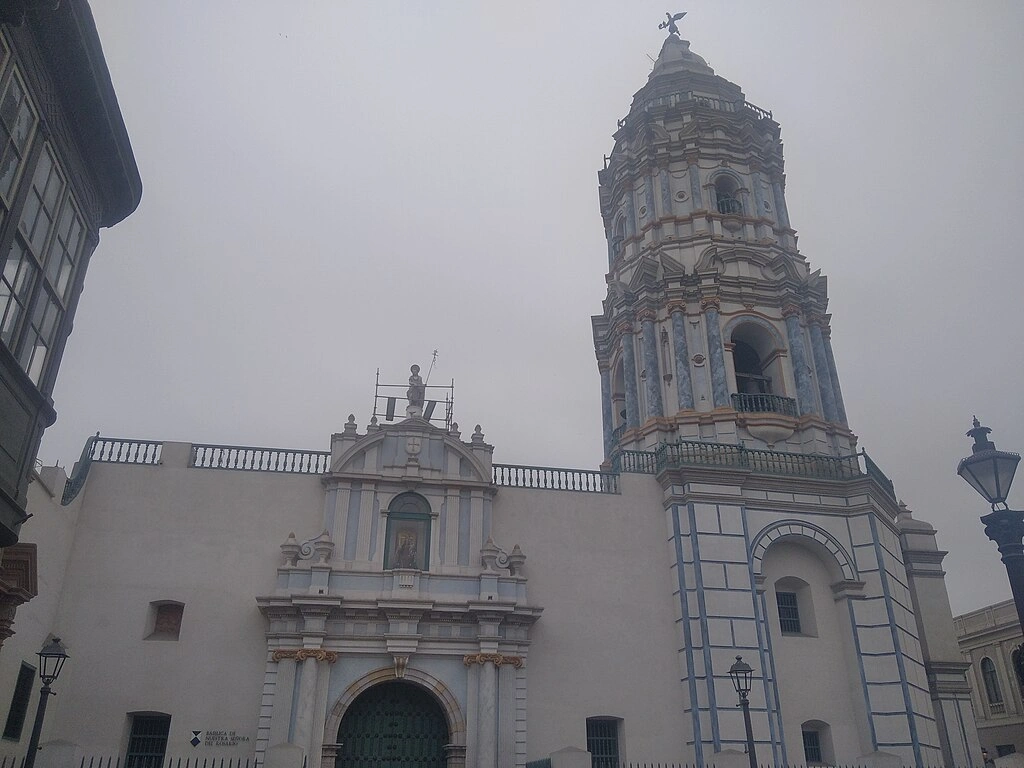
Architect: Manuel de Amat y Junyent , Diego Maroto , Juan Martínez de Arrona, Miguel Güelles, Juan de Uceda.
Architectural style: Rococo architecture, Mudéjar architecture.
Burials: John Macias, Rose of Lima, Martin de Porres.
Exterior
The exterior of the church was originally covered with padding, as can still be seen at the base of the bell tower. A primitive portal, with two sections and three sections, was built in the second half of the 17th century . A new portal was built in later years due to the earthquakes that destroyed the church. The current appearance of the church is largely due to the reconstruction work following the 1940 earthquake, which involved the application of cement to the walls and the restoration of the doorway, which, like the church’s façade, had been modified in the second half of the 19th century when the walls of the temple were covered with a brick finish.
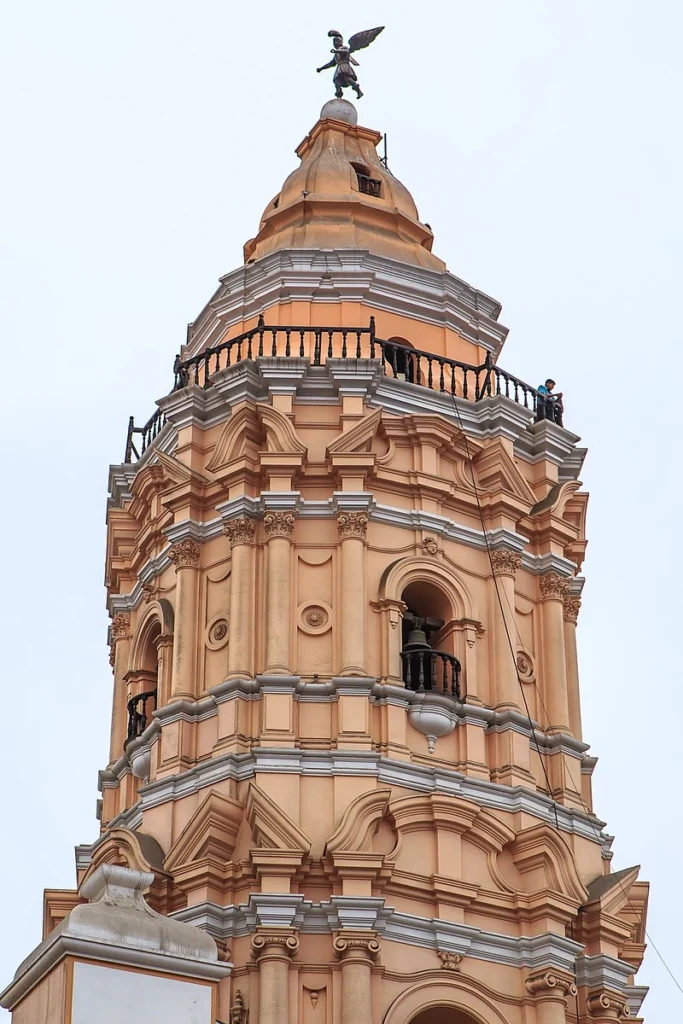
Church bell tower
The first bell tower of the church, in the Baroque style and with three bodies, was designed together with the church by the builder Diego Maroto in the second half of the 17th century , and was destroyed during the earthquake of October 28, 1746. The current tower was conceived and designed by Viceroy Manuel Amat y Juniet in 1766 in the Rococo style, with an octagonal lower section. It is divided into a lower section and two upper sections with small balconies on corbels. At the top is a sculpture of a figure holding a trumpet, representing the angel announcing the Last Judgment. The total height is 46 meters, and it is considered one of the most characteristic elements of the religious complex. The base of the tower still preserves the padding that once covered the church’s façade.
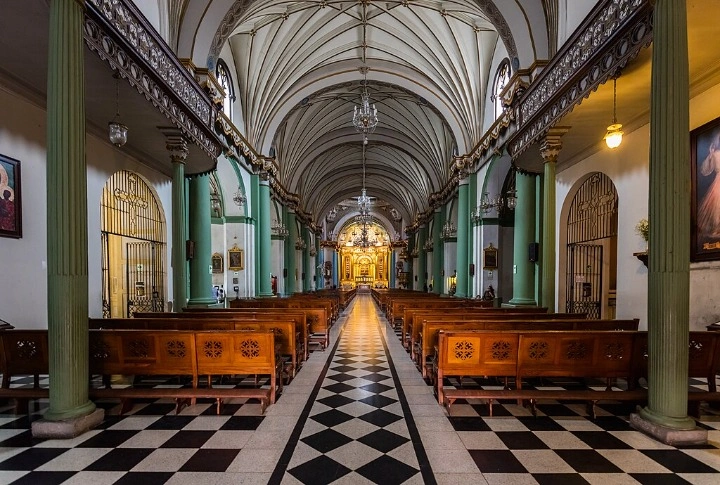
Description of its interior
The church is divided into a main nave covered by a false ribbed vault and two side naves with interconnected chapels and cupolas, which also contain the side door of the church, the access to the tower and, on the Epistle side, an entrance to the main cloister of the convent. The main nave has an additional entrance at the foot preceded by the narthex (space where religious instruction was given to indigenous people or those who were not baptized), above which is the church’s upper choir.
Choir
In the chorus of the church is the one that is considered the oldest ashlar masonry of the country. Completely worked in wood of cedar brought from Nicaragua, it is of Renaissance style, with Mannerist elements. It has two sets of stalls: the first level was modernly sculpted, with the design based on the old. The originals are in the back, bearing in the back carvings of saints and other biblical characters. In the central part of the ashlar is the main seat of the prior of the convent, with carvings of Saint Dominic and Saint Francis of Assisi founders of the Dominicans and The Franciscans, respectively. The seat of the choir was carved by several artists among which Juan Martínez de Arrona (1562 -1635) would be outstanding.
Nave
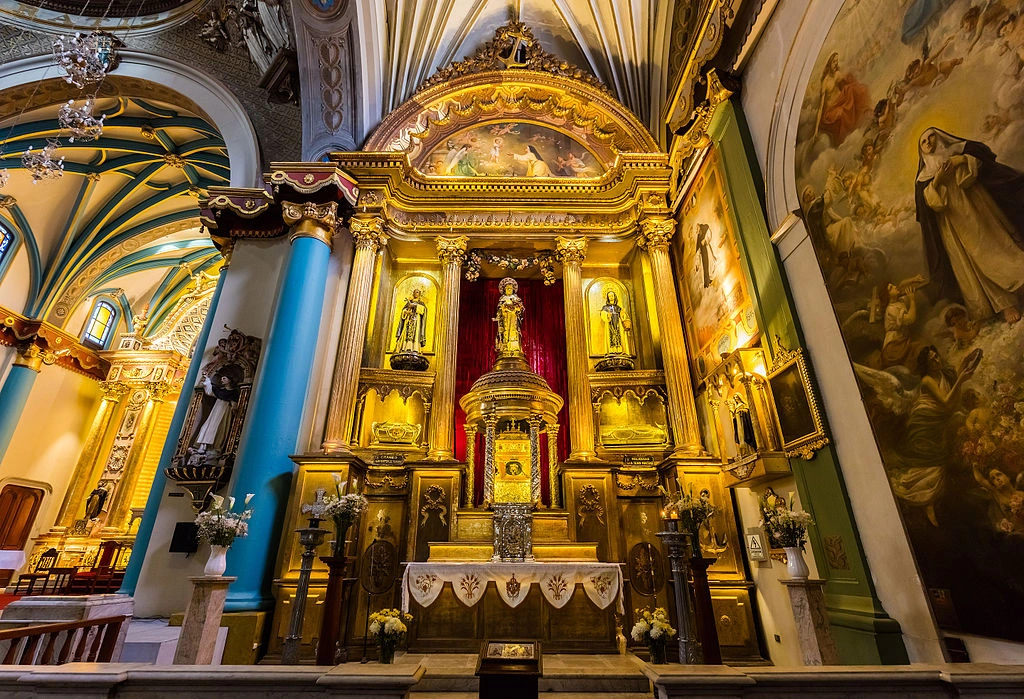
As mentioned above, the enclosure is made up of three naves, of which the side naves are made up of chapels containing several altarpieces. Along the side doorway from left to right we find the following altars: On the Gospel side, the altarpieces of Saint Hyacinth of Poland, Saint Joseph, Saint Dominic de Guzmán and Our Lady of the Rosary ; and on the Epistle side those of the Peruvian Saints, the Áminas, Saint Thomas Aquinas , the Sacred Heart of Jesus , the Chapel of the Lord of Justice and the Chapel of the Rosary Brotherhood. The most important is the Altar of the Peruvian Saints, in neoclassical style, located in the right transept of the church. In the center is the image of Saint Rose of Lima, to the left is Saint Martin de Porres and to the right Saint John Macias, who despite being born in the Iberian Peninsula, is considered Peruvian because he developed his religious life in Lima. In the lower part of these images are reliquaries where the remains of each saint mentioned above rest. In the lower area of the altar is a sculpture of Saint Rose of Lima, made by the Maltese artist Melchor Caffá in 1665, commissioned by Pope Clement IX to give to the Dominican fathers for her beatification. In the left transept is the altarpiece dedicated to the Patron Saint of Lima and patron saint of the Church, Our Lady of the Rosary. Neoclassical in style, the main niche houses the effigy of this patron saint, “who was the first in this Kingdom.” According to tradition, it was presented to Lima by King Charles I of Spain and V of Germany. She was especially venerated by Rosa de Lima and Martín de Porres, among others, and was solemnly crowned in 1927.
Presbytery
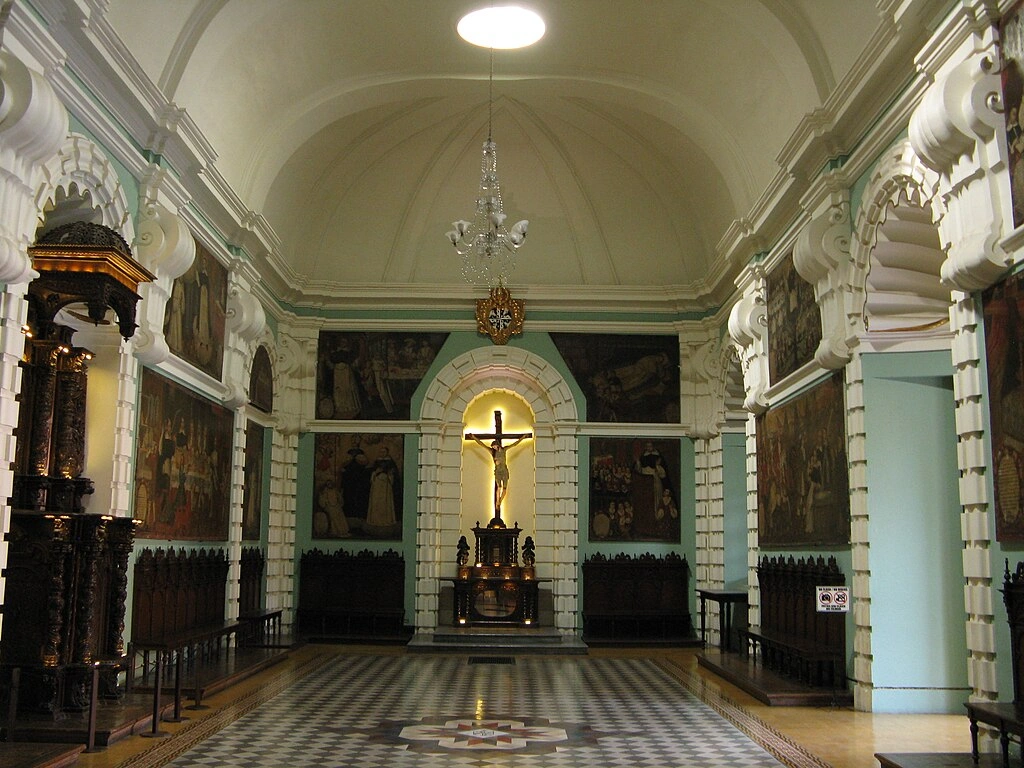
The altar is neoclassical in style with turquoise and gold decoration.
The Convent
Chapter house
It is called the Chapter House because all the friars were gathered by chapters in order to choose their authorities and solve their problems, the room was made in the 17th century, in Baroque style by the Friar Diego Maroto member of the Order, architect born in Camarena (current province of Toledo, Spain). In 1551 in this same stage the University of San Marcos is inaugurated. Its existing tribune or chatedra is used in the 17th century to dictate classes or support thesis, made in the baroque style, has solomonic columns, presents a painting of St. Thomas Aquinas, to the front is a small reredos where the Christ of the agony is venerated, before which Martin de Porres was ecstatic and embraced to whom it was seen.
Guest room
Here the fathers receive their authorities and relatives. The most noteworthy feature of this room is its artesonado ceilings dated to 1580, made of three thousand pieces held together by pressure without the use of nails. In this place the notes of the National Anthem of Peru were composed by José Bernardo Alcedo.

Main cloister
Composed of four galleries, decorated with Sevillian tiles dating from 1604 and 1606, the work of the workshop of Hernando de Valladares ; the paintings that present passages from the life of Saint Dominic de Guzmán , founder of the Dominican Order, were commissioned in 1608 by the provincial of the Order of Saint Dominic in Peru with the Sevillians Miguel Güelles , disciple of Juan de Uceda and his collaborator, Domingo Carro. In each corner of this cloister there is an altarpiece with biblical representations. The ceilings of these galleries are made of Nicaraguan cedar , carved in the Mudejar style . Also notable in this cloister is the presence of a bronze basin, built by the Dominicans and famous for being where Saint Martin de Porres , according to the writer Ricardo Palma , washed the brown sugar loaf, turning it white.
The Library
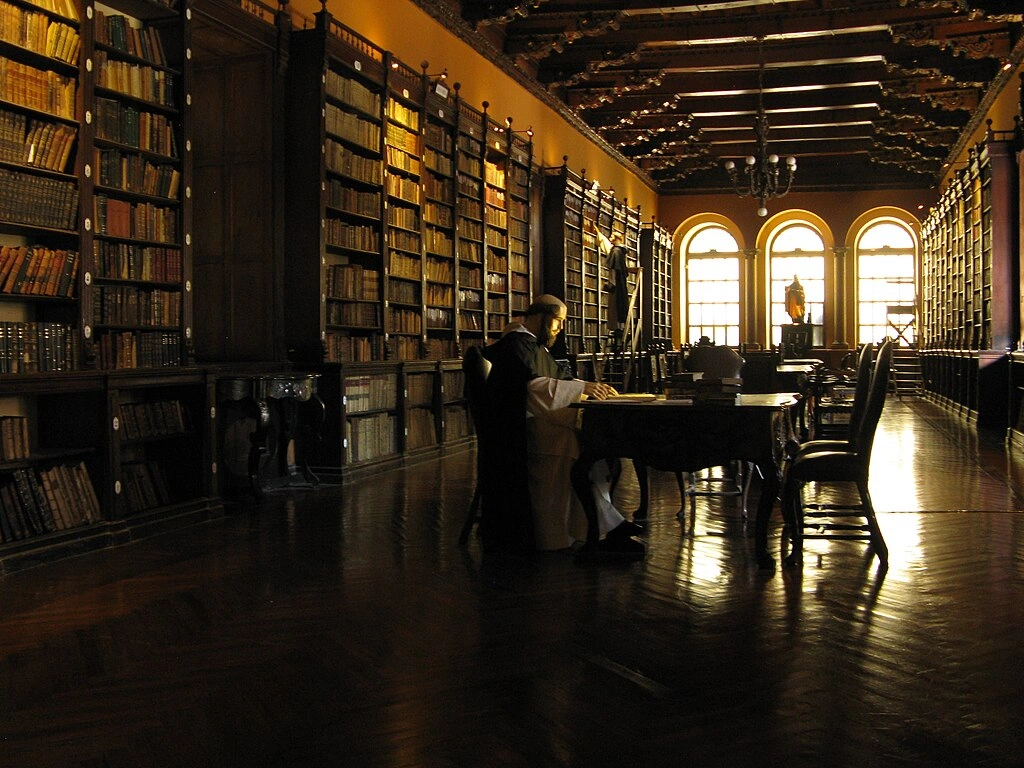
One of the most worthy places to visit is the library, not only for the value of the writing works, but also for the coffered ceilings. This hall houses the oldest books that the Dominicans used, being among these, incunables. The Library of the Convent has around 25,000 books, among them several bibliographical collections of great value. Currently it is in the space of the old dining room.
Second Cloister
Of simpler construction, a Carrara marble sculpture representing Christ at the Column can be seen in one corner. The cloister consists of two floors; the first features semicircular arches with cushions, and the second floor has a baluster of trefoil arches.
Chapel of St. Martin de Porres
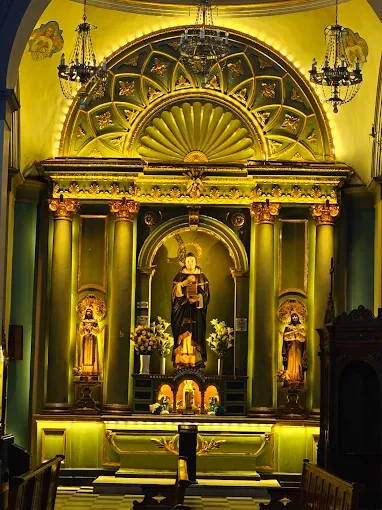
Place where St. Martin de Porres had its cell being destroyed by the earthquake of 1746. Due to the faithful and donations of the Church, a chapel is built in the place where he also had his nursery. It has an altar where its effigy is venerated, having to its sides to Saint Dominic and St. Francis of Assisi and in the superior part the Virgin of the Rosary. In the burial rest his remains and an urn where the timbers of his bed are conserved. On the walls you can see paintings depicting Martin de Porres’s miracles. In the back of the chapel is located his bedroom. Also it emphasizes the Oratory of the saint, small atmosphere under the stairs where Martin frequently prayed and was tempted by the devil. Today you can see the great amount of gifts brought to him by his faithful devotees. At the top is a wooden cross with which it is remembered that in this same place St. Martin removed the temptations of the evil one.
Tomb of Santa Rosa de Lima
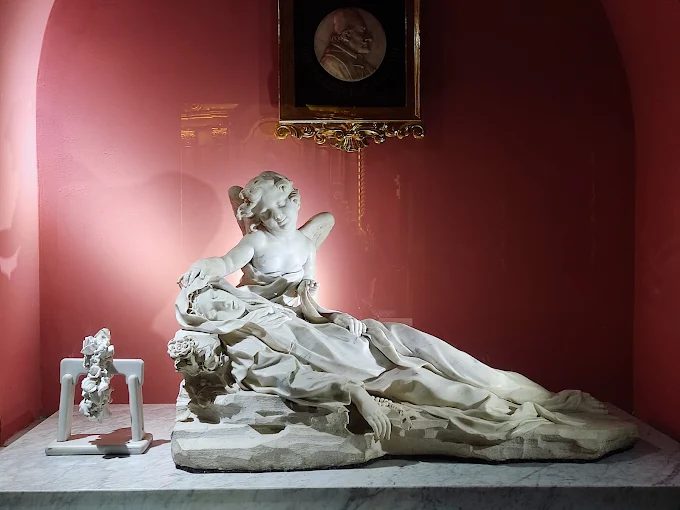
Located in the place that was an old cemetery where the first religious of the order were buried. An ossuary of several meters of depth where the bones of the time were placed. The tomb of marble where the remains of St. Rose of Lima are buried, are in the center of the environment that is decorated with mosaics. On a memorial plaque it reads: “Hago donación de mi cuerpo a mis hermanos Dominicos” (I make a donation of my body to my Dominican brothers). This phrase explains the gratitude of having belonged to the Tertiary Dominican Order.
College of Saint Thomas Aquinas
It was in 1892 when the Dominican Order inaugurated the Santo Tomás de Aquino School, next to the Santo Domingo Convent, in downtown Lima. One hundred and twenty-five years later, the school retains its original location: Pasaje Rinconada de Santo Domingo 209, and still has direct access from its main courtyard to the convent. It is the first and only educational center in Lima founded by the Dominican Fathers, with Fray Jordán Revilla as its first director. The school is marked by the city’s history. The Lima Post Office and Santo Domingo Church are located on Jirón Camaná, the street parallel to Pasaje Rinconada de Santo Domingo. The former Lima Post Office and Telegraph Office, now the Gastronomy Museum, is located on Conde de Superunda Street, behind the school. The cloisters of the Santo Domingo Convent separated from the school only by a gate have a close connection with the history of education in Peru. It was founded in 1535, at the same time as the city of Lima. The first classes of what is now the National University of San Marcos (UNMSM), also known as the dean of the Americas, were held there. The facade of Santo Tomás de Aquino has been a silent witness to changes in the city. Several decades ago, there was a car park in front of the school; but later, the facade was invaded by merchants who would establish the Polvos Azules shopping center there. In 1997, during the administration of Mayor Alberto Andrade, this center was relocated and the space would become what is now Alameda Chabuca Granda. Another recent change to the infrastructure surrounding the school was the construction of the Rayitos de Sol bridge during the administration of former Mayor Luis Castañeda Lossio. This bridge connects Alameda Chabuca Granda with the Santa Rosa bus stop on Evitamiento Road. A track is currently being built under the Rímac River, located in front of the school. This is part of the Vía Parque Rímac project, under the current municipal administration of Susana Villarán. But Santo Tomás de Aquino has also changed over time; initially, the school was for boys only, and remained so for over 100 years; only in 1994 was it accepted as a coeducational school for girls. Furthermore, since 2010, Inés Rossi Rossi has been the school’s principal, a milestone for the Aquino school, which since its inception has only had principals belonging to the Dominican Order.
Feast Day
Feast Day : 07 October
The feast day for the Basilica and Convent of Santo Domingo in Lima, Peru, is celebrated on October 7th, which is the Feast of Our Lady of the Rosary. This day honors the Virgin Mary under the title of Our Lady of the Rosary, to whom the basilica is dedicated.
Church Mass Timing
Monday to Saturday : 07:00 AM, 06:30 PM
Sunday : 7:00 AM, 8:00 AM, 9:00 AM, 10:00 AM, 11:00 AM, 12:00 PM, 1:00 PM, 5:00 PM, 6:00 PM, 7:30 PM
Church Opening Time:
Monday to Friday : 09:30 AM, 05:30 PM
Saturday, Sunday : Closed
Contact Info
Address : Convent of Santo Domingo
Jirón Camaná 170, Jirón Conde de Superunda 262, Lima 15001, Peru.
Phone : +51 1 4276793
Accommodations
Connectivities
Airway
Basilica and Convent of Santo Domingo, Lima, Peru, to New Jorge Chávez International Airport, distance 28 min (11.6 km) via Av. Morales Duárez.
Railway
Basilica and Convent of Santo Domingo, Lima, Peru, to Railway Station of Electricity Museum Auxiliar Av. Pedro de Osma 105, distance between 22 min (13.2 km) via Vía Expresa Luis Fernán Bedoya Reyes.