Introduction
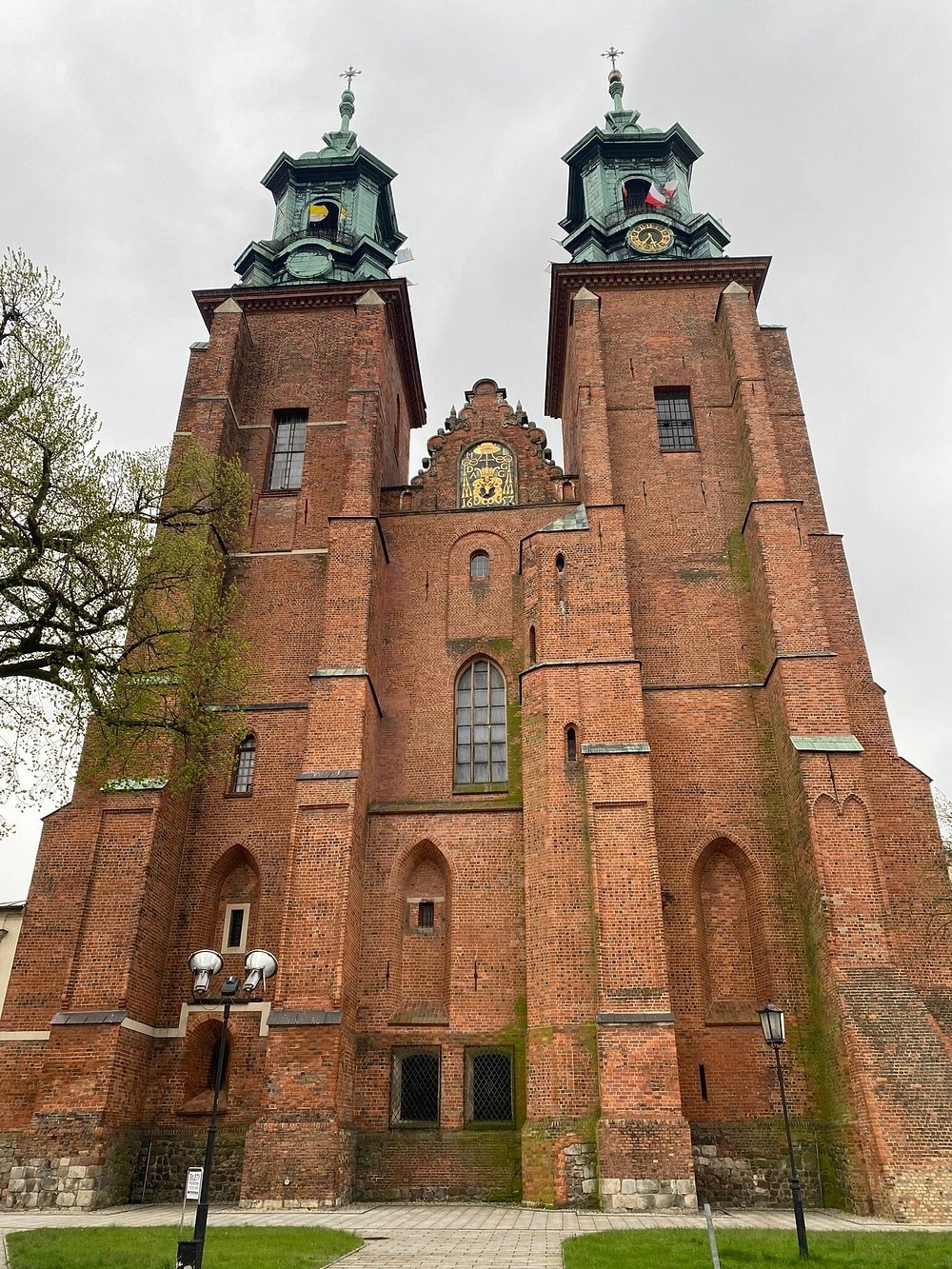
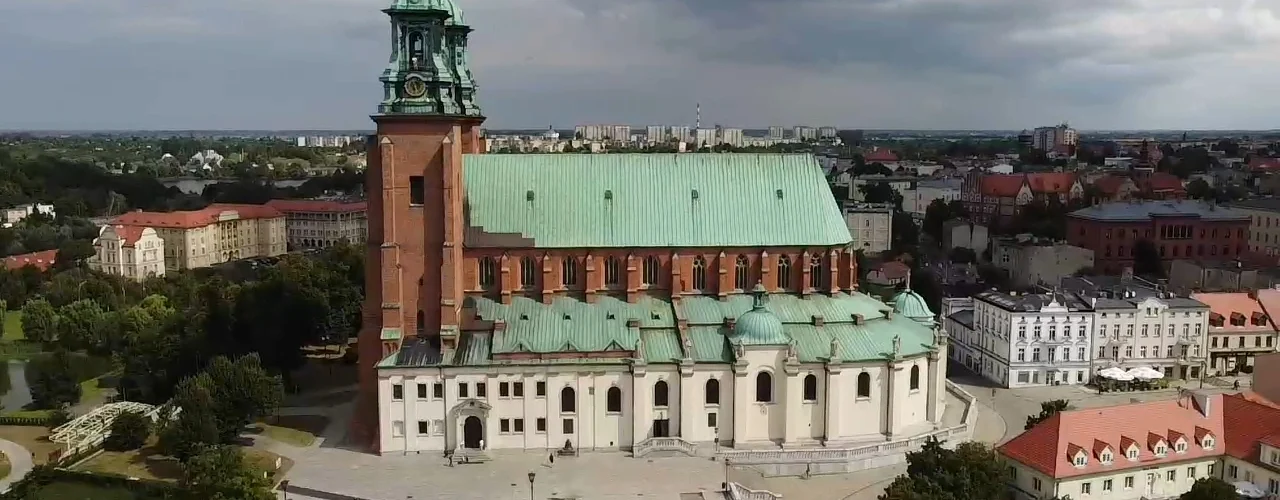
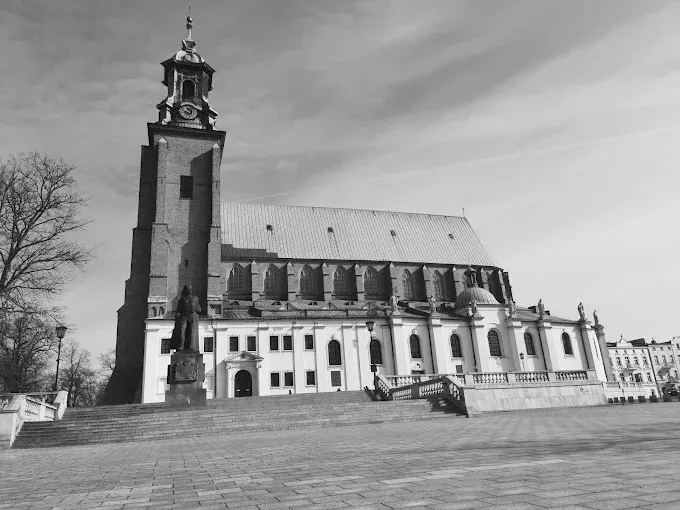
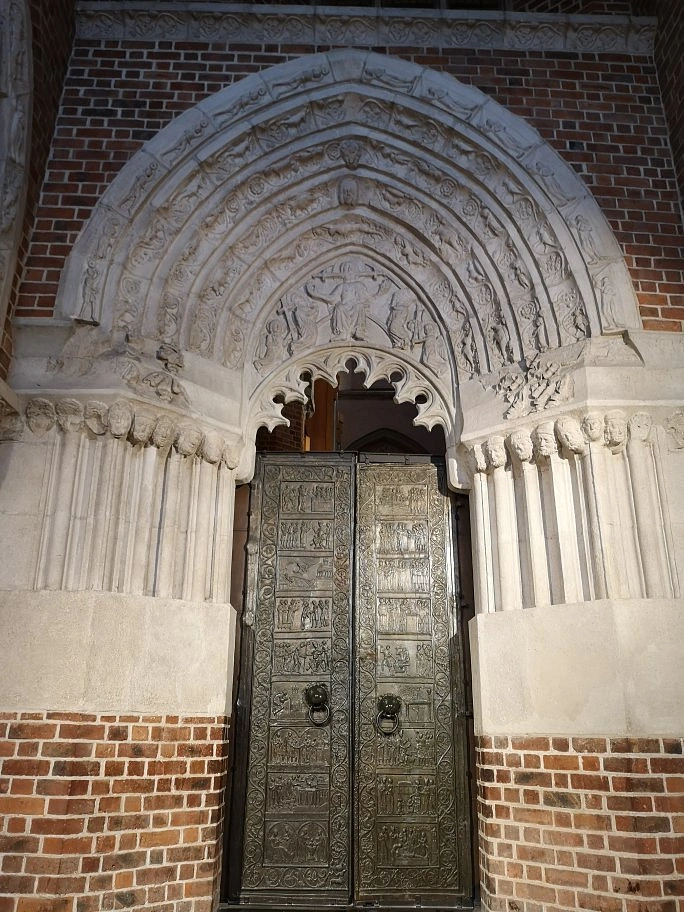
The Royal Gniezno Cathedral, officially known as the Primatial Cathedral Basilica of the Assumption of the Blessed Virgin Mary and the Shrine of St. Adalbert (Polish: Bazylika Archikatedralna Wniebowzięcia Najświętszej Marii Panny i Sanktuarium św. Wojciecha), is one of the most important religious and historical sites in Poland. Located in the heart of Gniezno, this impressive Brick Gothic cathedral has stood as a symbol of Polish statehood and Christianity for nearly a thousand years. Over the centuries, the cathedral has witnessed some of the most significant moments in Polish history. It was the coronation site for several early Polish kings and served continuously as the seat of Polish church leaders. Despite wars, fires, and invasions, the structure has largely remained intact, making it not only one of the oldest but also one of the most treasured sacral monuments in the country. One of its most remarkable features is the set of bronze doors, dating back to around 1175, which depict scenes from the life and martyrdom of St. Adalbert of Prague. Inside, you’ll also find the stunning silver coffin of the saint a work of art created in 1662 by Peter von der Rennen. This replaced an earlier coffin funded by King Sigismund III Vasa in 1623, which was looted by Swedish forces during the invasion in 1655. Perched on Lech Hill, the cathedral is also known as the Gniezno Archcathedral or the Sanctuary of St. Adalbert. It has been the central church of the Gniezno Metropolitanate since the year 1000 and holds the honorary title of “Mother of Polish Churches.” It is also the burial site of St. Adalbert, one of Poland’s patron saints, and has hosted five royal coronations. In recognition of its deep historical and cultural importance, the cathedral was declared a national Historic Monument (Pomnik historii) on September 16, 1994. It was also granted the status of a minor basilica in 1931. Today, it remains a powerful symbol of faith, national identity, and resilience through the centuries.
The beginnings of existence
The first Christian church in the area situated in the castle on Lech Hill was founded during the lifetime of Mieszko I, i.e. before 992. According to the tradition handed down by Jan Długosz, the founder was supposedly Dąbrówka, who was buried there in 977. We are able to define the pre-Romanesque castle church of Mieszko I’s spatial form as a so-called simple rotunda with a 9-meter-diameter circular nave and an eastern apse thanks to recently discovered relics that have been preserved in the basement of the cathedral. An annex was added to the north side of the rotunda, possibly for a funeral. The entire structure had an east-west orientation. The next construction phase is represented by the second annex, added to the nave of the rotunda on the south-west side. This annex can be interpreted as a funerary annex because of its size and configuration. This is where Saint Adalbert’s body was buried. Between March 7 and 15, 1000, Emperor Otto III came to Gniezno to pray at the tomb of St. Adalbert. The so-called Congress of Gniezno took place there, where the Polish Duke Bolesław the Brave and the emperor discussed plans to create a common kingdom of Germany, France, Rome, England, and the Slavic states. The Archdiocese of Gniezno was established, becoming the first ecclesiastical metropolis in Poland, subordinated solely to the Pope. Radzim Gaudenty succeeded his father as archbishop.
Pre-Romanesque cathedral
Archaeological evidence suggests that construction of a stone basilica began in the first half of the 11th century on the site of the rotunda. It was likely a three-nave, transeptless basilica, enclosed on the eastern side by three apses, with a new pre-Romanesque church dedicated to St. Adalbert. The cathedral likely lacked a prominent presbytery bay and lacked a western mass (thus, it was a towerless basilica). St. Adalbert’s church was located in the geometric center of the entire building (in medio ecclesiae). It was a sepulchral chapel, laid out on a square plan. Inside, against the eastern wall, stood an altar with a tomb containing relics. The sides of this altar may have been decorated with three golden plaques, later removed from Gniezno by Bretislaus in 1038. On the border between the main nave and the chancel there was the tomb of Gaudente (currently exhibited in the basement). In 1018, the cathedral burned down, but was rebuilt within seven years. In 1025, Bolesław the Brave was crowned king there, and after his death, his son Mieszko II Lambert. In 1038, the castle of Gniezno was attacked by the Czech prince Bretislaus I, destroying and plundering the castle grounds and the cathedral.
Romanesque cathedral
After Bretislaus’ invasion, the church was rebuilt in the Romanesque style and consecrated in 1064. The reconstruction was carried out partially using the foundations of the previous structure. The total length of the building was 37 m. In 1076, Bolesław II the Generous was crowned King of Poland in this building. After the coronation, expansion continued until 1097, consisting of extending the church in two directions: eastward by building a new chancel with a new apse and a new main altar, constructing an annex, and extending the church westward by building a massif with two towers. Here, there was a gallery intended for the reigning prince and his closest relatives. A new, Romanesque confession of St. Adalbert was built in the expanded cathedral. It was located in the central part of the nave, in the center of the Romanesque basilica. In the eastern part was a burial chamber. Just west of the confession was the necropolis of the Gniezno archbishops, of which a grouping of several large Romanesque underground tombs, arranged in a single row, has survived. These indicate that the shepherds of the archdiocese had the right to be buried in a particularly privileged space of the cathedral ad Sanctos – in front of the confession of their ideological predecessor, a short distance from his relics. Also dating from this period are the remains of the monastery buildings, adjacent to the cathedral’s northern wall, likely containing a chapter house, refectory, and cathedral school, discovered in the crypt of the Potocki Chapel.
In the years 1103–1104, a synod was held with the participation of a papal legate concerning the discovery and placement of the relics of St. Adalbert in the cathedral. A few years later, Duke Bolesław III Krzywousty visited St. Adalbert’s tomb. In 1127, the ceremony of finding and placing St. Adalbert’s head took place in the cathedral. Around 1175, the bronze Gniezno Doors were founded. In 1177, a great congress was held, at which Mieszko III the Old, Duke of Greater Poland, acted as “dux totius Poloniae”. In 1192, the cathedral and its neighbouring buildings burned down. During the reconstruction, among other things, the a sacristy annex between the northern apse and the southern wall of the presbytery, and in its place a mass grave appeared, the so-called Tomb of the Five Martyr Brothers with a plasterboard with the so-called ossa trium inscription . The monastery buildings were also destroyed. After 219 years, in 1295, the penultimate royal coronation took place in the Gniezno Cathedral, when Duke Przemysł II was crowned king. Five years later, Wenceslaus II of Bohemia entered Gniezno by force of arms and also crowned himself king. This was the last coronation in Gniezno. In 1331, the Teutonic Knights attacked Gniezno, destroying the church.
Gothic cathedral
Archbishop Jarosaw Bogoria Skotnicki started building the Gothic cathedral in Gniezno in 1342. On March 26, 1350, Skotnicki is first mentioned as having built an altar in the cathedral. In 1358, the same archbishop, along with the entire archcathedral chapter, welcomed King Casimir the Great, who contributed to the expansion of Gniezno. The work was organized so that part of the church could continue to serve the faithful. Services and masses were held in the Romanesque nave, which was separate and secured while the chancel was being built. When the latter was demolished and a new one built, people prayed in the new, Gothic chancel section. During construction, the Archbishop first erected an elongated three-bay choir in the eastern section, with a seven-sided dodecagon-shaped enclosure and a polygonal ambulatory, and soon added tomb chapels. The chancel was built with walls divided by a horizontal cornice into two stories – arcaded and windowed. The cathedral choir’s construction system consisted of a pillar-and-slope system and supporting arches that ran underneath the ambulatory roof. The eastern part of the church was constructed of ashlar and brick. The initiator of the project did not live to see the construction completed, but his successors continued the work. The nave was finished by Archbishop Janusz Suchywilk, and new altars were added by Archbishop Bodzanta to the Gothic cathedral. The nave’s roofing and vaulting were already well under way by 1382. One of the towers, the chapter house, the treasury, and the chapels at the southern nave were being built in the first half of the 15th century, when Mikoaj Trba was Archbishop of Gniezno. In 1419, following the granting of the title of primate to the Gniezno archbishops, the church became a primatial archcathedral.
In the second half of the 15th century, under Archbishop Jakub of Sienno, a massive crucifix was hung on the chancel beam, and a new mausoleum of St. Adalbert was constructed in front of the chancel, hidden behind a stone canopy supported by small columns and adorned with a sculptor Hans Brandt marble slab bearing an image of the martyr. In 1602, the northern tower was completed. The side aisles were also rebuilt. and chapels surrounding the chancel, changing their denominations and enriching their interiors with new architectural elements consistent with the spirit of the era. In 1613, during the reign of Archbishop Jan Łaski, a great fire broke out in Gniezno, destroying almost all the buildings, including the churches. The domes and the wooden tower structure were damaged by the fire, but the cathedral survived. In the 1680s, a gilded confession modeled on the one in St. Peter’s Basilica in Rome was placed in the chancel section of the cathedral. On a black altar beneath it was a silver coffin containing St. Adalbert. In the years 1641–1652, Primate Maciej Łubieński rebuilt the church’s interior in the Baroque style. Another great fire broke out in Gniezno in August 1760. The fire damaged the towers and consumed the roof of the cathedral, leading to the collapse of the vaults over the chancel and significant damage over the nave. Over the next few years, the interior was rebuilt in the Classicist style with Baroque elements. Primate Maciej ubieski initiated this. The 1770s saw the subsequent partial reconstruction of the church. The cathedral was briefly converted into a grain warehouse by the French invaders of Emperor Napoleon Bonaparte at the beginning of the 19th century, as the Grand Army was entering Gniezno. No significant construction work was undertaken thereafter.
Contemporary history
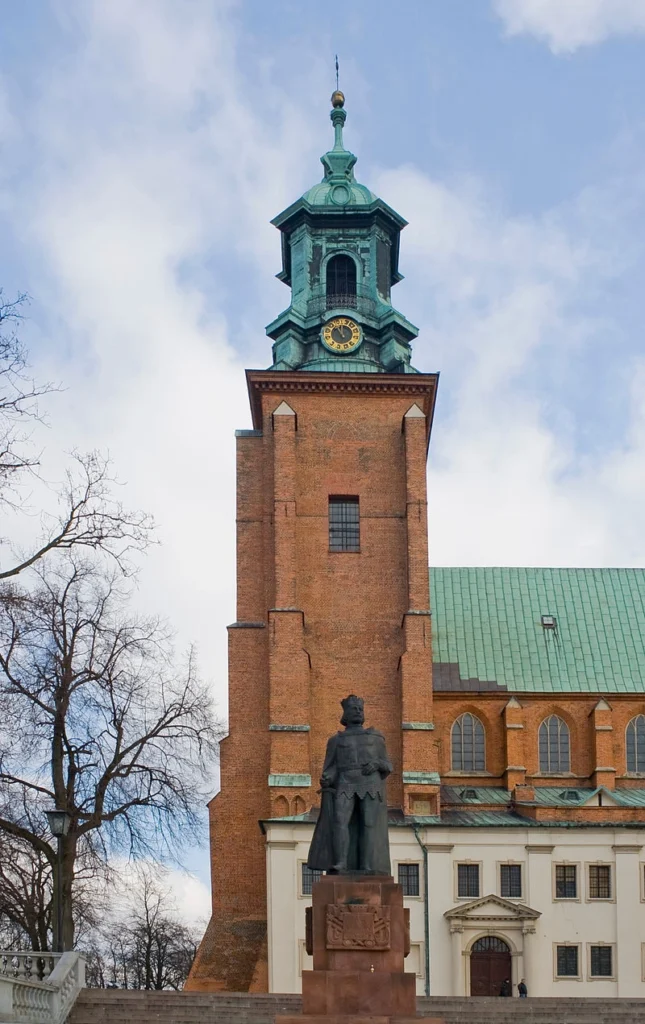
In 1931, Pius XI granted the cathedral the title of minor basilica. In 1939, after the Germans from the NSDAP occupied Gniezno, they initially closed the church and later turned it into a concert hall. The Red Army opened fire on the cathedral on January 23, 1945, two days after entering Gniezno, igniting the cupolas and roofs of the towers.Various speculations arose over the years regarding this fire. The communist authorities claimed that German soldiers had attacked Soviet soldiers while they were still in the towers. Witness testimonies and scientific publications support the theory of deliberate shelling from a tank located in the market square. The fire destroyed the towers’ cupolas and the vaulting in the gallery between the towers, and consequently also the organ. The roof over the southern part of the main nave also collapsed, destroying the stalls. At the turn of the 1950s and 1960s, the church was restored, restoring its Gothic style. John Paul II paid a visit to the Archcathedral on June 3, 1979. Gniezno lost its primatial status for 17 years after the then-Primate Cardinal Józef Glemp was appointed Metropolitan of Warsaw in 1992. The Gniezno Congresses’ initiator, Archbishop Henryk Muszyski, became the new Metropolitan of Gniezno. The gilded, baroque canopy that hung over St. Adalbert’s coffin was reinstalled. Hidden in the tower rooms during World War II, the Germans had not removed it. A year later, John Paul II visited the basilica again. On December 19, 2009, the title of Primate of Poland returned to Gniezno and to the Metropolitan of Gniezno. Archbishop Muszyski was sworn in as Primate on that day In 2012, the Gniezno Archcathedral received relics of John Paul II’s blood and placed them in a side chapel. In 2015, in the rooms adjacent to the northern tower, approximately 2,000 paper documents from the 14th, 15th and 16th centuries were found, illustrating the work of the general consistory, the only collection of this type in Poland. On April 14, 2016, the metropolitan church was the site of the celebration of the 1050th anniversary of the Baptism of Poland, attended by the Polish Episcopate and the highest state authorities, headed by the President of Poland Andrzej Duda .
Architecture of Shrine of St. Adalbert, Gniezno, Poland
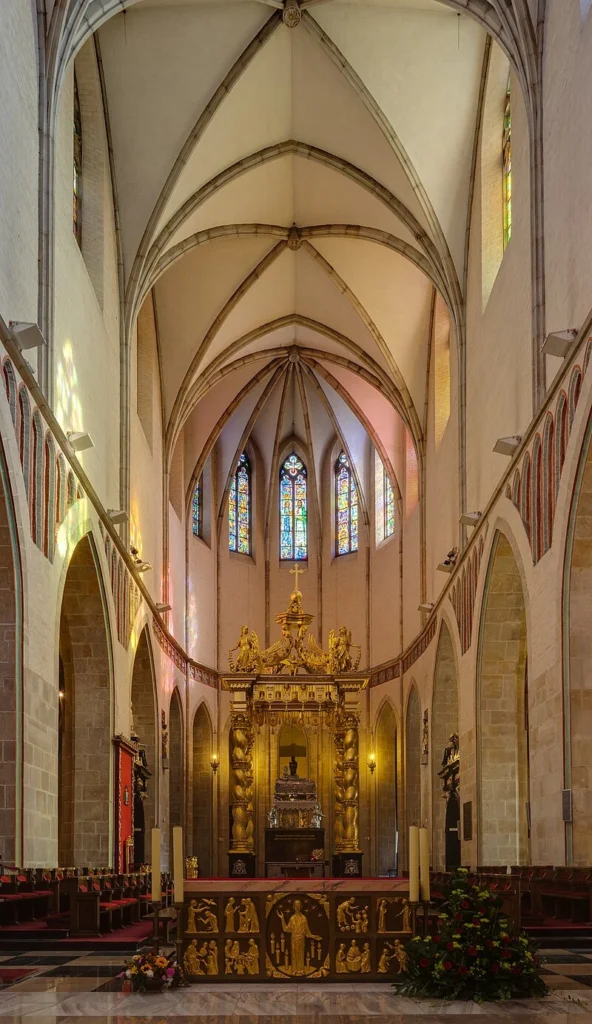
Architectural style: Gothic architecture
Burials: Jakub Świnka, Edmund Dalbor, Mikołaj Trąba.
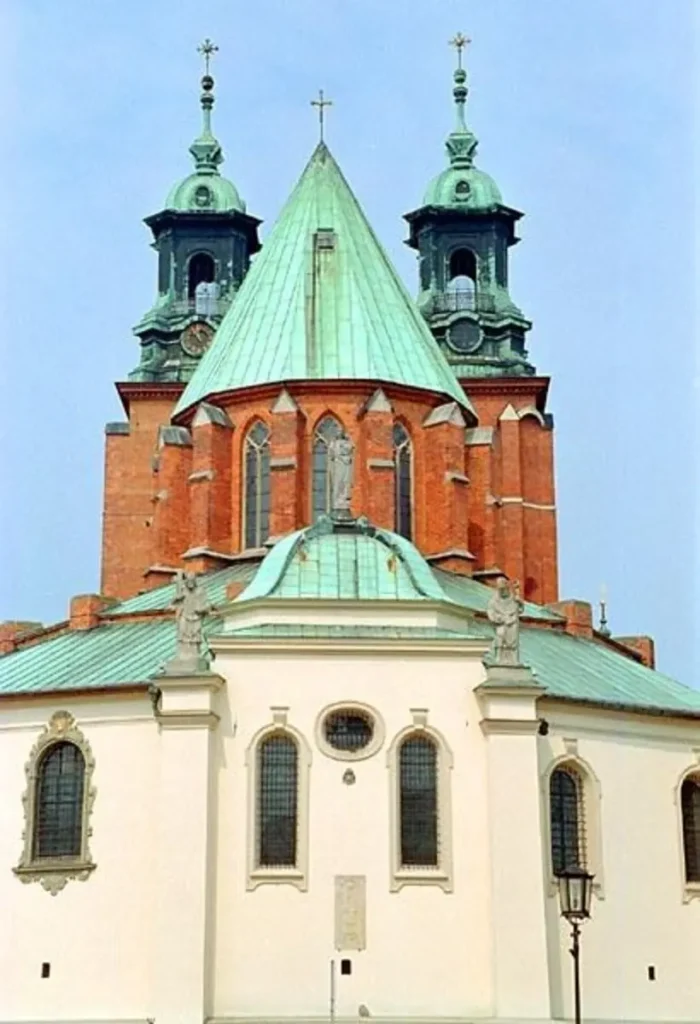
The cathedral is a three-nave structure, with a basilica layout , a polygonal chancel and an ambulatory. Adjacent to the side naves and ambulatory are a ring of fourteen side chapels.
Interior
The cathedral is a three-nave basilica-looking structure with polygonal presbytery and ambulatory and many adjacent chapels of noble and aristocratic families, some personally funded by the head of the family or the monarch of Poland. Under the tiled floor several discoveries were made; these included the relics of earlier pre-Romanesque buildings and several tombs of former archbishops. In the crypt of the cathedral there is a 1006-year-old sepulchral stone inscription on display, the oldest of its kind in the country, discovered by archeologists. Other aspects of the crypt may include the remaining fragments of the walls of the first temple funded by Mieszko I of Poland.
Presbytery
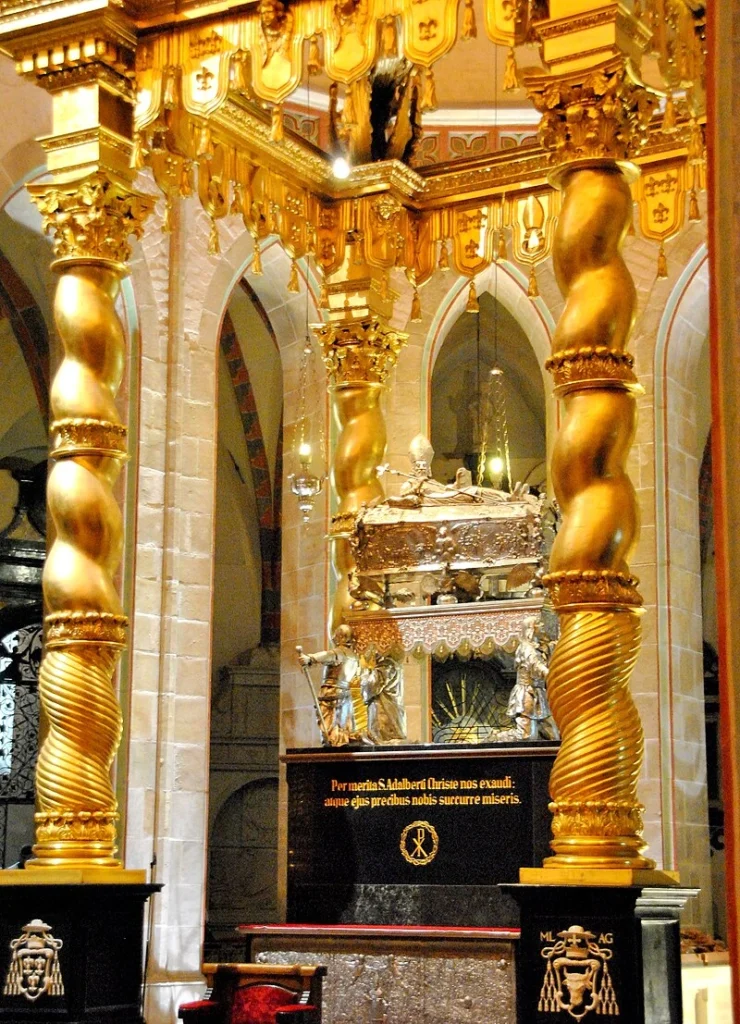
In the chancel of the archcathedral, in its center, there is a Baroque gilded confession, and beneath it an early Baroque reliquary – a coffin made of chiseled, repoussé silver sheet from 1662 (with the reliquary proper – a coffin inside, a wooden, probably cedar, box from the 12th century covered with bas-reliefs) with the remains of St. Adalbert (restored in 1987 after being stolen). Behind the reliquary is St. Adalbert’s tombstone made of red marble from a medieval tomb from 1480, made by Hans Brandt from Gdańsk. On the north side of the chancel, there is a gilded primate throne from 1835, and in front of it a kneeler with the coat of arms of Primate Stefan Wyszyński . Above the throne is the coat of arms of the current Metropolitan of Gniezno. New stalls for members of the Primate’s Chapter are located on both sides of the chancel. Furthermore, the chancel houses the main sacrificial altar, reminiscent of the golden Romanesque altar, made of gilded bronze panels with scenes from the lives of Jesus and Mary. It was donated by the German Episcopate in 1996. Above the altar is a rood beam with a Gothic linden crucifix from around 1430, placed in the second half of the 15th century.
The main nave and choir
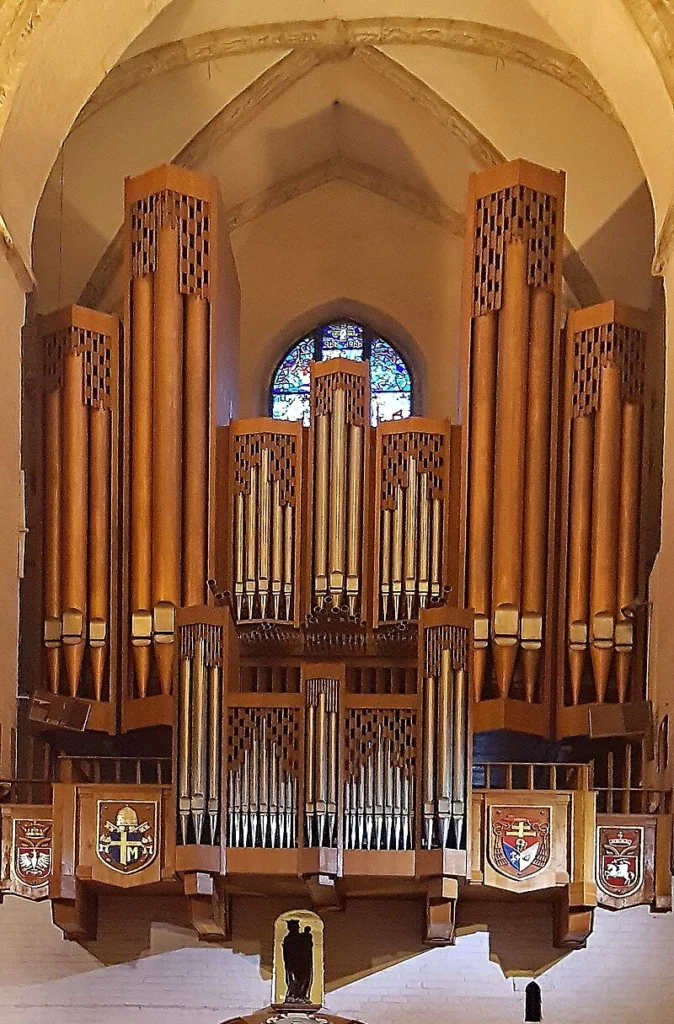
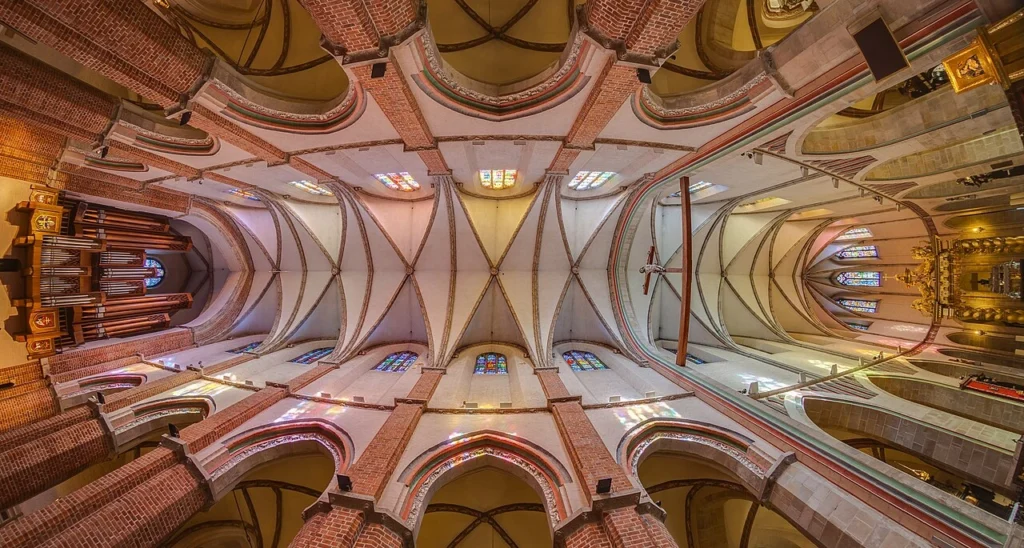
The main nave houses seats for the faithful. The cross-ribbed vault is typical of the Gothic style. At the end of the nave, in the gallery between the towers, there is a wooden choir loft with an organ built in 1975 by August Laukhuff from Weikersheim. Installation, by a company from Warsaw, took place in 1976-1977. The organ was renovated in 2015-2016, and the choir loft was also rebuilt. The previous organ, built after 1661 by Jerzy from Gdańsk, burned down in a fire on 23 January 1945. After the war, the church was temporarily used by a harmonium, and then, from 1952-1962, by an instrument from the Lipski Chapel. An electronic organ was later installed. Beneath the choir in the main nave, to the left of the entrance to the old chapter house, stands the late Gothic tombstone of Archbishop Zbigniew Oleśnicki, set into the western wall. The tombstone was carved by Veit Stoss. The primate, in pontifical robes and holding a processional cross, is depicted against a backdrop of a curtain held by two angels. The entire composition is framed by a trefoil arch with a richly carved floral twig. On the other side of the entrance to the old chapter house stands the tombstone of Archbishop Jakub of Sienna.The slab consists of four identical, elongated panels cast from a brass alloy, assembled on the wall into a single composition. The central part is occupied by a carved standing figure of the primate in pontifical robes, holding a crosier and a processional cross. The deceased stands surrounded by richly decorated Gothic architecture, featuring figures of apostles, patriarchs, and saints, while the corners are decorated with medallions bearing the symbols of the Evangelists.
Ambulatory and side aisle
Figurative sculpture abounds in abundance in the side nave, filling the portals, cornices, capitals of the inter-nave pillars, shaft capitals, and even the vault ribs. A group of slabs founded by Primate aski can be found in the side nave. Thanks to Roman contacts with Cardinal Bakocs, in 1515 the Archbishop of Esztergom commissioned six tombstones from the sculptor Jan Florentyńczyk: for himself, his brother Andrzej, his predecessors, Jan Gruszczyński and Andrzej Boryszewski, Chancellor Kurozwęcki, and Bishop of Kraków Jan Radlica . The first four of these slabs were placed on the northern wall, in the church ambulatory, on both sides of the sacristy. All slabs are characterized by a uniform composition. The deceased’s coat of arms cartouche occupies the center and is surrounded by a wreath of fruits and leaves. At the bottom is an inscription informing about the deceased’s achievements. In addition, between the sacristy and the Doctoral Chapel there is a monument to Cardinal Stefan Wyszyński from 1982 and on the parallel side of the aisle, on the south side, the epitaph of Cardinal Józef Glemp. The sacristies are at the level of the chancel in the ring of chapels on the north side. The vicar’s sacristy was constructed on a rectangular plan and is larger. The sacristy of the prelature, on the other hand, is octagonal and has a dome-shaped vault. A monumental early Baroque portal leads from the nave to the vicars’ quarters, topped with the coat of arms of the Gniezno chapter, featuring a ducal crown and a cardinal’s hat. It was funded in 1726 by the then parish priest, Aleksander Kołudzki, to mark the inauguration of the new Archbishop, Teodor Potocki.
Chapels
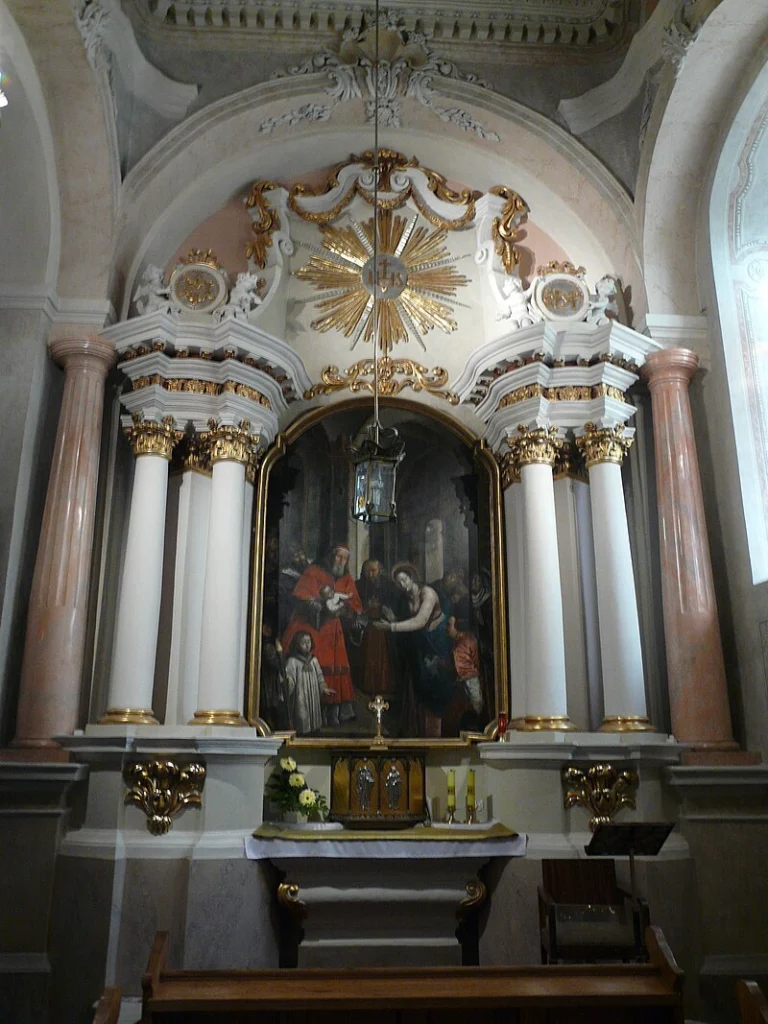
The elliptical cupola covering the late-baroque Potocki Chapel, designed by Pompeo Ferrari and built 1727–1730, is the most beautiful in the cathedral. The parietal tomb of Archbishop Teodor Potocki (d. 1738), who pronounced Stanisław I Leszczyński king upon the death of Augustus II the Strong, and the epitaph of Ignacy Krasicki, poet and Archbishop of Gniezno (d. 1801). The 14th-century Kołudzki Chapel was renovated in 1647 with consistent interior furnishings. The four corners of the world are personified on the mid-18th-century polychrome vault. The early-baroque portal with its 17th-century renaissance grille from Gdańsk is one of Poland’s greatest blacksmithing achievements. The foundation plaque of the chapel has Szymon Kołudzki’s (d. 1656), portrait, epitaph and tombstone. St. Nicholas Chapel, also known as Dzierzgowski Chapel, dates from the 14th century. The Gothic arcade has the remains of 14th-century Gothic sculptural ornamentation featuring hunting scenes engraved in artificial stone and a mid-16th century renaissance polychrome. The chapel is embellished with two precious renaissance tombstones: the first was sculpted from red marble by Bartolommeo Berecci and features the reclining figure of Abp. Andrzej Krzycki (d. 1573), humanist and politician; the second was for Abp. Mikołaj Dzierzgowski (d. 1559), a supporter of Queen Bona Sforza, and was sculpted from sandstone and red marble by Hieronim Canavesi. There is also a round tondo with the Madonna of Giovanni Maria Padovano in the copestone. The Łubieński Chapel was created in 1642–1648 by joining two medieval chapels and restructured along early-classicist lines in 1778. The early-baroque portals from c. 1640 are made of marble and closed with renaissance grilles from Gdańsk. The early-baroque tomb of Archbishop Maciej Łubieński (d. 1652) is made of marble and alabaster. The altar painting from 1646 has portraits of Łubieński family members.
Chapterhouses
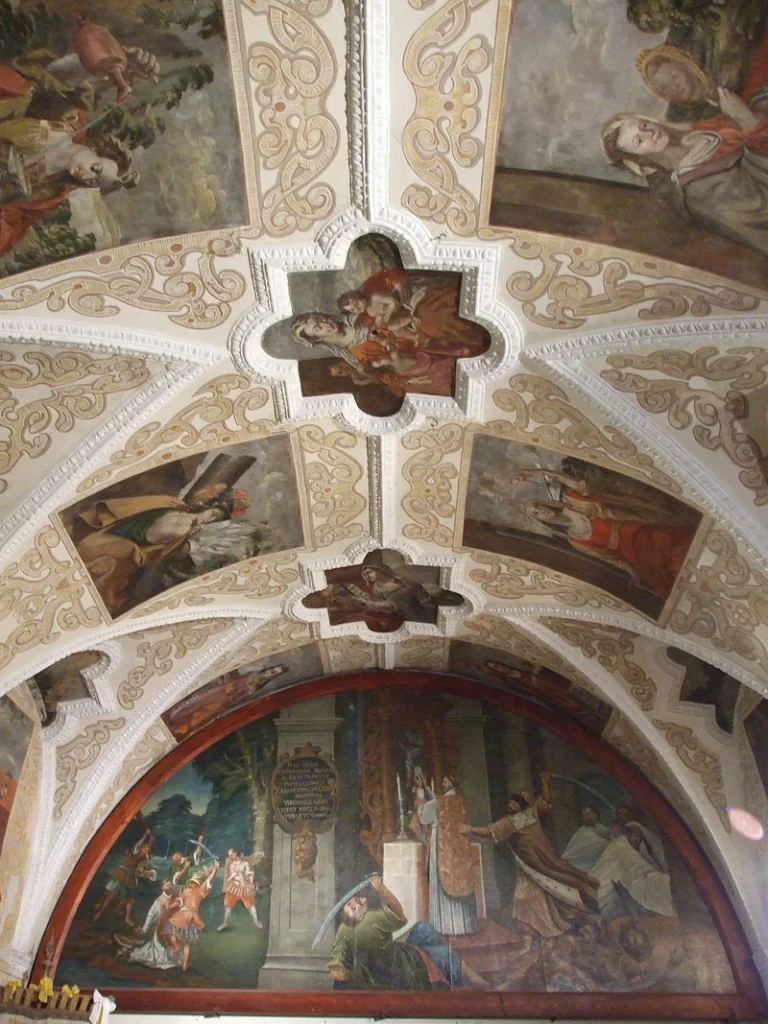
The Old Chapter House – located on the cathedral’s axis, in the bay between the towers, beneath the current choir loft. A marble portal from 1726 leads into the interior. Above the portal is a niche carved into the face with a figure of St. John of Nepomuk, intended to remind canons attending chapter meetings of their duty to maintain secrecy. The chapter house itself has two side annexes. One once served as a treasury, the other as an archive. The barrel vault with lunettes is decorated with Baroque paintings of Gdańsk provenance from the mid-17th century. They depict allegories of theological and cardinal virtues with appropriate Latin maxims. Two paintings copied in 1777 are incorporated into the side walls, bordered at the top by the shield arch of the vault. The first depicts the death of the Bishop of Krakow, St. John of Nepomuk. Stanislaus, and the second shows the Five Martyr Brothers with Barnabas and an Angel. New Chapter House – a marble portal with the Pomian coat of arms leads to the chapter house. The entrance is closed by a richly decorated grille from the second half of the 17th century, still retaining a late Renaissance style. Inside, a spiral staircase with an ornate balustrade, built between 1784 and 1788, leads to the chapter house, which once housed part of the collections of the Archdiocesan Archives and the Cathedral Library.
Porches
North Porch – Above the entrance to the cathedral interior is a Gothic portal with a scene of the Crucifixion. This porch also houses the pilgrim’s office and the entrance to the tower rooms, the former seat of the Archdiocesan Archives in Gniezno. The southern porch – the second porch on this side – houses the Gniezno Doors . In the portal above them, a tympanum depicts a scene of the Last Judgment. The portal’s design draws on the patterns of the Doors’ border.
Surroundings and appearance
On the roof of the side nave, along the entire ring of chapels, are figures of the twelve apostles, patrons of Poland, and above the Gembicki Chapel (of the Immaculate Conception of the Blessed Virgin Mary) is a figure of the Virgin Mary . Near the basilica, on the south side, stands the damaged Bogumił bell , which fell from the church tower during the fire in 1945. To the east, the metropolitan church borders Tumska Street and the city buildings. To the north, there are further buildings on Lech Hill – a collegiate complex, home to the Archdiocesan Museum in Gniezno and the Archdiocesan Archives in Gniezno, as well as St. George’s Church. To the west, lies St. Adalbert Square, the site of indulgence ceremonies in honor of this saint and various cultural events.
The bells of the cathedral
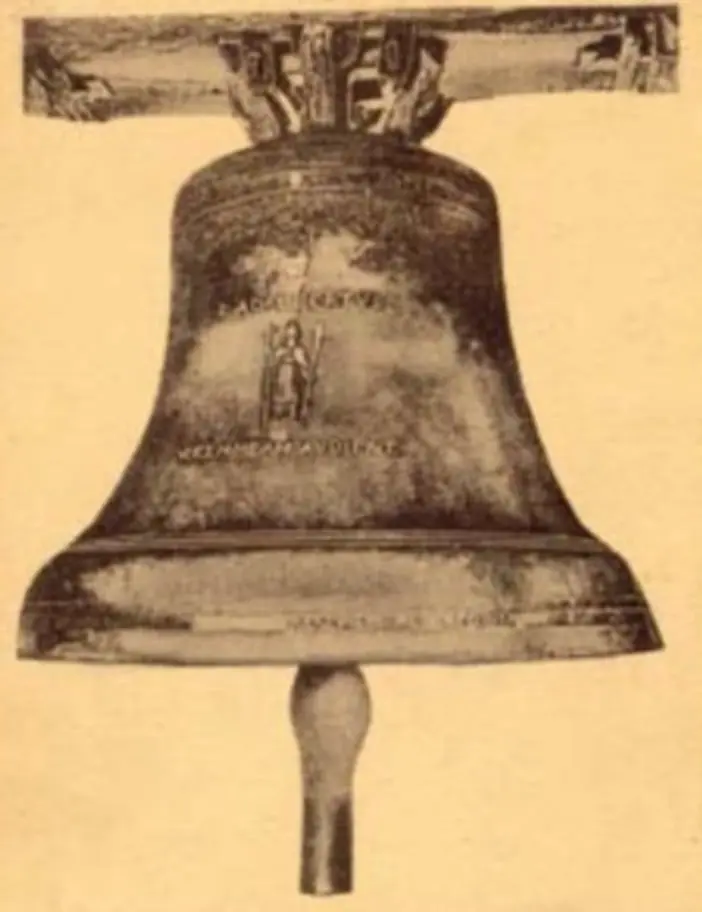
Two bells belonged to Gniezno Cathedral as early as the 11th century. In 1038, the Czech prince Bretislav stole them. The bells were not returned, despite the Archbishop of Gniezno filing a complaint with the Holy See. There is no information about the bells from the 12th-16th centuries. After the great fire in Gniezno in 1613, information about how the bells were cast dates back to the 17th century. The bells of Gniezno Cathedral can be divided into two groups – those located in the bell tower and the clock bells, located in the southern tower. The bell tower contains: The Saint Wojciech bell (large), also known as the Great Wojciech, produces the sound of as. The Saint Adalbert Bell (small) is 162 cm high, has a diameter of 156 cm, weighs 2,300 kg, and produces a D-flat sound. The inscription on the bell’s cap indicates that Pozna founder Jan Zachariasz Neuberdt made it in Gniezno. The bell has a crown with angel heads. In the center of the cap are bas-reliefs depicting the Mother of God and Saint Adalbert, as well as the coat of arms of the Gniezno Chapter. The Latin inscription on the opposite side reads in the words of Holy Scripture: In the year of our Lord 1760, on August 25th, / He destroyed, and burned, and reduced to dust (4 Kings 23:15). / And in the same year, on December 18th, / He raised up my spirit (Jeremiah 29:15). The St. Stanislaus Bell is 113 cm high, has a rim diameter of 105 cm, weighs 900 kg, and produces a G scale tone. In addition, Jan Zachariasz Neuberdt acted in it in Gniezno in 1761. The crown is decorated with angel heads. A saintly figure is depicted in the middle of the mantle. St. Stanislaus with Piotrowin and the inscription: St. Stanislaus, the Kraków Bishop. On the opposite side are Latin quotations from psalms that define the bell’s role: Come, sing, offer sacrifices, sing psalms, praise the Lord all peoples. The coat of arms of the Gniezno chapter, the founder of the bell, is also inscribed. St. Florian’s Bell – 99 cm high, with a heart ring diameter of 98 cm, and weighing 540 kg. It produces a tone of as and is also a work of Neuberdt from 1761. In the center of the mantle is St. Florian holding a flag in one hand and a water bucket for extinguishing fires in the other. The Latin inscription on the mantle translates as: “When I am set in motion, I move the hearts of mortals towards the first engine, whose worship is in my heart .” An additional element is the coat of arms of the cathedral chapter, the founder of the bell. Insignia from 1975 All the bells cast by JZ Neuberdt were consecrated in 1762 by Bishop Krzysztof Dobiński. There are two more bells in the basilica. Originally, they were located in the bell tower next to the great Adalbert, serving as bell towers. They were moved with it to the north tower, and after 1945, they were hung in the south tower, where they serve as clock bells in place of those destroyed in the 1945 fire. These bells have not been weighed or measured. The larger bell, sounding the tone B, bears the inscription: ” I am ringing: Jesus, Mary, Jesus, Mary.” One of the few remaining Gothic bells from the 15th century in Poland, this is the oldest bell in Gniezno. The smaller bell, striking the quarter hours, has no inscriptions.
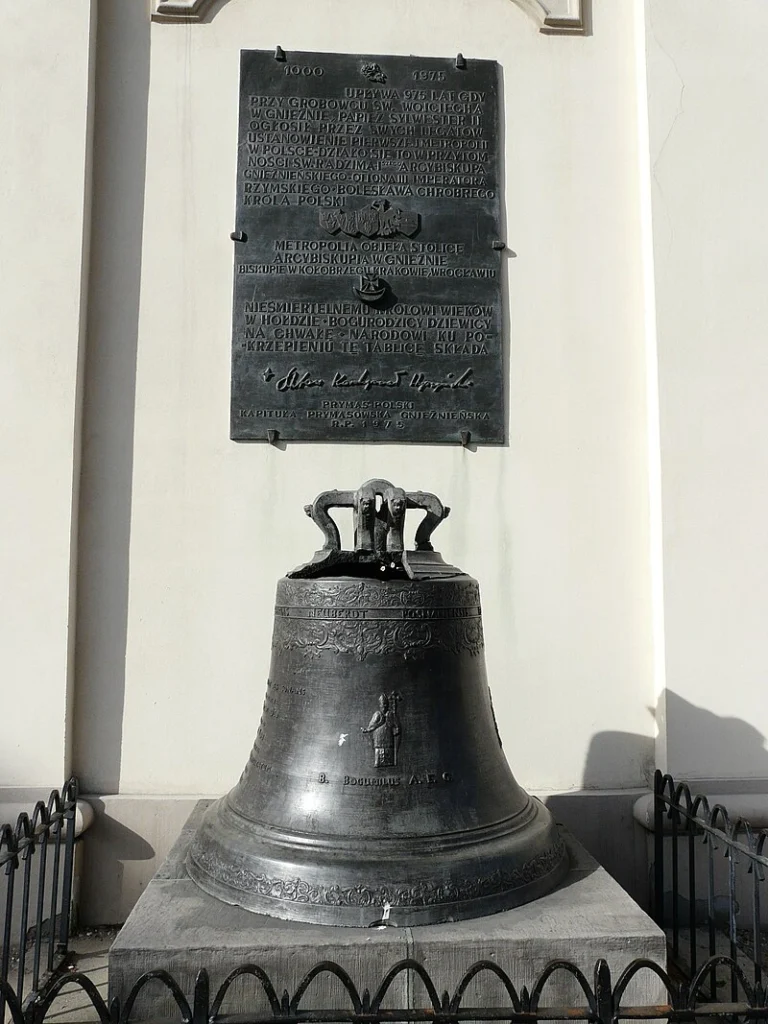
The Bell of Blessed Bogumił – damaged in a fire in 1945. Its head was torn off, and the crown is decorated with angel heads. The bell is 108 cm high, has a 135 cm diameter at the heart ring, and weighs 1,450 kg. It emitted a tone in E flat. It was cast in 1761 in Gniezno by bell founder Jan Zachariasz Neuberdt , which is visible on the cap between the ornamental band. On one side of the cloak is a bas-relief depicting Blessed Bogumił holding a cross in his hand and the appropriate signature: Blessed Bogumił, Archbishop of Gniezno . Inscriptions in the center of the cloak speak of its purpose: I am become as sounding bronze (1 Corinthians 13:1) / Giving glory to God (Romans 4:20) / To adorn the place (2 Maccabees 5:16) / To depart . Currently, the bell is placed near the southern walls of the cathedral.
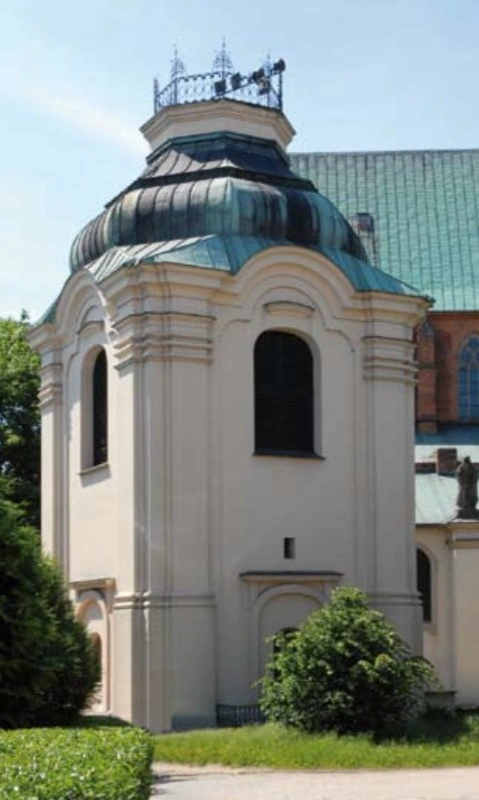
The bell tower of the cathedral
The cathedral bell tower is located on the north side of the Assumption of the Blessed Virgin Mary Church, between the church and St. George’s Church. Archival records indicate that the bell towers at the cathedral were mentioned by Vincent de Seve in his visitation records in 1608. At that time, a wooden bell tower stood on the south side of the cathedral, whose technical condition required the construction of a new, brick one. Before 1602, by order of Primate Stanisław Karnkowski , it was decided to move the bells from the wooden bell tower to the southern tower of the cathedral. Not all were moved due to the weak foundation on which the tower was built. In 1613, a fire in the city destroyed the church roof, along with the towers and bells within. In 1616, the Saint Adalbert Bell , brought from Moscow as a war booty of King Władysław IV , was placed in the brick bell tower. Along with it were four bells cast by Jan of Pułtusk from ore melted by the fire, as well as the preserved bells from the wooden belfry. In 1638, these bells were moved to the cathedral tower, and the belfry was rebuilt. In 1793, the belfry had to be rebuilt again, as its foundations and walls proved too weak. The structure stood on an early medieval wood-and-earth rampart surrounding the first fortified settlement. Over the years, the wood that formed the core of the rampart decayed, and the buildings on it fell into disrepair. Pompeo Ferrari undertook the reconstruction of the belfry. It was a Baroque structure with a square plan, accessed by stairs. The doorway was large enough to allow the St. Adalbert bell to be carried through. Four large openings, covered with wooden shutters, were located at the upper floor level, through which the sound of the bells emanated, echoing low throughout the city. The copper-plated dome was topped by a balcony surrounded by an openwork grille. This brick, unplastered bell tower survived until 1933. The St. Adalbert bell, removed from the bell tower on October 12, 1932, was hung in the north tower. As the bell tower was being dismantled, it was noticed that fragments of earlier structures still remained in the 18th-century walls. In 1973, the bell tower was rebuilt in the same location, modeled on the 18th-century design, based on preserved drawings by engineer Józef Śmielecki from 1933, but plastered. In this rebuilt bell tower, the St. Adalbert bell, three smaller bells, and a new bell tower were reinstalled in 1975. A plaque commemorating the founder, Cardinal Stefan Wyszyński , was placed above the bell tower entrance.
The church basement
In the basement you can see, among other things, the oldest tombstone inscription in Poland, dating back to around 1006, relics of a stone structure from the end of the 9th century discovered during archaeological research, as well as fragments of the walls of Mieszko I’s basilica.
Feast Day
Feast Day : 15 August
The Primate’s Basilica of the Assumption of the Blessed Virgin Mary in Gniezno celebrates its main feast day on August 15th, honoring the Assumption of Mary. Additionally, the cathedral honors St. Adalbert, its patron saint, with a feast on April 23rd. These dates are important times for worship and celebration at the historic cathedral.
Church Mass Timing
Monday to Saturday : 12:00 PM , 6:00 PM.
Sunday : 8:00 AM , 10:00 AM , 12:00 PM , 3:00 PM , 6:00 PM.
Church Opening Time:
Monday to Sunday : 7:00 AM, 7:00 PM.
Contact Info
Address : Gniezno Cathedral
Wzgórze Lecha, 62-200 Gniezno, Poland.
Phone : +48 61 428 40 80
Accommodations
Connectivities
Airway
Shrine of St. Adalbert, Gniezno, Poland, to Lądowisko Działyń (Airstrip), Unnamed Road, 62-271, distance 16 min (11.9 km) via DW190.
Railway
Shrine of St. Adalbert, Gniezno, Poland, to Dworcowa 15 62-200 Gniezno, distance between 4 min (1.4 km) via Cierpięgi.