
Introduction
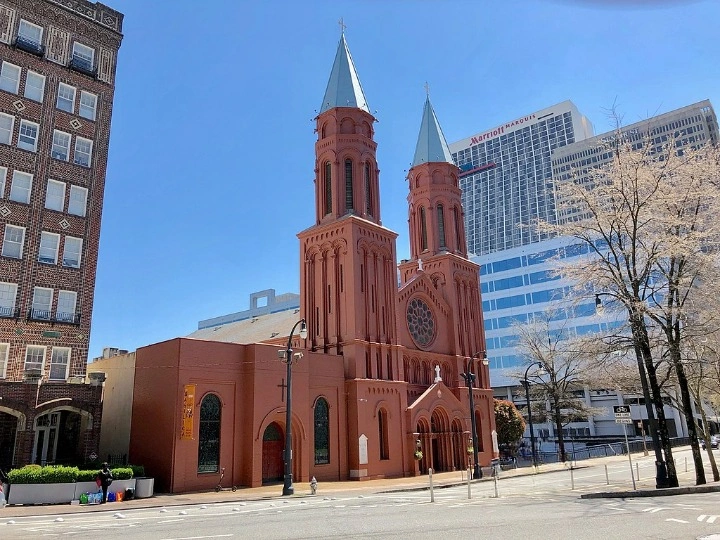
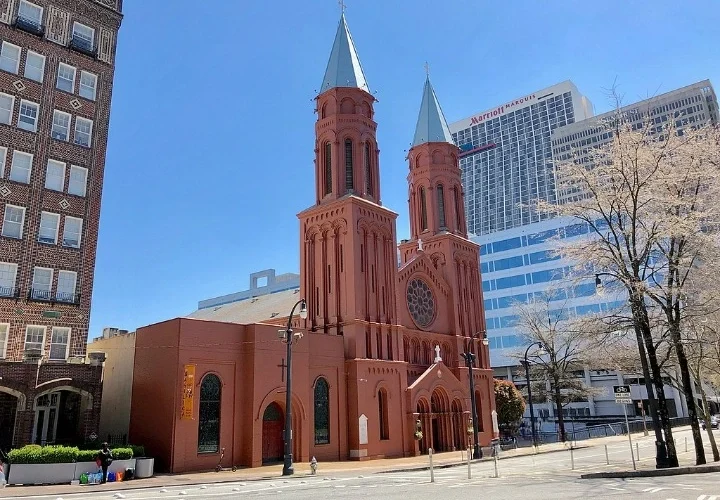
The Basilica of the Sacred Heart of Jesus is a Roman Catholic Church in downtown Atlanta, Georgia, United States. The current building, at the intersection of Peachtree Street and Peachtree Center Avenue, was completed in 1898. It was added to the National Register of Historic Places in 1976 and was designated a minor basilica in 2010. The church traces its origins to 1880, when the parish of Saints Peter and Paul was established to cover the northern part of the city. In 1897, the Marist Fathers took over responsibility for the parish and began constructing the current church, which was designed by Walter T. Downing with elements of French Romanesque and Romanesque Revival architecture. It was dedicated the following year as the Church of the Sacred Heart of Jesus, leading to the new name of the parish. The church saw steady growth during its first few decades and by 1917 was one of the largest parishes operated by the Marists. This group returned operation of the church to the Archdiocese of Atlanta in the 1960s. In the following decades, the area around the church went through a period of decline, and there were concerns that the church would close. However, it continued to operate and saw a growth in its congregation. In 1995, Mother Teresa attended Mass at the church and the building celebrated its 100th anniversary three years later. By 2010, the church had a congregation of about 1,300 families, and it is one of the few buildings constructed around the turn of the 20th century that is still standing in Atlanta.
Parish of Saints Peter and Paul
In the late 1800s, the population of Atlanta increased as the city’s development grew northward from its downtown. As a result of this expansion, Catholics increased their demand for a church in the northern part of the city, which at the time was part of the parish that the Church of the Immaculate Conception served. The parish of Saints Peter and Paul was established on February 28, 1880, by Bishop William Hickley Gross of the Diocese of Savannah. This parish, which was carved out of territory that had previously been served by Immaculate Conception, covered all of the city north of Edgewood Avenue, the Georgia Railroad, and the Western and Atlantic Railroad. To serve as the parish’s church building, a wooden structure was quickly constructed on Marietta Street shortly after its formation. The year of its formation, this parish had about 250 members in its congregation. The parish saw its first baptism on April 6 1880, and later that year the Sisters of Mercy established a parish school that had about 125 students. However, the school closed in 1892 due to financial difficulties.
Establishment of Sacred Heart
In 1897, Savannah Bishop Thomas Albert Andrew Becker asked the Marist Fathers for assistance in the diocese’s missions in north Georgia, which covered approximately 9,500 square miles (25,000 km2). The Marists accepted on May 12 and appointed a new parish pastor the following month. When they took over Saints Peter and Paul, they found that the current buildings were in bad shape and in a bad place. So, they started planning to build a new church. On July 14, they spent $12,000 to purchase land at the corner of Peachtree Street and Ivy Street for this new building, which was to be designed by Walter T. Downing, an Atlanta-based architect. The Marists started a campaign to raise money for the new church, and they were successful in raising $10,851 Construction commenced in September, with Mass continuing to be held in the wooden building until the new building was completed. Work on the new building lasted until 1898, and the cost significantly exceeded the amount that had been raised by the Marists. On May 1 1898, the newly completed church building was dedicated by Becker to the Sacred Heart of Jesus, leading to the parish being renamed accordingly. Following this, the old wooden building was abandoned and eventually sold in 1905. In 1898, the parish had a congregation of about 340 people. John Edward Gunn was appointed pastor of the Church of the Sacred Heart of Jesus in the same year, During its early years under Gunn, the new church grew at a rapid rate, and by 1910, the church had a congregation of about 1,250 people. The church catered to a primarily Irish Catholic population, which included Maybelle Stephens Mitchell, a noted suffragist who was a member of the church in the early 1900s. A Sunday school was established in the basement of the church in 1905, and Sisters of St. In the parish, Joseph established a parochial school. Other physical improvements included the installation of stained glass windows in 1902 and the interior’s decoration and painting in 1907. In 1911, Gunn resigned as a pastor to become the bishop of the Diocese of Natchez. On August 29, he was ordained to the episcopate at the church. The following year, Our Lady of Lourdes Catholic Church was established within Sacred Heart’s parish territory as the first “non-territorial” Catholic Church in the city, with a mission to serve the city’s African American population.
In 1913, a new rectory was built for Sacred Heart at a cost of $40,000, and this building was blessed on March 19 of that year. At this time, the congregation stood at about 2,000 members, and the parochial school had an enrollment of 260. In addition, the Marists had established missions all over the northern part of the state, primarily in towns along the numerous railroads that ran through the area. By 1917, Sacred Heart was one of the largest churches operated by the Marists, with ten priests serving a membership of about 2,500 to 3,000 divided between the main church in Atlanta and the several missions that they were operating in north Georgia. On June 9, 1920, the church was formally consecrated by Bishop Edward Patrick Allen of the Diocese of Mobile, becoming the first Catholic church in Atlanta to have such a distinction. In 1924, a dedicated building for the parochial school was built adjacent to the church by the Atlanta-based architectural firm of Pringle and Smith. In 1938, a significant renovation project was carried out on the church’s interior. On September 11, Bishop Gerald O’Hara of Savannah-Atlanta blessed the structure.
Late 20th century
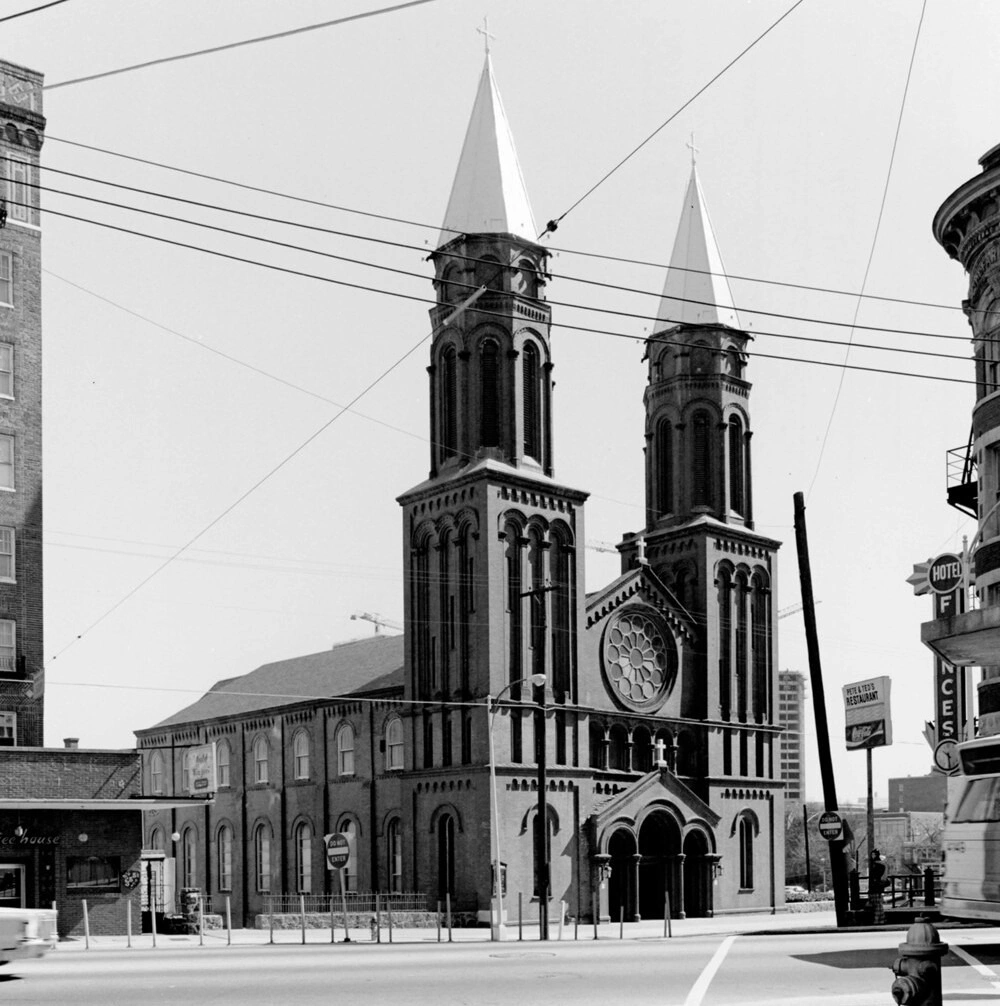
In 1961, the exterior of the church was refaced. Several years later, on September 5 1965, the church returned to the administration of the Archdiocese of Atlanta as the Marist Fathers refocused their efforts in the city on operating the Our Lady of the Assumption parish. After about a year of negotiations between the Marists and the archdiocese, this transfer was finalized on September 5 1966. On May 13 1976, the church was added to the National Register of Historic Places, a federal list of historic sites in the United States. Through the 1970s and 1980s, the area surrounding the church went through a period of decline, and there were concerns that the church might close. However, the church continued to operate, and it saw several renovation and construction projects during this time, including the completion of a new rectory in 1977 and an extensive interior renovation that commenced in 1978. During this renovation, the church was the target of an arson attack that damaged its basement, but the rest of the church was relatively unharmed, and the damages were repaired shortly thereafter. On April 10, 1990, the government of Atlanta declared the church a Landmark Building, a designation to promote historic preservation in the city. On June 12, 1995, Mother Teresa visited the church during a trip to Atlanta and took Mass while there. Several years later, the church celebrated its 100th anniversary with a Mass on May 3 1998.
Elevation to a minor basilica
By 2010, the church had seen a large growth in its congregation over the past several years and had a membership of about 1,300 families. That same year, the church received the designation of minor basilica from the Dicastery for Divine Worship and the Discipline of the Sacraments, giving the church certain privileges not held by regular churches. The church’s pastor had proposed petitioning the organization for this status approximately ten years earlier, but no action was taken in this direction until about 2007. The pastor then made a request to the archbishop of Atlanta, who approved it and forwarded it to the United States Conference of Catholic Bishops, who further forwarded it to the Catholic Church’s administration in the Holy See. The title was granted on February 22, making it the 67th basilica in the United States and the first in both the archdiocese and the state. Today, the building is one of the few remaining structures in the area that was built around the turn of the 20th century, and the parish is one of the oldest operating in the archdiocese.
Architecture of Basilica of the Sacred Heart of Jesus, Atlanta, Georgia, United States
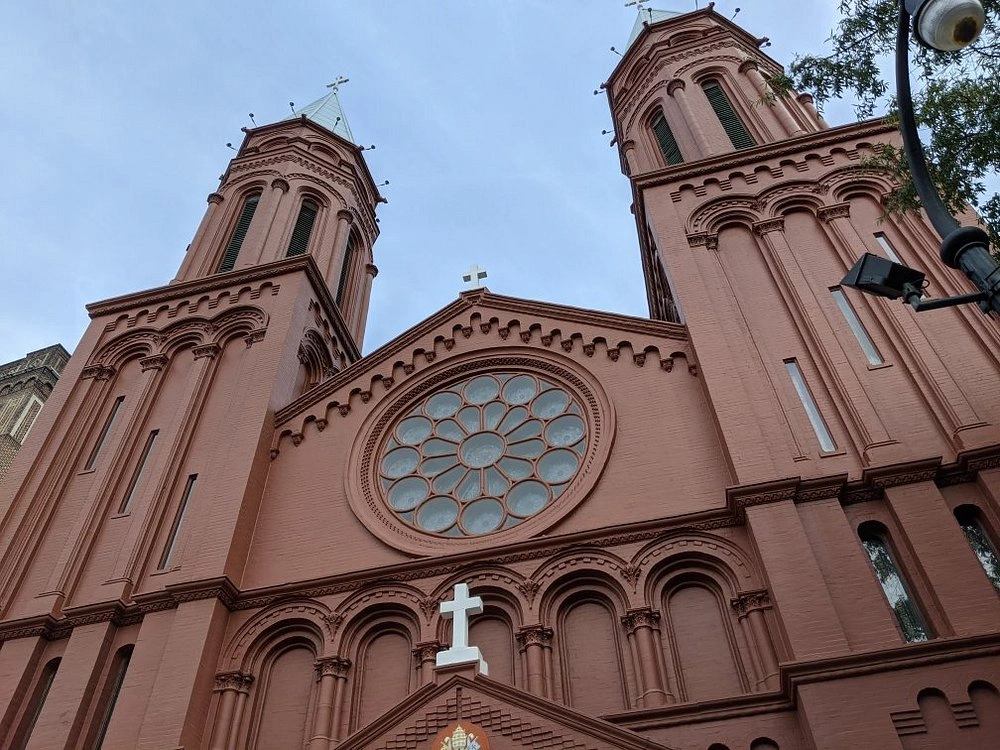
Architect: Walter T. Downing
Architectural styles: Romanesque Revival architecture, Romanesque architecture.
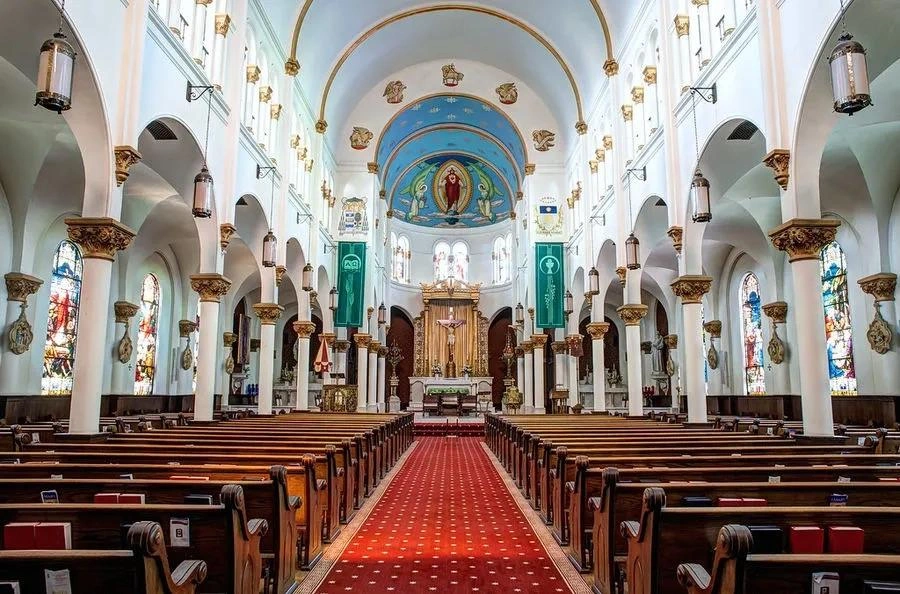
The church is located at 353 Peachtree Street NE, at the intersection of that road and Peachtree Center Avenue (formerly known as Ivy Street). The building’s design incorporates elements of both the Romanesque Revival and French Romanesque styles, with architect Robert Michael Craig describing it as “one of the finest Romanesque Revival churches in the South.” The main building is rectangular in shape and has two stories. Its exterior is primarily of brick and terracotta, with additional ornamentation in marble. The front of the building consists of an arcade featuring three doorways within rounded arch entryways. Above these entryways is a flat facade with a large rose window that includes a design of the Sacred Heart. While the front entrance initially had five granite steps, these were removed in 1912 after Ivy Street was regraded, making them unnecessary. There are two octagonal towers measuring 137 feet (42 meters) tall on either side of the front arcade. Both towers have pavilion roofs and louvered belfries on top. The building’s nave has high arches that lead to the sanctuary, which has a life-size baldachin holding a crucifix.The baldachin covers the church tabernacle. A representation of the Sacred Heart of Jesus can be found in the apse, above the tabernacle. On the arch separating the nave from the sanctuary are five symbols. Jesus is depicted as the Lamb of God at the top of the arch, and other symbols represent the Four Evangelists: a man (Matthew the Apostle), a lion (Mark the Evangelist), an eagle (John the Evangelist), a bull (Luke the Evangelist), and a lion (Mark the Evangelist). Closer to ground-level, the arch depicts the seal of the Society of Mary and the seal for the Archdiocese. 28 stained glass windows line the nave, all designed by the Mayer Studios in Munich, and it is topped by a gable roof.
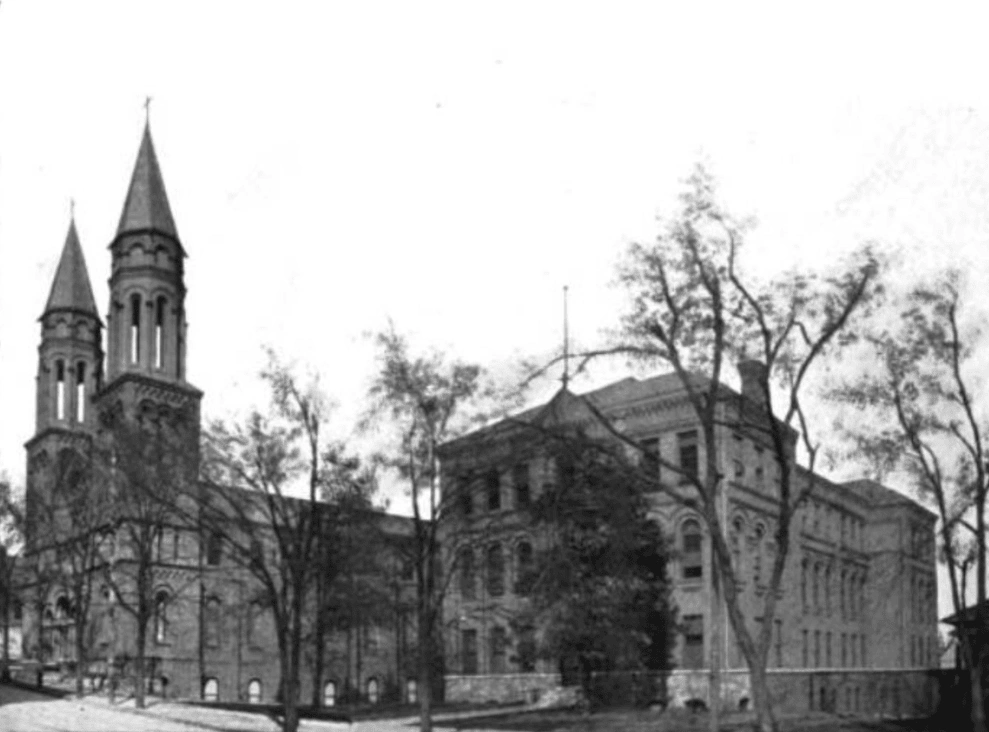
Marist College
Pastor Gunn bought land next to the church in 1901 so that Sacred Heart could build a boys’ military academy there. Construction on this school, which is now known as Marist College, began in June of that year. On October 2, it opened, and it has a mostly high school curriculum and a few college-level classes. Around 1905, these schools stopped offering college courses. There was a gymnasium on the campus of the school, and the building itself had three floors and a basement. During the 1907–1908 school year, it had an enrollment of about 127 students. Throughout its early years, the school experienced steady expansion, reaching 140 students in 1914. During World War I, 85 percent of the school’s alumni who joined the United States Army became commissioned officers. The school was accredited by the Catholic University of America and the University of the South, according to a 1917 history book. The school established a Reserve Officers’ Training Corps program in the same year. Between 1922 and 1933, the school operated a summer camp on Lake Rabun in Lakemont, Georgia. By the 1950s, the school had grown to about 225 students, and in 1957, property was purchased north of the city to create a new campus.The school changed its name to Marist School in 1962 when it moved to this new location. The building near the church was eventually abandoned in 1976 and was later demolished.
Feast Day
Feast Day : Third Friday after Pentecost
The feast of the Basilica of the Sacred Heart of Jesus in Atlanta is celebrated on the Third Friday after Pentecost, which is the Solemnity of the Sacred Heart of Jesus. This important day commemorates Christ’s boundless love, symbolized by His Sacred Heart, and is observed with special Masses and devotions at the basilica.
Church Mass Timing
Monday to Friday : 12:10 PM.
Saturday : 4:00 PM.
Sunday : 8:00 AM, 10:00 AM, 12:30 PM, 5:00 PM.
Church Opening Time:
Monday to Thurday : 10:00 AM, 04:00 PM
Friday to Sunday : Closed
Contact Info
Address : Basilica of the Sacred Heart of Jesus
353 Peachtree St NE, Atlanta, GA 30308, United States
Phone : +1 404-522-6800
Accommodations
Connectivities
Airway
Basilica of the Sacred Heart of Jesus, Atlanta, Georgia, United States, to Atlanta International Airport (ATL),distance between 11 min (9.8 mi) via I-75 S.
Railway
Basilica of the Sacred Heart of Jesus, Atlanta, Georgia, United States, to Amtrak Peachtree Station, distance between 7 min (3.0 mi) via I-75 N/I-85 N.